
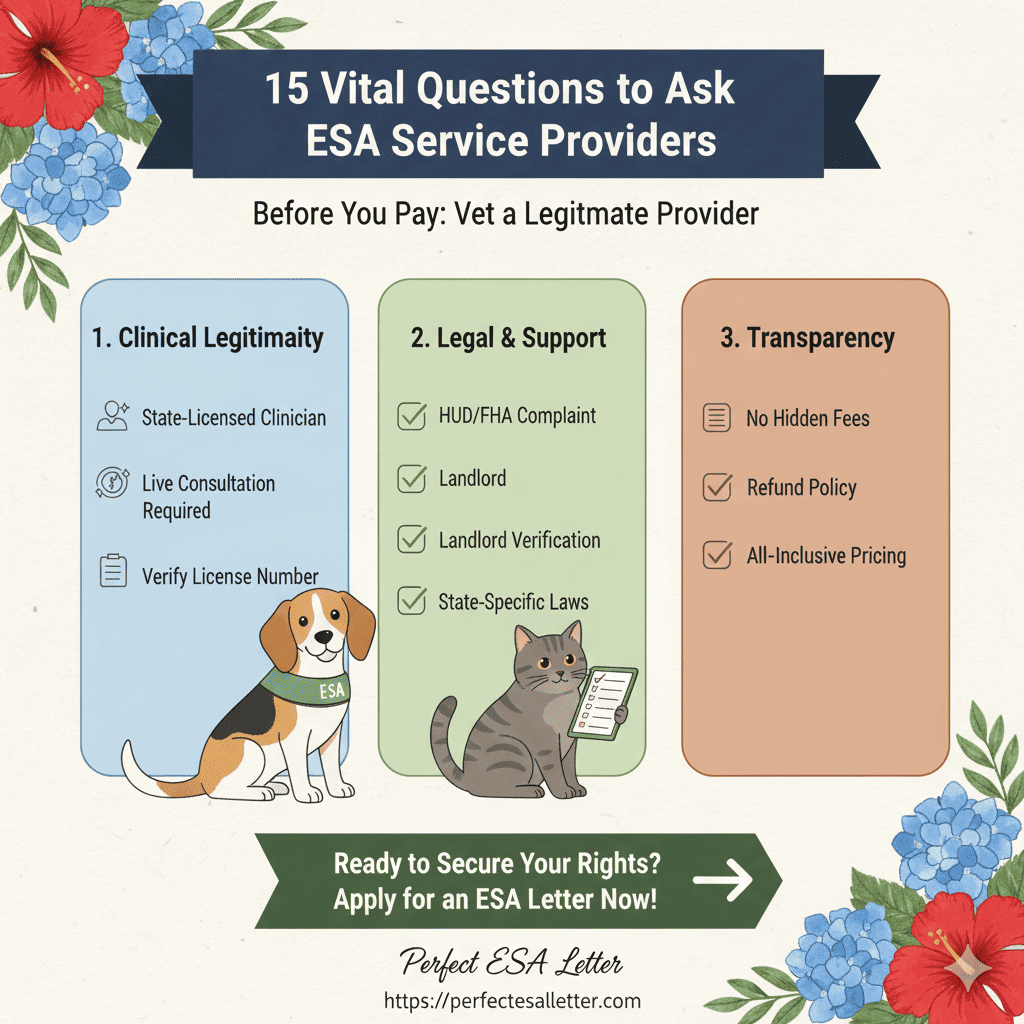
Vital Questions to Ask ESA Service Providers Before You Pay
Vital Questions to Ask ESA Service Providers Before You Pay
For many individuals living with mental health challenges, an Emotional Support Animal (ESA) is more than just a pet; they are a critical component of a therapeutic treatment plan. However, obtaining a legitimate ESA letter can feel like navigating a maze of legal jargon and online advertisements. To protect your housing rights and your peace of mind, you must be prepared with a specific list of questions to ask ESA service providers before you share your personal information or payment details.
The Fair Housing Act (FHA) provides strong protections for ESA owners, but these protections are only as strong as the documentation backing them. Landlords are becoming increasingly sophisticated at spotting “letter mill” documents. By asking the right questions, you ensure that your letter is signed by a qualified professional and meets all Department of Housing and Urban Development (HUD) guidelines.
At Perfect ESA Letter, we believe in total transparency. We don’t just provide documentation; we provide a clinical service that stands up to legal scrutiny. Apply for an ESA letter now to speak with a licensed professional who can answer all your questions directly.
Why You Need a Strategy: Questions to Ask ESA Service Providers
The internet is flooded with websites promising “instant” ESA registration. The reality is that HUD does not recognize any “registration” or “database” as proof of an ESA’s status. A valid letter must come from a licensed mental health professional (LMHP) with whom you have an established relationship.
Before you commit to a service, you should have a “vetting call” or look for these answers on their website. Use these questions to ask ESA service providers as your checklist for legitimacy.
Section 1: Questions About Clinical Legitimacy
1. Will I be matched with a clinician licensed in my specific state?
This is the most critical question. Landlords often reject letters if the clinician is not licensed to practice in the state where the tenant lives.
-
Why it matters: Out-of-state letters are one of the biggest “red flags” for property managers.
2. Does the service require a live consultation?
HUD guidelines suggest that a “quiz-only” approach is insufficient. A legitimate provider will schedule a phone or video call between you and the clinician.
-
Why it matters: It establishes the “reliable knowledge” the clinician has of your disability, which is a federal requirement.
3. Can I verify the clinician’s license number?
A reputable service will provide the name and license number of the clinician on the final letter.
-
Why it matters: You (and your landlord) have the right to look up the professional on state board websites to ensure they are in good standing.
Section 2: Questions About Legal Compliance & Support
4. Is the letter 100% HUD and FHA compliant?
Federal housing laws have very specific requirements for what must be included in a “Reasonable Accommodation” request.
-
Why it matters: If the letter lacks the “clinical nexus” (the link between your disability and the animal’s support), the landlord can legally deny it.
5. Do you provide landlord verification support?
Some landlords require an additional form to be filled out or a phone call to verify the letter’s authenticity.
-
Why it matters: You don’t want to be left alone if a landlord pushes back. A service like Perfect ESA Letter stands by its clients throughout the entire approval process.
6. How do you handle state-specific laws (like California’s 30-day rule)?
Some states now require a 30-day clinical relationship before a letter can be issued.
-
Why it matters: Using a service that ignores these laws will result in a document that is legally worthless in those states.
Comparison Table: What a Good Service vs. a Bad Service Says
| The Question | A Legitimate Service Says… | A Scam Site Says… |
| “Is there a live interview?” | “Yes, via phone or video call.” | “No, just fill out this 2-minute quiz.” |
| “Is this a registration?” | “No, we provide a clinical letter.” | “Yes, we put you in a national database.” |
| “What if my landlord calls?” | “Our clinicians provide verification.” | “The letter is all you need. (No support)” |
| “Do you sell vests/IDs?” | “No, those are not legally required.” | “Yes! Buy our ‘Gold’ package for an ID.” |
Section 3: Questions About Costs and Transparency
7. Are there hidden “renewal” fees I should know about?
Some services lure you in with a low initial price but charge exorbitant amounts for annual updates.
-
Why it matters: Transparency in pricing is a hallmark of a trustworthy medical service.
8. What is your refund policy if my letter is rejected?
While no one can guarantee a landlord’s behavior, a legitimate service should offer a money-back guarantee if the letter itself is found to be non-compliant.
-
Why it matters: It shows the provider has skin in the game and confidence in their clinicians.
9. Does the price include the consultation AND the letter?
Avoid sites that charge a “processing fee” for the letter after you’ve already paid for the evaluation.
-
Why it matters: Bundled, transparent pricing protects you from predatory “up-selling.”
Internal Linking Suggestions
Section 4: Questions About Privacy and Security
10. Is your platform HIPAA-compliant?
You are sharing sensitive mental health information. The platform must follow federal privacy standards.
-
Why it matters: Your medical data should never be sold or stored on insecure servers.
11. What information is shared with my landlord?
A legitimate provider knows that the landlord is not entitled to your medical records or a detailed history of your condition.
-
Why it matters: The provider should only confirm the existence of a disability and the need for the animal, protecting your dignity and privacy.
Frequently Asked Questions (FAQs)
1. Why are there so many “questions to ask ESA service” providers?
Because the industry is currently unregulated, many “fake” companies have appeared. Asking these questions is the only way for a consumer to ensure they are receiving a legal medical recommendation rather than a worthless piece of paper.
2. Can I get a letter for my existing pet?
Yes. An ESA letter transitions a pet into an “assistance animal” in the eyes of the law. As long as you have a qualifying mental health condition, any pet can potentially be an ESA.
3. Do I have to ask my landlord’s permission before getting an ESA?
No. You have the right to seek treatment and an ESA evaluation at any time. However, you must present the letter to your landlord to request the “reasonable accommodation” for housing.
4. Is an ESA the same as a Service Dog?
No. Service dogs are trained for specific tasks (like guiding the blind). ESAs provide comfort through their presence and do not require specialized training. The questions to ask an ESA service are different because the legal requirements for the letter are unique to housing.
5. Can my landlord charge me a “verification fee”?
Absolutely not. Under the FHA, landlords cannot charge any fees associated with processing a reasonable accommodation request for an assistance animal.
6. What if my clinician is a doctor but not a therapist?
A letter from a primary care physician (PCP) is valid, provided they are treating you for your mental health condition. However, specialized mental health professionals (LMHPs) are often more familiar with the specific phrasing HUD requires.
7. Does the letter need to mention my pet’s name?
It is not strictly required by law, but it is a “best practice” that makes the letter appear more personalized and professional to a landlord.
8. How long does the consultation usually take?
A thorough evaluation usually takes between 15 to 30 minutes. This gives the clinician enough time to understand your history and determine if an ESA is an appropriate part of your treatment.
Why Perfect ESA Letter Stands Out
When you run through your list of questions to ask ESA service providers, you’ll find that Perfect ESA Letter checks every box. We don’t believe in shortcuts because we know how much your housing security matters.
-
Expertise: We work exclusively with professionals who understand the nuances of the Fair Housing Act.
-
Support: We don’t disappear after the letter is sent. Our team is here to help you navigate landlord interactions.
-
Privacy: Your data is protected by industry-leading security protocols.
Stop guessing and start living with the support you deserve.
Don’t let an uneducated landlord or a scam website dictate your living situation. Get a document that is backed by real science and real law.