
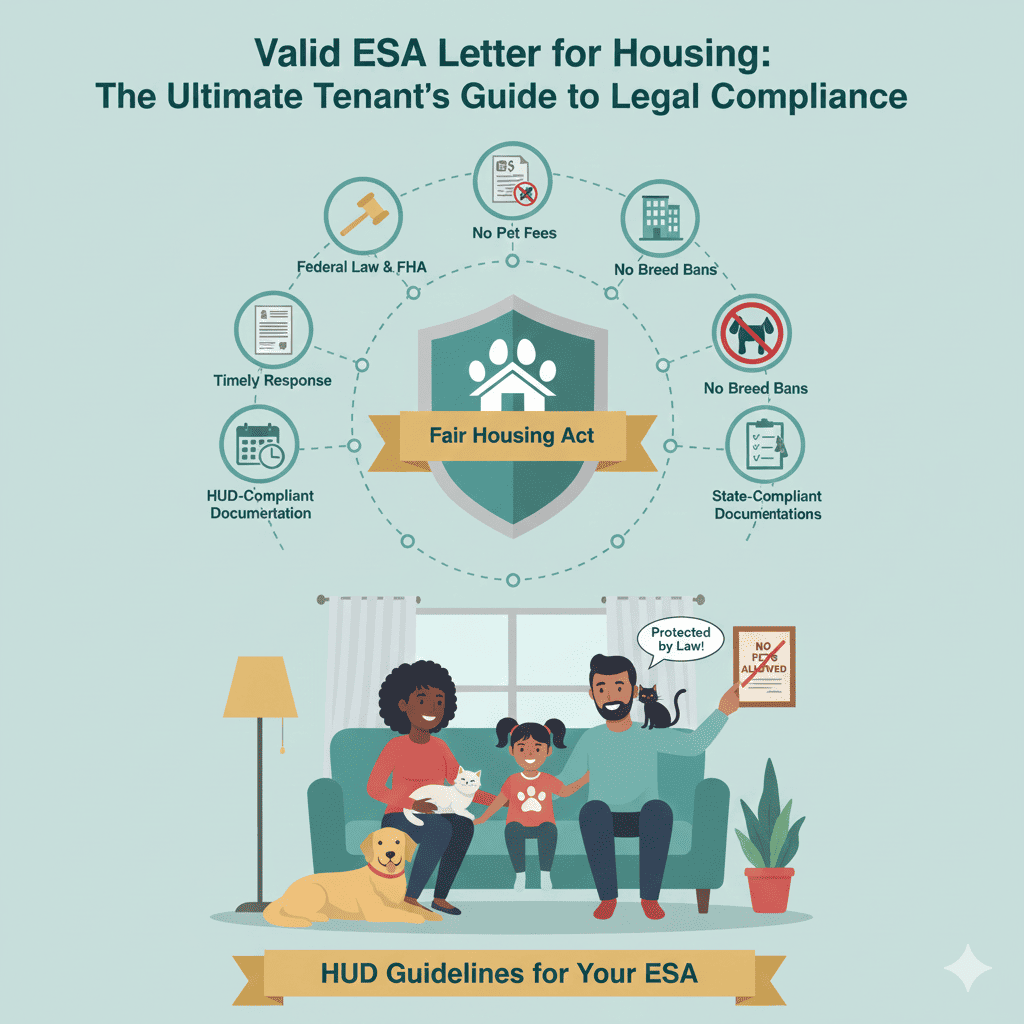
Valid ESA Letter for Housing: The Ultimate Tenant’s Guide to Legal Compliance
Valid ESA Letter for Housing: The Ultimate Tenant’s Guide to Legal Compliance
Finding a safe, comfortable place to live should be a right, not a privilege—especially when your mental health depends on the companionship of an animal. For many, the “No Pets Allowed” sign on a dream apartment feels like a brick wall. However, if you have a mental or emotional disability, a valid ESA letter for housing is the key that unlocks that door.
Under the federal Fair Housing Act (FHA), emotional support animals (ESAs) are classified as assistance animals, not pets. This means they are exempt from standard rental rules. But here is the catch: to get these protections, your documentation must be legally airtight. In this guide, we’ll break down what makes a letter valid, how to present it to a landlord, and how to avoid the “instant” certificate scams that can get your application denied.
What is a Valid ESA Letter for Housing?
A valid ESA letter for housing is a formal medical recommendation from a state-licensed healthcare professional. It serves as official verification that you have a disability-related need for an animal. While the animal itself doesn’t need “training” like a service dog, the paperwork must be precise to meet the standards set by the U.S. Department of Housing and Urban Development (HUD).
The Primary Legal Protections You Gain:
-
Bypass “No-Pet” Rules: You can live in properties that otherwise ban animals.
-
Zero Pet Fees: Landlords are prohibited from charging pet deposits, monthly pet rent, or move-in fees.
-
No Breed or Size Restrictions: Your ESA is exempt from weight limits or “aggressive breed” bans.
-
University Housing: These rights extend to college dorms and on-campus apartments.
5 Requirements for a Letter to Be Legally Valid
Not all letters are created equal. If your documentation lacks any of the following elements, a landlord has the legal right to deny your request for accommodation.
1. Issued by a Licensed Professional
The letter must be written by a Licensed Mental Health Professional (LMHP) or a physician. This includes:
-
Psychiatrists and Psychologists
-
Licensed Clinical Social Workers (LCSW)
-
Licensed Marriage and Family Therapists (LMFT)
-
Licensed Professional Counselors (LPC)
-
General Physicians or Nurse Practitioners
2. State-Specific Licensure
The professional must be licensed to practice in your state. Landlords often check state licensing boards; if your therapist is licensed in Florida but you are renting in California, the letter may be rejected.
3. Professional Letterhead & Contact Info
A valid ESA letter for housing must be on the official letterhead of the provider. It must include their name, license number, license type, and direct contact information so the landlord can verify its authenticity.
4. The “Nexus” Statement
The letter doesn’t need to (and shouldn’t) disclose your specific diagnosis. However, it must state that you have a mental health disability and explain that the animal provides therapeutic support that alleviates at least one symptom of that condition.
5. Signature and Date
The letter must be signed and dated by the provider. While the law doesn’t state an “expiration” date, most landlords require a letter issued within the last 12 months to prove the need is current.
Valid Letters vs. Scam Certificates: How to Tell the Difference
The internet is flooded with websites promising “instant” ESA registration. It is vital to understand that ESA registration databases and certificates have zero legal standing.
| Feature | Legitimate Valid ESA Letter | Fake Registry/Certificate |
| Requires Clinical Evaluation | Yes (Telehealth or in-person) | No (Just a form/payment) |
| Signed by Licensed Professional | Yes | No (Usually just a logo) |
| HUD & FHA Compliant | Yes | No |
| Accepted by Landlords | Yes | Frequently Denied |
| Legal Status | Medical Recommendation | Marketing Gimmick |
Using a fake certificate doesn’t just waste your money—it can lead to a formal denial of housing or even legal repercussions for misrepresentation in certain states. At Perfect ESA Letter, we focus exclusively on clinical legitimacy to ensure your documents are bulletproof.
How to Submit Your Valid ESA Letter to a Landlord
Presenting your valid ESA letter for housing should be a professional and transparent process. You are requesting a “Reasonable Accommodation,” and following these steps will help you avoid friction.
-
Do Not Pay Pet Fees: Once you have your letter, do not sign a pet addendum or pay a deposit. These can be difficult to refund later.
-
Submit in Writing: Send an email or a physical letter to the landlord or property manager.
-
Sample Text: “I am requesting a reasonable accommodation under the Fair Housing Act for my emotional support animal. Attached is a valid ESA letter from my licensed healthcare provider.”
-
-
Provide Only What is Required: You are only required to provide the letter itself. You do not have to provide medical records, give them access to your therapist, or disclose your diagnosis.
-
Allow for Verification: Landlords are allowed to verify that the letter is real. This usually involves them calling the provider’s office to confirm the license is active and the letter was indeed issued to you.
Internal Linking Suggestions
-
Anchor Text: how to qualify for an emotional support animal (Link to eligibility page)
-
Anchor Text: Fair Housing Act for ESA owners (Link to legal resources)
-
Anchor Text: ESA vs. Service Dog guide (Link to comparison article)
Frequently Asked Questions (FAQs)
1. Can a landlord deny a valid ESA letter for housing?
A landlord can only deny a request if the specific animal poses a direct threat to safety, would cause substantial property damage, or if the property is exempt (such as owner-occupied buildings with 4 or fewer units). They cannot deny it simply because they have a “no-pets” policy.
2. Is an online ESA letter valid?
Yes, as long as the online service connects you with a licensed mental health professional who performs a legitimate evaluation. HUD explicitly states that letters from online health professionals are acceptable if they follow these clinical standards.
3. Do I have to tell the landlord about my ESA before signing the lease?
Legally, no. You can request an accommodation at any time—before you move in, during your lease, or even if you are already facing a “no-pets” violation notice.
4. Can my landlord charge a “processing fee” for my ESA?
No. There are no administrative fees allowed for processing a reasonable accommodation request. Charging such a fee is a violation of the Fair Housing Act.
5. What if my ESA is a “restricted breed” like a Pit Bull?
Under valid ESA letter for housing protections, breed restrictions do not apply. The landlord must allow the animal regardless of its breed or weight, unless that specific animal has a history of aggression.
6. Do I need to buy a vest or ID tag?
No. Vests, ID tags, and certificates are not required by law and do not provide any legal protection. The only document a landlord can require is your signed ESA letter.
7. Can I have more than one emotional support animal?
Yes, you can have multiple ESAs. However, your letter must justify the therapeutic need for each individual animal (e.g., how two cats provide different support than one).
8. What happens if my landlord refuses my letter?
If a landlord refuses to accept a valid letter from an LMHP, they are in violation of federal law. You can file a complaint with HUD’s Office of Fair Housing and Equal Opportunity (FHEO).
Secure Your Housing Rights with Confidence
Living with an emotional support animal is a therapeutic choice that is protected by federal law. A valid ESA letter for housing ensures that you don’t have to choose between your home and your health. By following the legal requirements and avoiding the “instant” scams, you can move into any neighborhood with the peace of mind that you and your companion are legally protected.
At Perfect ESA Letter, we take the guesswork out of the process. We connect you with state-licensed mental health professionals who understand the nuances of HUD and FHA regulations. Our goal is to provide you with the legitimate documentation you need to save money on pet fees and live comfortably with your support animal.