
Using an ESA Letter for No Pets Policy: Your Legal Guide to Housing
Using an ESA Letter for No Pets Policy: Your Legal Guide to Housing
Finding the perfect home can feel like an impossible task when you are met with “No Pets Allowed” signs at every turn. For those who rely on an animal for emotional stability and mental health support, these policies are more than an inconvenience—they are a barrier to well-being. This is where a legitimate ESA letter for no pets policy becomes your most powerful legal asset.
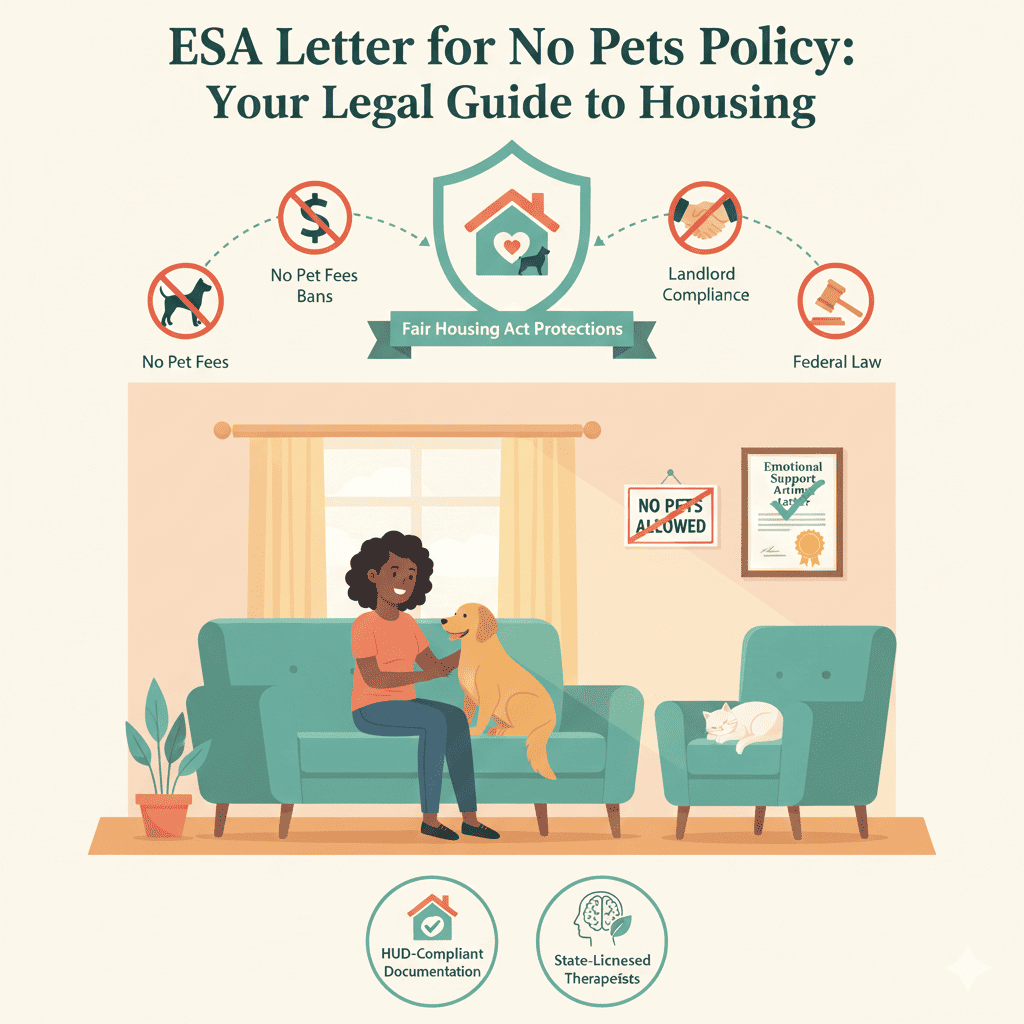
Under federal law, emotional support animals (ESAs) are not considered pets. They are classified as assistance animals, which means standard “no pets” rules simply do not apply to them. In this guide, we will explore how an ESA letter overrides restrictive housing policies, what the law requires of landlords, and how you can secure your housing rights without the stress of a legal battle.
How an ESA Letter Overrides a No Pets Policy
The primary protection for ESA owners comes from the Fair Housing Act (FHA). Managed by the U.S. Department of Housing and Urban Development (HUD), the FHA requires housing providers to make “reasonable accommodations” for individuals with disabilities.
When you present a valid ESA letter for no pets policy, you are officially requesting an accommodation. Legally, the landlord must treat your request as a medical necessity rather than a lifestyle choice.
Key Legal Protections Under the FHA:
-
Mandatory Exceptions: Landlords must waive their “no pets” rule for a tenant with a valid ESA letter.
-
Zero Pet Fees: Because ESAs are not pets, landlords cannot charge pet deposits, monthly pet rent, or move-in fees.
-
No Breed or Weight Limits: Even if a building has a ban on “aggressive breeds” or a 20lb weight limit, your ESA is exempt.
-
Inclusive Housing: These rights apply to apartments, rental homes, condos, and even university dorms.
Why Landlords Must Accept Your ESA Letter
Many tenants worry that a landlord will simply say “no” regardless of the law. However, HUD guidelines are very strict. A housing provider can only deny an ESA letter for no pets policy under very specific, limited circumstances:
-
Direct Threat: The specific animal has a documented history of aggression or poses a direct threat to the safety of others.
-
Substantial Damage: The animal has caused significant physical damage to the property that cannot be prevented by reasonable actions.
-
Undue Burden: The accommodation would cause extreme financial or administrative hardship (this is extremely rare for a single animal).
-
Exempted Housing: Small owner-occupied buildings (4 units or less) or single-family homes rented without a broker may sometimes be exempt.
Outside of these rare exceptions, a landlord who ignores or denies a valid request is in violation of federal law and can face significant legal consequences.
What a Legitimate ESA Letter Must Include
To successfully bypass a “no pets” policy, your letter must meet the legal standards set by HUD. A fake “registration” or “ID tag” will not work. Your ESA letter for no pets policy must be a formal document from a licensed professional.
Required Elements of a Valid Letter:
-
Licensed Professional’s Info: Must be on the official letterhead of a Licensed Mental Health Professional (LMHP) like a therapist, psychologist, or psychiatrist.
-
State Licensure: The professional must be licensed to practice in your state.
-
The “Nexus” Statement: The letter must confirm you have a disability and explain that the animal provides support that alleviates symptoms of that condition.
-
Current Date: Letters should generally be dated within the last 12 months to prove the need is ongoing.
| Documentation Type | Valid for No-Pet Housing? | Legally Required? |
| ESA Letter from LMHP | YES | Yes |
| Online “Registration” | NO | No |
| ID Tags or Vests | NO | No |
| Doctor’s Note | Usually YES | Yes |
How to Present Your ESA Letter to a Landlord
Presenting your ESA letter for no pets policy should be a professional and straightforward process. Follow these steps to ensure a smooth transition:
-
Do Not Pay Pet Fees First: If you pay a pet deposit, it can be harder to get it back later. Present your letter as early as possible.
-
Submit in Writing: Send a formal “Reasonable Accommodation Request” via email or certified mail so you have a paper trail.
-
Attach Your Letter: Include the PDF or a high-quality scan of your ESA letter.
-
Be Patient: Landlords generally have 10 to 30 days to respond. They may ask for “verification” (contacting the therapist to confirm the letter is real), which is legally allowed.
At Perfect ESA Letter, we provide letters that are pre-vetted for HUD compliance, making this conversation much easier for you.
Internal Linking Suggestions
-
Anchor Text: how to qualify for an ESA (Link to eligibility/conditions page)
-
Anchor Text: Fair Housing Act for tenants (Link to legal rights guide)
-
Anchor Text: ESA vs. Service Dog differences (Link to comparison article)
Frequently Asked Questions (FAQs)
1. Can a landlord evict me if I get an ESA in a no-pet building?
No. If you have a valid ESA letter for no pets policy, getting an animal is a protected right. As long as you follow the proper procedure for requesting an accommodation, the presence of the animal cannot be used as grounds for eviction.
2. Do I have to disclose my ESA before signing the lease?
You are not legally required to disclose your ESA during the application process. Many tenants wait until the lease is signed to avoid “stealth discrimination” where a landlord might find another reason to reject your application.
3. Does the “no pets” policy override my ESA if it’s a “restricted breed”?
No. Breed, weight, and size restrictions do not apply to ESAs under the Fair Housing Act. A landlord cannot deny your Pit Bull, Rottweiler, or Great Dane based solely on their breed or size.
4. Can a landlord charge a “pet cleaning fee” when I move out?
They cannot charge a pre-emptive fee. However, if your animal causes actual damage (beyond normal wear and tear), the landlord can deduct the cost of repairs from your standard security deposit, just like they would for any other tenant.
5. What if the landlord asks for my medical records?
This is illegal. A landlord can only ask for a letter that confirms you have a disability-related need. They are not entitled to see your diagnosis, medical history, or treatment plans.
6. Can a landlord require my ESA to have professional training?
No. Unlike service dogs, ESAs do not require any specialized training. Their benefit comes from their presence and companionship.
7. Does an ESA letter work for Airbnbs or Hotels?
Generally, no. The FHA applies to “dwellings” (long-term housing). Hotels and short-term rentals are covered by the ADA, which only protects trained Service Dogs.
8. How many animals can I have in a no-pet building?
You can have more than one ESA, but your ESA letter must justify the therapeutic need for each specific animal.
Live Where You Want with the Support You Need
Living in a home that supports your mental health shouldn’t be a luxury. The ESA letter for no pets policy is the key to ensuring you are never forced to choose between a roof over your head and the animal that helps you stay balanced.
At Perfect ESA Letter, we believe in advocacy and clinical excellence. We connect you with state-licensed professionals who provide the exact documentation landlords need to see. Our letters are built to withstand scrutiny, ensuring your move-in process is as smooth as possible. Don’t let a “no pets” sign stop you—take control of your housing rights today.