
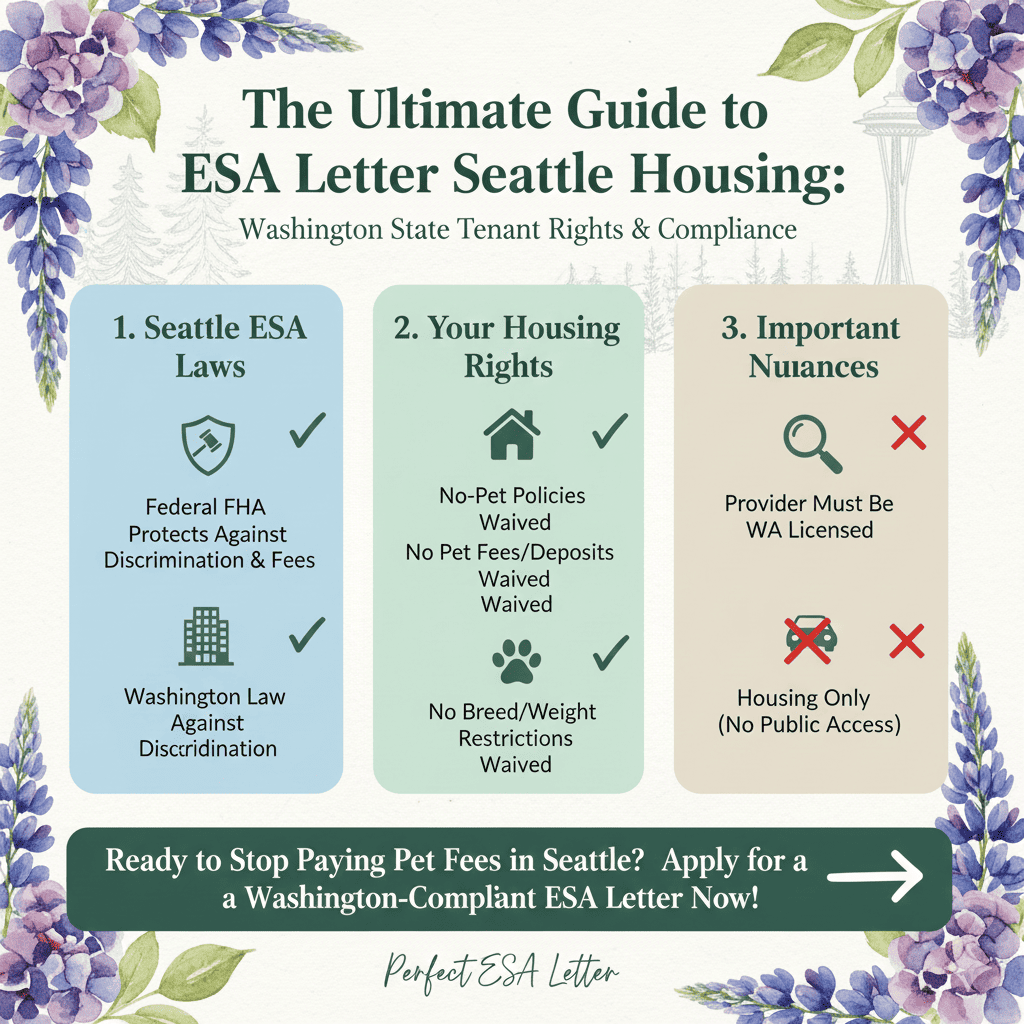
The Ultimate Guide to ESA Letter Seattle Housing: Protecting Your Rights in the Emerald City
The Ultimate Guide to ESA Letter Seattle Housing: Protecting Your Rights in the Emerald City
Finding a home in Seattle can feel like navigating a maze of soaring rents and competitive applications. For many residents in Capitol Hill, Ballard, or Queen Anne, the challenge is amplified when a landlord’s “no-pet” policy stands between them and their essential support system. If you rely on an animal for mental health support, an emotional support animal (ESA) is a medical necessity, not a luxury. To ensure your companion is legally protected, you need a valid ESA letter for Seattle housing.
In the Emerald City, tenant protections are among the strongest in the nation. Your rights are anchored by the federal Fair Housing Act (FHA) and further reinforced by the Washington Law Against Discrimination (WLAD) and specific Seattle Municipal Codes. Together, these laws ensure that individuals with disabilities have an equal opportunity to enjoy their dwelling with the help of an assistance animal.
At Perfect ESA Letter, we bridge the gap between Seattle renters and state-licensed mental health professionals. We provide the ironclad documentation necessary to waive pet fees and secure your housing. Apply for an ESA letter now to start your professional evaluation.
Understanding Seattle Housing Laws: FHA, WLAD, and the City Code
When you present an ESA letter to Seattle housing providers, you are invoking a specific set of legal protections designed to prevent discrimination.
1. The Fair Housing Act (FHA)
The FHA is the federal foundation for your rights. It classifies ESAs as “assistance animals,” meaning they are not considered pets. Under the FHA, housing providers must grant “reasonable accommodations” to tenants with a verified disability-related need for an animal.
2. Washington Law Against Discrimination (WLAD)
Washington State’s WLAD (RCW 49.60) goes beyond federal basics. It explicitly prohibits landlords from discriminating against any person who uses an assistance animal. This state-level protection is a powerful tool for Seattle renters facing pushback from property managers.
3. Seattle’s Local Protections
The City of Seattle is particularly protective of renters. Under local ordinances, landlords are held to strict standards regarding fair housing. They must engage in an “interactive process” with you rather than issuing a blanket denial based on “no-pet” rules.
Key Takeaway: Because an ESA is not a pet under Seattle law, standard pet rules simply do not apply to them.
Why You Need an ESA Letter for Seattle Housing
In a market where “pet rent” can range from $50 to $100 per month and non-refundable pet fees often exceed $300, the financial benefit of an ESA letter is substantial. However, the legal security it provides is even more valuable.
1. Exemption from Pet Fees and Deposits
Seattle landlords are legally prohibited from charging pet rent, pet application fees, or additional security deposits for an ESA. This can save a typical Seattle renter over $1,000 in a single year.
2. Bypassing “No-Pet” Policies
If you have a legitimate ESA letter for Seattle housing, you can live in apartments, condos, and rental homes that otherwise ban animals entirely.
3. Overriding Breed and Weight Restrictions
Many Seattle management companies have “aggressive breed” lists or weight caps (e.g., no dogs over 25 lbs). Under the FHA and WLAD, these restrictions are waived for assistance animals. Your Great Dane or German Shepherd is welcome, provided they are well-behaved.
4. Protection Against Eviction
Providing a valid letter protects you from lease violations related to unauthorized animals. Even if you already have the animal in your home, submitting a letter starts the legal “reasonable accommodation” process.
Seattle Renter’s Rights: Standard Pet vs. ESA
| Feature | Standard Pet in Seattle | ESA with Valid Seattle Letter |
| Lease Access | Up to the Landlord | Legally Mandatory |
| Monthly Pet Rent | Legal (avg. $50+) | Prohibited ($0) |
| Pet Deposits/Fees | Legal | Prohibited ($0) |
| Breed/Weight Limits | Common | Waived |
| Verification Needed | None | Clinical ESA Letter |
How to Successfully Secure Your ESA Accommodation in Seattle
Navigating the conversation with a Seattle property manager requires professionalism. Follow these steps for the smoothest experience:
Step 1: Obtain a Washington-Licensed ESA Letter
Seattle property managers are highly educated on fair housing. They often check to see if your letter comes from a professional licensed to practice in Washington State. At Perfect ESA Letter, we ensure your clinician has the proper state credentials.
Step 2: Submit a Written Request
While you can make a verbal request, it is best to submit your ESA letter for Seattle housing via email. Use the phrase: “I am requesting a reasonable accommodation under the Fair Housing Act for my assistance animal.”
Step 3: Know the “Privacy Boundary”
In Seattle, a landlord cannot ask for your medical records, require a “demonstration” of what the animal does, or ask for your specific diagnosis. They are only entitled to know that you have a disability and that the animal provides support for it.
Step 4: Maintain Responsible Ownership
While the animal is protected, you are still responsible for its behavior. Ensure your ESA is housebroken and doesn’t create a “nuisance” (like excessive barking) that disturbs neighbors, as this can be grounds for a legitimate complaint.
Internal Linking & Washington Resources
-
Understanding the Washington Law Against Discrimination (WLAD)
-
The difference between a Service Dog and an ESA in Washington
Frequently Asked Questions (FAQs)
1. Can a Seattle landlord deny my ESA if they have a “no-pet” policy?
No. Under the Fair Housing Act and Washington state law, an ESA is not a pet. Landlords must make a reasonable accommodation and allow the animal to live with you, provided you have a valid ESA letter for Seattle housing.
2. Do I need to register my ESA on a website or with the City of Seattle?
No. There is no official “ESA Registry” or “Certification” recognized by the government. Many websites sell fake badges and IDs; these have no legal value. The only document that matters is a letter from a licensed healthcare provider.
3. Can my landlord charge me for damages caused by my ESA?
Yes. While they cannot charge “pet deposits” or “pet rent,” you are still financially responsible for any damage your animal causes to the property beyond normal wear and tear. This is typically deducted from your standard security deposit.
4. Does my therapist need to be located in Seattle?
They do not need to be in Seattle specifically, but for the highest chance of acceptance, they should be licensed to practice in Washington State. Many landlords reject out-of-state letters if they suspect the tenant has no real clinical relationship with the provider.
5. Can I have more than one ESA in a Seattle apartment?
Yes. You can have multiple ESAs, but your letter must justify the need for each animal. For example, your provider might explain that one animal helps with anxiety while another assists with a separate mental health condition.
6. What if my landlord asks for my animal’s training certificates?
ESAs do not require specialized training. Unlike service dogs, they provide support through their companionship. A landlord cannot ask for “training papers” or for the animal to perform a task.
7. Are ESAs allowed in Seattle restaurants or on the Link Light Rail?
No. An ESA letter for Seattle housing only covers your home. For public places like restaurants or the Sound Transit Light Rail, standard pet rules apply (meaning they usually must be in a carrier). Only service animals have broad public access.
8. What if my landlord refuses my ESA letter?
If a landlord denies a valid request, it may be a violation of the Fair Housing Act. You can file a complaint with the Seattle Office for Civil Rights or HUD. Usually, mentioning these agencies is enough to resolve the dispute.
Conclusion: Secure Your Sanctuary in Seattle
Living in Seattle is a beautiful experience, but it shouldn’t come with the stress of choosing between your home and your health. An ESA letter for Seattle housing is your legal key to a more affordable, stable, and supportive living environment. By following the guidelines set by the FHA and Washington law, you can ensure your companion is always by your side.
Don’t let expensive pet rent or “no-pet” clauses diminish your well-being. At Perfect ESA Letter, we provide the professional, state-compliant documentation you need to live with confidence.
Ready to stop paying pet fees and secure your rights?
Connect with a Washington-licensed professional and get the documentation your landlord respects.