
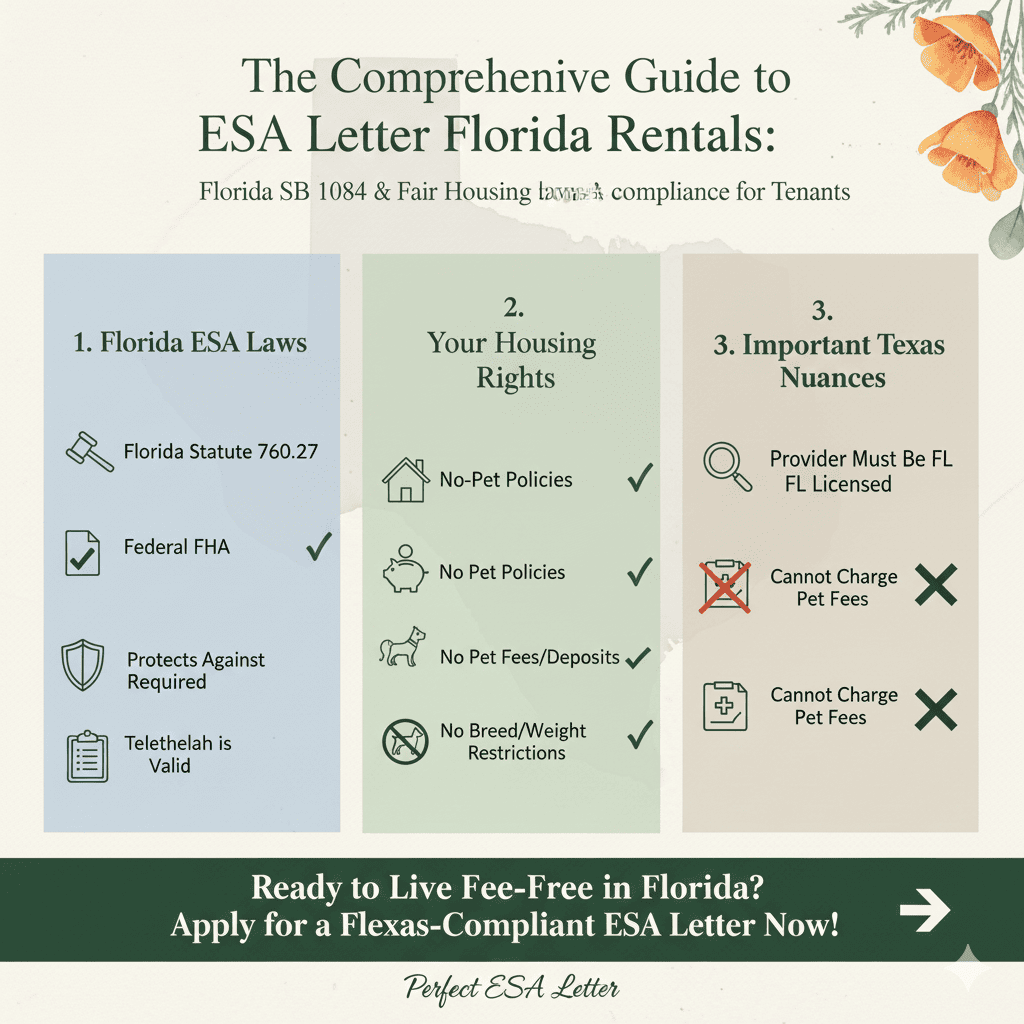
The Comprehensive Guide to ESA Letter Florida Rentals: Navigating Laws and Securing Your Housing
The Comprehensive Guide to ESA Letter Florida Rentals: Navigating Laws and Securing Your Housing
Florida is a top destination for renters, but its competitive housing market often comes with strict “no-pet” policies and high pet fees. For those managing mental health conditions, an emotional support animal (ESA) provides essential therapeutic support. To protect your right to live with your companion, you need a valid ESA letter for Florida rentals.
In Florida, housing rights for ESA owners are protected under both the federal Fair Housing Act (FHA) and specific state legislation, most notably Florida Statute 760.27 (originated from Senate Bill 1084). This law clarifies what constitutes a legitimate request and protects tenants from discrimination. However, Florida has also tightened rules to prevent fraud, meaning a “certificate” from the internet is no longer enough.
At Perfect ESA Letter, we connect Florida residents with licensed mental health professionals who provide documentation that is 100% compliant with Florida’s stringent statutes. If you are ready to ensure your housing success, apply for an ESA letter now to begin your evaluation.
Understanding Florida Statute 760.27: The Rules for Renters
Florida passed specific laws to codify how landlords must handle assistance animals. If you are looking for an ESA letter for Florida rentals, you must understand these three pillars of the state law:
1. The Definition of an ESA
In Florida, an emotional support animal is defined as an animal that does not require training to do work but provides support that alleviates at least one identified symptom of a person’s disability.
2. Reliable Information Requirements
Florida law is strict about where your letter comes from. To be considered “reliable,” the information must be provided by:
-
A federal, state, or local government agency.
-
A healthcare practitioner licensed in Florida.
-
A telehealth provider (which is explicitly recognized in Florida law).
-
An out-of-state practitioner, but only if they have provided in-person care to the tenant on at least one occasion.
3. The Anti-Fraud Clause
Florida has made it a second-degree misdemeanor to provide fraudulent ESA documentation. This is why using a “registry” or “ID card” site is dangerous—not only will your landlord reject it, but it could lead to legal trouble.
Your Rights as a Tenant in Florida
When you present a valid ESA letter for Florida rentals, your landlord is required to grant you a “reasonable accommodation.” This provides several major financial and lifestyle benefits.
No Pet Rent or Security Deposits
Florida law mirrors federal law here: a landlord or HOA cannot charge you pet rent, pet deposits, or any one-time fees for your ESA. They are viewed as assistance animals, not pets.
Exemption from Breed and Weight Limits
Even if an apartment complex has a “no large dogs” policy or bans specific breeds, they must waive these rules for your ESA. The only exception is if the individual animal poses a direct threat to the safety of others.
Protections Against Invasive Questions
Under Florida Statute 760.27, a landlord cannot:
-
Ask for your specific medical diagnosis.
-
Request to see your medical records.
-
Require your doctor to fill out a specific, proprietary form (though they can offer one).
Florida ESA Rights Comparison Table
| Feature | Standard Pet in Florida | ESA with Valid Florida Letter |
| Pet Rent / Fees | Allowed | Prohibited |
| “No Pet” Policies | Must Obey | Waived |
| Breed Restrictions | Allowed | Waived |
| Documentation Needed | None | Letter from Licensed Pro |
| Liability for Damage | Tenant pays | Tenant pays |
How to Get a Legitimate ESA Letter in Florida
To ensure your ESA letter for Florida rentals is accepted the first time, follow this professional path:
-
Select a State-Licensed Provider: Ensure the clinician is licensed in Florida. Florida landlords often check the “Florida Department of Health” license portal.
-
Complete a Clinical Assessment: You must have a consultation (via telehealth or in-person) where a professional determines you have a disability-related need for the animal.
-
Review the Letter Content: The letter must be on official letterhead and include the practitioner’s license number and contact information.
-
Submit to Your Landlord: Once you have the letter, submit a written request for a reasonable accommodation.
At Perfect ESA Letter, we handle the complexities of Florida’s specific laws for you, ensuring your letter meets every requirement of Section 760.27.
Internal Linking & Compliance Resources
Frequently Asked Questions (FAQs)
1. Can a Florida landlord deny my ESA if the letter is from a telehealth site?
No. Florida Statute 760.27 explicitly includes “telehealth providers” as a valid source of reliable information. As long as the provider has personal knowledge of your condition and is licensed in Florida, the landlord must accept it.
2. Can I have more than one ESA in my Florida apartment?
Yes, but Florida law allows landlords to request specific documentation for each animal. Your letter should explain why you need multiple animals (e.g., one for anxiety and one for depression).
3. Am I liable for damages caused by my ESA?
Yes. While you don’t pay pet deposits, you are still financially responsible for any physical damage the animal causes to the unit or injuries to other tenants.
4. Does my ESA letter for Florida rentals expire?
While the law doesn’t state an expiration date, HUD guidance and Florida landlords generally expect the letter to be “current,” which is typically defined as being issued within the last 12 months.
5. Can a landlord require my ESA to be registered?
No. Florida law states that “registration” or “ID cards” obtained online are not sufficient proof of a disability. A signed letter from a licensed professional is the only legal requirement.
6. Can I be evicted for getting an ESA after moving in?
No, as long as you provide valid documentation. You can request a reasonable accommodation at any time during your tenancy, even if you already live in a “no-pet” building.
7. Do ESAs have public access rights in Florida?
No. An ESA letter for Florida rentals only covers housing. ESAs are not allowed in restaurants, grocery stores, or malls unless the specific business is pet-friendly.
8. What are the penalties for a fake ESA letter in Florida?
Under SB 1084, misrepresenting an ESA is a second-degree misdemeanor. This can result in up to 60 days in jail and a $500 fine, plus community service with a disability organization.
Conclusion: Secure Your Home and Your Peace of Mind
Navigating the landscape of an ESA letter for Florida rentals requires a balance of understanding your rights and respecting state-specific regulations. Florida is one of the most protected states for ESA owners, but it is also one of the most vigilant against fraud. By obtaining a clinician-backed, Florida-compliant letter, you eliminate the risk of denial and the stress of hidden pet fees.
Don’t let confusing statutes or skeptical landlords keep you from the support you need. Protect your bond with your animal and your right to a fair home.
Ready to live fee-free with your ESA in Florida?
Our network of Florida-licensed professionals is ready to provide you with the legal documentation you need.