
Your Housing Rights with ESA Letter: The Ultimate Legal Guide
Your Housing Rights with ESA Letter: The Ultimate Legal Guide
In 2026, the rental market is more competitive than ever, and for many, finding an apartment that feels like “home” means having a faithful animal companion by their side. If you suffer from a mental health condition like anxiety, PTSD, or depression, your animal is not a luxury—it is a vital part of your well-being. This is where understanding your housing rights with ESA letter documentation becomes a game-changer.
Under federal law, an Emotional Support Animal (ESA) is not considered a pet. Instead, it is classified as a “reasonable accommodation” for a disability. This legal distinction grants you specific protections that most renters are unaware of. At Perfect ESA Letter, we empower you to stand your ground with landlords using 100% legal, HUD-compliant documentation.
If you’re ready to protect your home and your peace of mind, apply for an ESA letter now to begin your state-licensed clinical evaluation.
The Foundation: What Are Your Housing Rights with ESA Letter Protection?
Your rights are primarily rooted in the Fair Housing Act (FHA), which is enforced by the Department of Housing and Urban Development (HUD). As of 2026, these protections remain the “gold standard” for assistance animals in the United States.
1. Exemption from “No-Pet” Policies
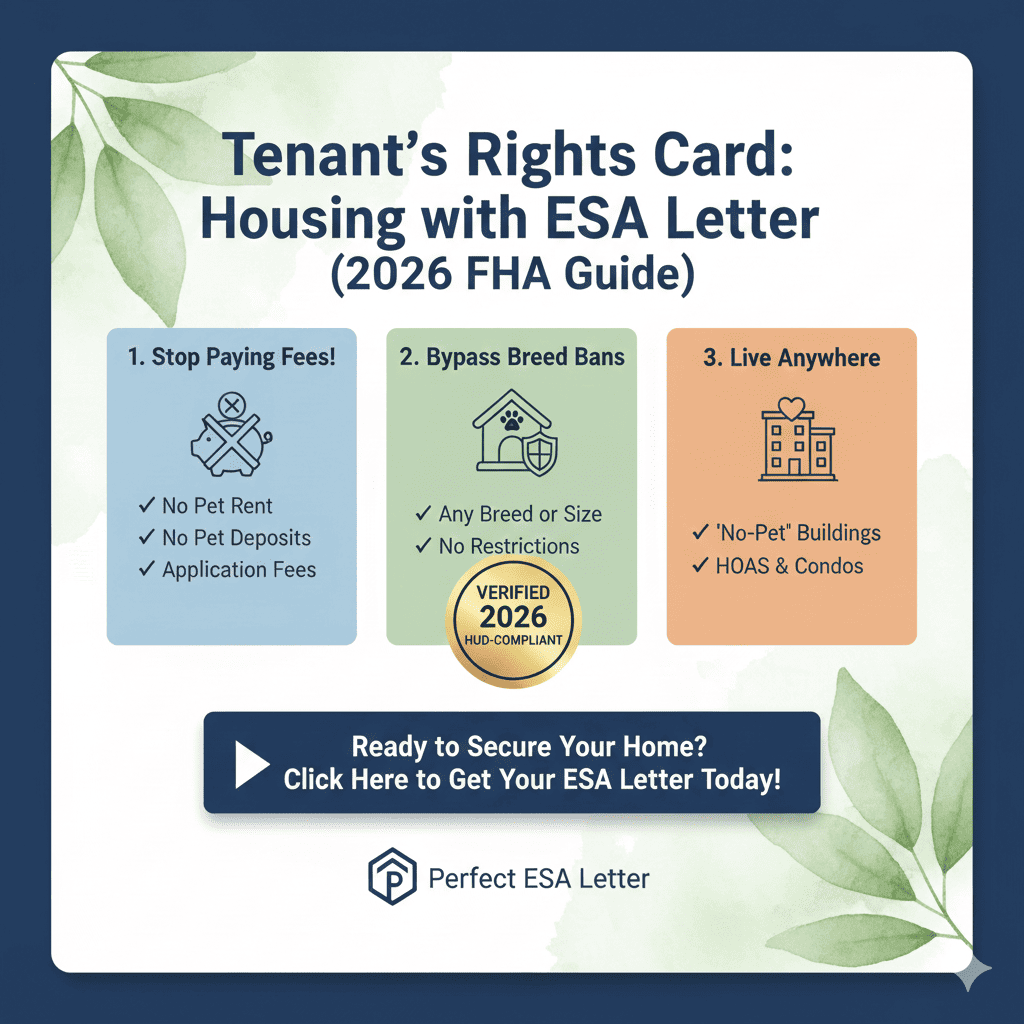
The most powerful of the housing rights with ESA letter coverage is the ability to bypass a building’s “no-pets” rule. If you have a valid letter, a landlord must make an exception to their policy to allow your animal to live with you.
2. Elimination of Pet Fees and Deposits
Landlords are legally prohibited from charging you:
-
Monthly Pet Rent: Often $50–$100 in savings per month.
-
Pet Security Deposits: One-time fees that can range from $200 to $500.
-
Pet Application Fees: Any surcharge for “processing” your animal.
3. Protection Against Breed and Weight Restrictions
Even if a building has a ban on “aggressive breeds” (like Pit Bulls or Rottweilers) or a weight limit (e.g., “dogs under 20 lbs only”), these rules do not apply to an ESA. As long as your specific animal is not a direct threat to safety, its breed and size cannot be used to deny you housing.
How to Exercise Your Housing Rights with ESA Letter Documentation
Knowing your rights is one thing; successfully exercising them is another. To ensure your accommodation is granted, follow this 2026 professional protocol:
Step 1: Get Your Documentation Early
Do not wait until you have a conflict with your landlord. Obtain your letter during the application process or before your lease renewal. A valid letter must be signed by a Licensed Mental Health Professional (LMHP) licensed in your state. Apply for an ESA letter now to get started.
Step 2: Submit a Written Request
While you can make a verbal request, it is best to submit your ESA letter with a brief cover note stating: “I am requesting a reasonable accommodation for my Emotional Support Animal under the Fair Housing Act.”
Step 3: Allow Time for Verification
A landlord has the right to verify that your letter is authentic. They can contact the clinician’s office to confirm they wrote the letter and that their license is active. However, they cannot ask for your specific medical diagnosis.
2026 HUD Guidelines: What Landlords Can and Cannot Do
To protect your housing rights with ESA letter documentation, you must know where the landlord’s authority ends.
| Landlord Action | Legal Status |
| Verify Clinician License | ✅ Legal |
| Ask for Medical Records | ❌ Illegal |
| Charge Pet Rent | ❌ Illegal |
| Deny Based on Breed | ❌ Illegal |
| Demand “Registration” ID Cards | ❌ Illegal (IDs are not legal proof) |
| Deny if the Animal is Destructive | ✅ Legal |
Exceptions to the Rule: When Housing Rights Don’t Apply
While the FHA is broad, there are four specific scenarios where housing rights with ESA letter protections may not apply:
-
Small Owner-Occupied Buildings: Buildings with 4 or fewer units where the landlord lives in one of them.
-
Single-Family Homes: If the owner owns 3 or fewer homes and rents them out without using a real estate agent.
-
Direct Threat: If the animal has a history of aggression or bites.
-
Undue Financial Burden: If the animal’s presence would fundamentally change the nature of the housing or cause extreme insurance costs (rare).
Internal Linking & Legal Resources
-
The difference between ESA and Psychiatric Service Dogs in 2026.
-
Apply for an ESA letter now to secure your housing rights.
Frequently Asked Questions (FAQs)
Can a landlord refuse an online ESA letter?
Only if the letter is from a “registry” site that doesn’t involve a real doctor. In 2026, landlords must accept letters obtained through telehealth, provided the therapist is licensed and has a clinical relationship with you.
Do I have housing rights with ESA letter protection in college dorms?
Yes. University-owned housing and dormitories are covered under the Fair Housing Act. Schools must allow ESAs and cannot charge you “pet fees” for living on campus with one.
Can I have more than one ESA?
Yes. Federal law allows for multiple ESAs if your clinician determines that each animal provides a unique therapeutic benefit. You will need a letter that specifically mentions the need for multiple animals.
Do my housing rights cover public places like restaurants?
No. Housing rights with ESA letter documentation only apply to where you live. For public access (stores, restaurants), you would need a Psychiatric Service Dog (PSD) that is task-trained.
What if I get an ESA after I’ve already signed the lease?
You are still protected. You can request a reasonable accommodation at any time during your tenancy. Once you provide the letter, the landlord must stop charging pet rent immediately.
Can a landlord evict me for having an ESA?
Not if you have a valid letter. Evicting someone for a documented assistance animal is a violation of the Fair Housing Act and can lead to heavy fines for the landlord.
Conclusion: Secure Your Home Today
Your housing rights with ESA letter protection are your best defense against unfair pet fees and housing discrimination. In 2026, don’t let a “no-pets” sign keep you from the stability of your home. By securing a legitimate, verifiable letter, you ensure that you and your animal can live together in peace.
At Perfect ESA Letter, we specialize in the complex intersection of mental health and housing law. Our team of state-licensed professionals is ready to provide you with the documentation you need to satisfy even the strictest property managers.
Ready to exercise your rights?