
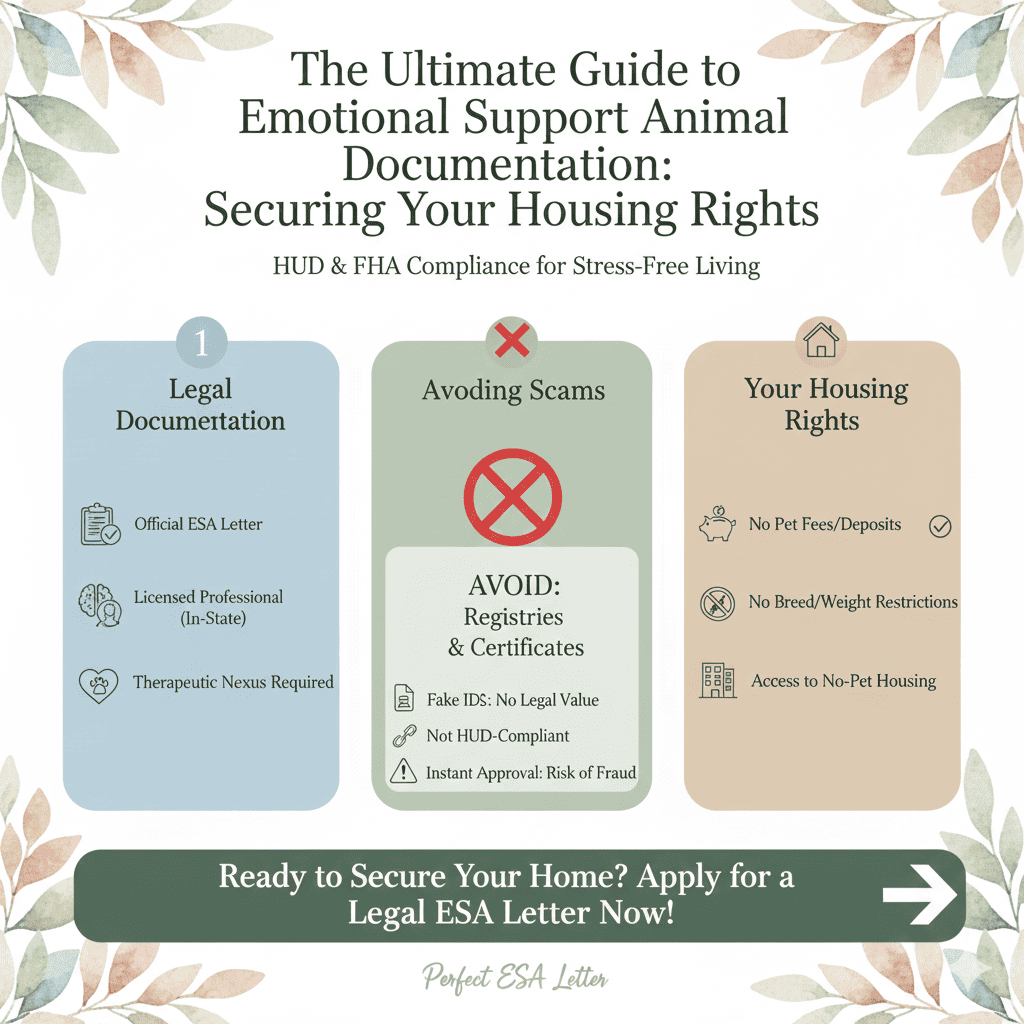
The Ultimate Guide to Emotional Support Animal Documentation: Securing Your Housing Rights
The Ultimate Guide to Emotional Support Animal Documentation: Securing Your Housing Rights
For individuals living with mental health challenges, the companionship of an animal is often a cornerstone of their recovery and daily stability. Whether it’s managing symptoms of PTSD, chronic anxiety, or depression, the presence of a pet can be life-changing. However, the legal landscape of housing can be a significant barrier. To live in “no-pet” housing or waive expensive pet fees, you must possess the correct emotional support animal documentation.
The Fair Housing Act (FHA) provides robust protections for ESA owners, but these rights are only accessible if your paperwork meets specific federal criteria. Unfortunately, the internet is flooded with “registries” and “certificates” that hold no legal weight, often leading to rejected applications and frustrated tenants. Understanding what constitutes valid documentation is the first step toward a stress-free living situation.
At Perfect ESA Letter, we connect you with state-licensed mental health professionals who provide 100% compliant documentation. If you are ready to protect your rights and your companion, apply for an ESA letter now to begin your consultation.
What is Valid Emotional Support Animal Documentation?
Under the guidelines set by the Department of Housing and Urban Development (HUD), valid emotional support animal documentation is not a “certificate” or a “registration number.” Instead, it is a formal letter written and signed by a licensed healthcare professional.
The Three Pillars of a Legal ESA Letter
To be considered legally binding, your documentation must establish three specific points:
-
The Professional’s Credentials: The letter must come from a provider licensed in your state (e.g., a therapist, psychiatrist, or primary care doctor).
-
Verification of Disability: The provider must confirm that you have a physical or mental impairment that substantially limits one or more major life activities.
-
The Therapeutic Nexus: The document must state that the animal provides emotional support or performs tasks that alleviate one or more symptoms of your disability.
Why “Registries” and “Certificates” Are Not Valid Documentation
Many pet owners are misled by websites offering “Official ESA Registration.” It is critical to understand that there is no legally recognized national database for ESAs.
| Feature | Legitimate ESA Letter | Online Registry/ID Card |
| Legal Standing | Recognized by FHA and HUD | Not recognized by law |
| Provider | Licensed Mental Health Professional | Marketing company |
| Requirement | Clinical Evaluation | A one-time fee |
| Landlord Acceptance | Mandatory (if valid) | Often rejected as fraudulent |
Using “fake” emotional support animal documentation can result in more than just a rejected application; in several states, misrepresenting an ESA is a punishable offense. Always prioritize a clinician-backed letter to ensure your housing remains secure.
Navigating HUD Guidelines for Housing Providers
Landlords are becoming increasingly savvy regarding assistance animal laws. When you present your emotional support animal documentation, property managers are permitted to verify specific details.
What Landlords Can Verify:
-
License Status: They can check if the professional who signed the letter has an active license in your state.
-
Authenticity: They can contact the provider’s office to confirm the document was actually issued to you (though they cannot ask about your private medical details).
-
Current Status: Most landlords require the letter to be dated within the last 12 months to prove the need is ongoing.
What Landlords CANNOT Do:
-
Charge Fees: They cannot charge “pet rent,” “pet deposits,” or one-time pet fees.
-
Demand Medical Records: They cannot ask for your specific diagnosis or medical history.
-
Enforce Breed Restrictions: The FHA overrides breed or weight limits for assistance animals.
How to Obtain Legitimate ESA Documentation Online
The rise of telehealth has made obtaining emotional support animal documentation more accessible and private. The process at Perfect ESA Letter follows a strict clinical path to ensure legality:
-
Online Assessment: Complete a confidential screening to identify your mental health needs.
-
Clinical Consultation: Connect with a licensed professional in your state for a one-on-one evaluation.
-
Digital & Hard Copy Delivery: Once approved, your legal letter is generated on the provider’s official letterhead, complete with their license number and contact information.
Internal Linking & Compliance Checklist
Emotional Support Animal Documentation FAQ
1. Can a landlord refuse my ESA letter if it was obtained online?
No. HUD explicitly recognizes telehealth as a valid method for receiving a mental health evaluation. As long as the clinician is licensed in your state and has personal knowledge of your condition, the letter is legally valid.
2. Do I need to show my animal’s training records?
No. Unlike service dogs, ESAs do not require specialized training. Your emotional support animal documentation focuses on the therapeutic benefit the animal provides, not the animal’s skills.
3. Does my ESA documentation expire?
While the FHA doesn’t have a strict expiration date, HUD guidance suggests that documentation should be “current.” Most landlords require an update every 12 months to confirm the disability-related need persists.
4. Can I have more than one ESA?
Yes. However, your documentation must justify the need for each specific animal. Your provider should explain how each animal provides a unique therapeutic benefit that the other does not.
5. Is an ID tag or vest considered valid documentation?
No. Accessories like vests, tags, and “certificates” are not legal documents. They are often used by scammers to sell products. The only document a landlord is required to accept is a signed letter from an LMHP.
6. What happens if I move to a different state?
Since ESA housing laws can vary slightly and providers must be licensed in the state where you live, it is a best practice to obtain updated emotional support animal documentation from a clinician licensed in your new state.
7. Can a landlord ask for my medical records?
No. Landlords are legally prohibited from asking for your specific diagnosis or full medical history. They are only entitled to the information provided in a standard ESA letter.
8. Are there any housing types exempt from ESA laws?
Yes. Some exceptions include owner-occupied buildings with four or fewer units and single-family houses sold or rented by the owner without a broker.
Secure Your Housing Rights Today
Navigating the world of emotional support animal documentation doesn’t have to be a source of stress. By choosing a path that is clinical, transparent, and fully compliant with federal law, you protect the bond you share with your animal.
Don’t let pet restrictions or illegal fees stand in your way. A legitimate, clinician-backed letter is the key to a more supportive and stable home environment.
Ready to live without pet fees?
Get the documentation that landlords respect and the law requires. Our network of state-licensed professionals is here to guide you through a secure and professional evaluation.