
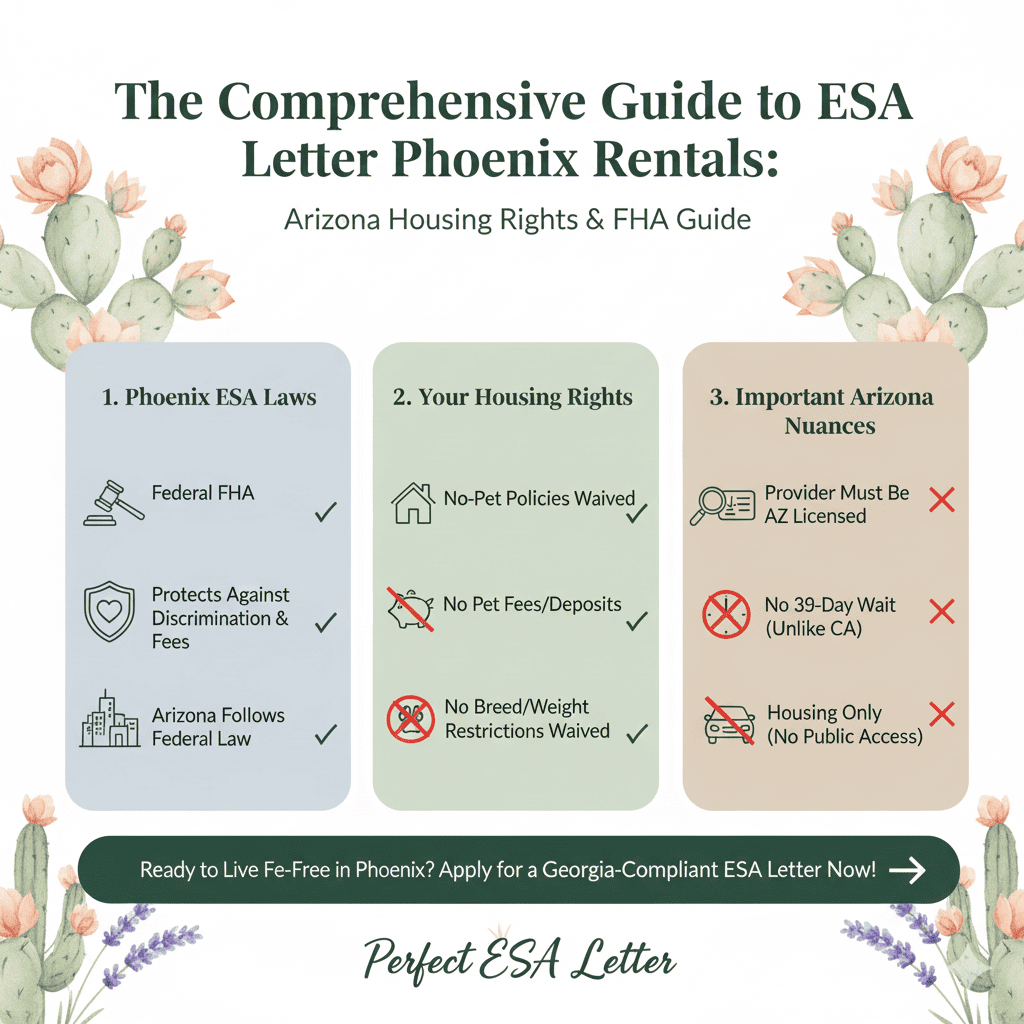
The Comprehensive Guide to ESA Letter Phoenix Rentals: Laws and Securing Your Housing
The Comprehensive Guide to ESA Letter Phoenix Rentals: Laws and Securing Your Housing
Phoenix is known for its sprawling desert landscapes and sun-drenched neighborhoods, but for many renters, the “Valley of the Sun” can feel a bit cold when it comes to housing. With many modern apartments in areas like Downtown Phoenix, Scottsdale, and Tempe enforcing strict “no-pet” policies or charging hefty monthly fees, finding a home for you and your companion can be a challenge.
However, if you live with a mental or emotional health condition, an emotional support animal (ESA) is not just a pet—it is a vital component of your treatment and well-being. To protect your rights and your bond with your animal, you need a valid ESA letter for Phoenix rentals.
Under the federal Fair Housing Act (FHA) and Arizona’s own fair housing regulations, tenants with documented emotional support animals are entitled to “reasonable accommodations.” This means that with the right documentation, your animal is recognized as an assistance animal, not a pet, allowing you to bypass restrictive leases and save on extra costs.
At Perfect ESA Letter, we bridge the gap between Phoenix residents and the Arizona-licensed professionals who can provide legally binding documentation. Don’t let a “no-pets” clause stand in your way. Apply for an ESA letter now to start your professional evaluation.
Understanding Arizona Housing Laws for ESA Owners
In Phoenix, your right to live with an emotional support animal is primarily protected by the Fair Housing Act (FHA). While Arizona does not have a specific state statute that creates more restrictive rules than the federal government, local landlords must comply with the Department of Housing and Urban Development (HUD) guidelines.
The Definition of an Assistance Animal
The FHA categorizes ESAs as “assistance animals.” Unlike service dogs, which are trained to perform specific physical tasks (like guiding the blind), an ESA provides therapeutic support through its presence alone.
Your Rights in Phoenix Rentals:
-
Exemption from “No-Pet” Policies: Even if a building is strictly pet-free, they must accommodate your ESA.
-
No Pet Rent or Security Deposits: Landlords in Phoenix are prohibited from charging any extra fees, monthly “pet rent,” or one-time pet deposits for your ESA.
-
Bypassing Breed and Weight Limits: Many Arizona property management companies ban specific “aggressive” breeds. Under the FHA, these bans are waived for ESAs unless the individual animal poses a proven safety threat.
Why You Need an ESA Letter for Phoenix Rentals
In a city where luxury apartment pet fees can reach $500 initially and $50 monthly, a legitimate ESA letter is a significant financial asset. But more importantly, it provides legal security.
Key Benefits of a Legitimate Letter:
-
Financial Savings: Over a standard 12-month lease, an ESA letter can save you over $1,000 in fees.
-
Housing Stability: You cannot be evicted or denied an application simply because you have an assistance animal.
-
Peace of Mind: You no longer have to worry about “hiding” your animal or facing conflict with management.
Arizona ESA Rights Comparison Table
| Feature | Standard Pet in Phoenix | ESA with Valid Arizona Letter |
| Housing Access | Landlord’s Discretion | Mandatory Access |
| Monthly Pet Rent | Typical ($25–$100) | Prohibited ($0) |
| Pet Deposits/Fees | Allowed | Prohibited |
| Breed/Weight Bans | Common | Waived |
| Documentation Needed | None | Official Clinician Letter |
How to Get a Legitimate ESA Letter in Phoenix
To ensure your ESA letter for Phoenix rentals is accepted by major property management groups, it must follow a specific professional path.
1. Consultation with an Arizona-Licensed Professional
Your letter must come from a healthcare professional (LMHP) who is licensed to practice in Arizona. Phoenix landlords often verify these licenses through the Arizona Board of Behavioral Health Examiners.
2. Clinical Evaluation
The professional must determine that you have a mental or emotional disability and that the animal provides a specific benefit that alleviates your symptoms. This evaluation can be conducted via a secure telehealth appointment.
3. Reviewing the Letter Content
The letter must be on the provider’s official letterhead and include:
-
The clinician’s license type and number.
-
The date of issuance.
-
Confirmation of the disability-related need for the animal.
At Perfect ESA Letter, we ensure your documentation is fully compliant with HUD standards and Arizona’s professional requirements.
What Phoenix Landlords CANNOT Do
Tenants often feel intimidated when presenting their request to a landlord. It is vital to know that the law limits a landlord’s power in these situations.
Phoenix Landlords CANNOT:
-
Ask for your specific medical diagnosis or “proof” of your disability beyond the letter.
-
Require the animal to wear a vest or have a “certificate” from a registry.
-
Charge you an “application fee” for your ESA.
-
Deny your request because they “already have too many animals in the building.”
Internal Linking & Local Resources
Frequently Asked Questions (FAQs)
1. Can a Phoenix landlord deny my ESA if it’s a “restricted” breed like a Pit Bull?
No. Under the Fair Housing Act, breed restrictions do not apply to assistance animals. A landlord can only deny an animal if that specific animal has a documented history of aggression or if its presence would fundamentally alter the nature of the housing.
2. Do I need to register my ESA with the City of Phoenix?
No. There is no such thing as an official ESA registry. Websites selling “registration badges” are not legally recognized. The only document that matters is your signed ESA letter for Phoenix rentals.
3. Can I have more than one ESA in a Tempe or Scottsdale apartment?
Yes. You can have multiple ESAs, but your clinician must explain why each animal is necessary for your treatment.
4. Does my ESA letter expire?
While the law doesn’t provide a strict expiration date, most Phoenix property managers follow the industry standard of requiring the letter to be updated annually.
5. Can a landlord ask to see my animal’s training certificates?
No. Emotional support animals do not require specialized training. Therefore, a landlord cannot ask for training proof or for the animal to demonstrate a task.
6. Am I liable for damages my ESA causes?
Yes. While you are exempt from pet deposits, you are still financially responsible for any physical damage your animal causes to the property, excluding normal wear and tear.
7. Can a landlord evict me if I get an ESA after moving in?
No. You can request a reasonable accommodation at any time during your lease. If you provide a valid letter, they must accommodate the animal.
8. Are ESAs allowed on the Valley Metro light rail?
An ESA letter only covers housing. For public transport like the Valley Metro, your animal must generally be in a carrier unless it is a trained service dog.
Conclusion: Secure Your Home in the Valley
Renting in Phoenix is easier when you know your rights. An ESA letter for Phoenix rentals is your legal shield against unfair pet fees and restrictive housing policies. By working with a licensed Arizona professional, you ensure that your documentation is ironclad and ready for any property manager’s desk.
Don’t let the heat of a “no-pets” lease burn your chances of living with your companion. Take control of your housing situation and enjoy the therapeutic support you deserve.
Ready to live without pet rent and deposits in Phoenix?
Our network of Arizona-licensed professionals is ready to help you secure your rights.