
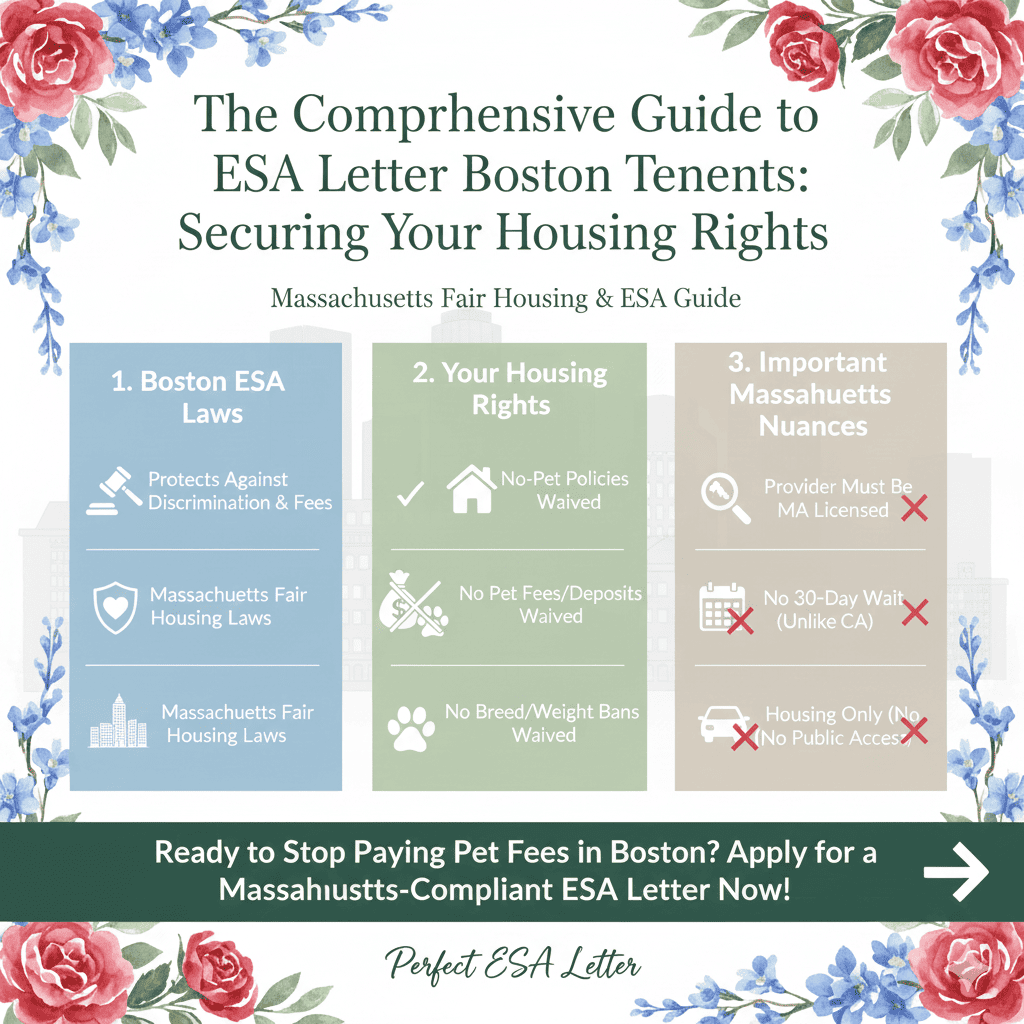
The Comprehensive Guide to ESA Letter Boston Tenants: Securing Your Housing Rights
The Comprehensive Guide to ESA Letter Boston Tenants: Securing Your Housing Rights
Boston is a city of historic charm and modern innovation, but for many renters in neighborhoods like Back Bay, Southie, or Allston, the housing market can feel restrictive. With some of the highest rents in the country and many luxury buildings enforcing strict “no-pet” policies, finding a home for you and your companion can be a major hurdle.
However, if you live with a mental or emotional health condition, an emotional support animal (ESA) is far more than a pet—it is a vital part of your well-being. To ensure your rights are protected in the Hub, you need a valid ESA letter for Boston tenants.
Under the federal Fair Housing Act (FHA) and Massachusetts fair housing laws, tenants with documented emotional support animals are entitled to “reasonable accommodations.” This means that with the proper documentation, your animal is recognized as an assistance animal, allowing you to live in pet-free housing and save significantly on extra costs.
At Perfect ESA Letter, we bridge the gap between Boston residents and the Massachusetts-licensed professionals who can provide legally binding documentation. Don’t let a landlord’s pet policy stand in your way. Apply for an ESA letter now to start your professional evaluation.
Understanding Massachusetts Housing Laws for Boston Tenants
In Boston, your right to live with an emotional support animal is protected by both federal and state regulations. While many people use the terms “pet” and “ESA” interchangeably, the law makes a very clear distinction.
The Legal Status of Assistance Animals
The Fair Housing Act (FHA) classifies ESAs as “assistance animals.” Unlike service dogs, which must be trained to perform specific physical tasks, an ESA provides therapeutic support through its presence. Massachusetts law aligns with these federal guidelines, ensuring that assistance animals are not subject to the same rules as traditional pets.
Your Rights in Boston Rentals:
-
Exemption from “No-Pet” Policies: Even if your lease says “no pets,” a valid ESA letter legally obligates the landlord to accommodate your animal.
-
Zero Pet Rent or Deposits: Boston landlords are prohibited from charging any extra fees, monthly “pet rent,” or one-time pet deposits for a documented ESA.
-
Waiver of Breed and Weight Limits: Many Boston property management companies ban specific “aggressive” breeds. Under fair housing laws, these bans are waived for ESAs unless the individual animal is a proven safety threat.
Why You Need an ESA Letter for Boston Housing
In a city where pet fees can reach $100 per month and initial deposits can be hundreds of dollars, a legitimate ESA letter is a significant financial tool. More importantly, it provides the legal security you need to avoid housing discrimination.
Key Benefits for Boston Renters:
-
Financial Savings: Over a standard 12-month lease in Boston, an ESA letter can save you well over $1,200 in pet-related fees.
-
Housing Stability: You cannot be evicted or denied an application simply because you have an assistance animal.
-
Peace of Mind: You no longer have to worry about “hiding” your animal or facing conflict with your landlord.
Boston Renter’s Comparison: Standard Pet vs. ESA
| Feature | Standard Pet in Boston | ESA with Valid Massachusetts Letter |
| Housing Access | Landlord’s Discretion | Mandatory Access |
| Monthly Pet Rent | Typical ($50–$100) | Prohibited ($0) |
| Pet Deposits/Fees | Allowed | Prohibited |
| Breed/Weight Bans | Common | Waived |
| Documentation Needed | None | Official Clinician Letter |
How to Get a Legitimate ESA Letter in Boston
To ensure your ESA letter for Boston tenants is accepted by major property management groups like Greystar or Equity Residential, it must follow a specific professional path.
1. Consultation with a Massachusetts-Licensed Professional
Your letter must come from a healthcare professional (LMHP) who is licensed to practice in Massachusetts. Boston landlords often verify these licenses through the Massachusetts Board of Registration.
2. Clinical Evaluation
The professional must determine that you meet the definition of having a mental or emotional disability and that the animal provides a specific benefit that alleviates your symptoms. This can be conducted via a secure telehealth appointment.
3. Professional Letter Content
The letter must be on the provider’s official letterhead and include:
-
The clinician’s license type and number.
-
The date of issuance.
-
Confirmation of the disability-related need for the animal.
At Perfect ESA Letter, we ensure your documentation is 100% compliant with HUD standards and Massachusetts professional requirements.
What Boston Landlords CANNOT Do
Tenants in Boston often feel intimidated when presenting their request. It is vital to know that the law strictly limits a landlord’s power.
Boston Landlords CANNOT:
-
Demand Medical Records: They cannot ask for your specific diagnosis or “proof” of your disability beyond the letter.
-
Require a Vest or ID: They cannot demand the animal wear a vest or have a “certificate” from a registry.
-
Charge an Accommodation Fee: There is no charge for processing a reasonable accommodation request.
-
Restrict Based on “Pet Quotas”: They cannot deny your request because “too many” animals already live in the building.
Internal Linking & Local Resources
Frequently Asked Questions (FAQs)
1. Can a Boston landlord deny my ESA because of its breed?
No. Under the Fair Housing Act, breed restrictions (like those for Pit Bulls or Rottweilers) do not apply to assistance animals. A landlord can only deny an animal if that specific animal has a documented history of aggression.
2. Do I need to register my ESA with the City of Boston?
No. There is no official or legal ESA registry. Websites selling “registration badges” are not legally recognized. The only document that matters is your signed ESA letter for Boston tenants.
3. Can I have more than one ESA in a Boston apartment?
Yes. You can have multiple ESAs, but your clinician must explain why each animal is necessary for your specific treatment.
4. Does my ESA letter expire?
While the law doesn’t provide a strict expiration date, most Boston property managers follow the industry standard of requiring the letter to be updated every 12 months.
5. Am I liable for damages my ESA causes?
Yes. While you are exempt from pet deposits, you are still financially responsible for any physical damage your animal causes to the property beyond normal wear and tear.
6. Can a landlord evict me if I get an ESA after I’ve already moved in?
No. You can request a “reasonable accommodation” at any time during your lease. Once you provide a valid letter, they must accommodate the animal.
7. Are ESAs allowed on the MBTA?
An ESA letter only covers housing. For public transport like the T or Boston buses, your animal must generally be in a carrier unless it is a trained service dog.
8. What if I live in an owner-occupied building?
There are small exemptions for owner-occupied buildings with two units (the “Mrs. Murphy” exemption). If you live in a duplex where the landlord lives in the other half, the rules may differ.
Conclusion: Secure Your Home in the Hub
Renting in Boston is challenging enough—don’t let pet fees and restrictive leases make it harder. An ESA letter for Boston tenants is your legal shield against unfair costs and housing barriers. By working with a licensed Massachusetts professional, you ensure your documentation is ironclad.
Don’t let the stress of housing affect your mental health. Take control of your situation and enjoy the therapeutic support you deserve.
Ready to live without pet rent and deposits in Boston?
Our network of Massachusetts-licensed professionals is ready to help you secure your rights.