
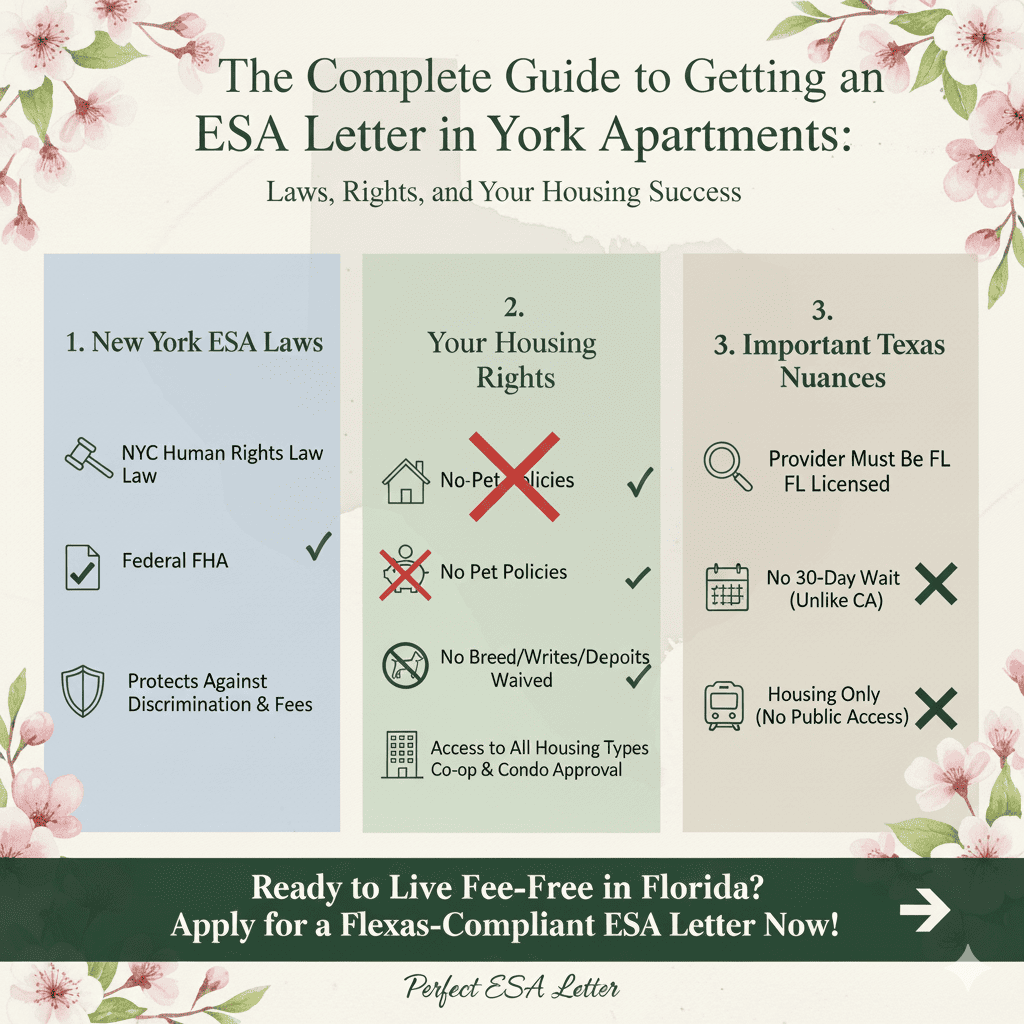
The Complete Guide to Getting an ESA Letter in New York Apartments: Laws & Rights
The Complete Guide to Getting an ESA Letter in New York Apartments: Laws & Rights
Renting in the Empire State—especially within the five boroughs—presents a unique set of challenges. From sky-high rents to restrictive “no-pet” policies, finding a home that welcomes your companion can feel impossible. However, for those managing mental health conditions, an emotional support animal (ESA) is not a luxury; it is a vital part of daily stability. To protect your bond and your wallet, you need a legitimate ESA letter for New York apartments.
New York is one of the most protective states in the country for tenants with assistance animals. Between the federal Fair Housing Act (FHA), the New York State Human Rights Law, and the even more rigorous New York City Human Rights Law, you have significant legal leverage. When you have the right documentation, your animal is no longer a “pet” in the eyes of the law—it is a recognized assistance animal that a landlord must accommodate.
At Perfect ESA Letter, we bridge the gap between New York renters and the state-licensed professionals who can provide legally binding documentation. Don’t let a “no-pets” lease stand in your way. Apply for an ESA letter now to start your professional evaluation and secure your housing rights.
The Legal Trio: FHA, NYSHRL, and NYC Human Rights Law
When you request an accommodation for an ESA letter in New York apartments, your rights are supported by three distinct layers of protection:
1. The Federal Fair Housing Act (FHA)
This is the baseline protection across the United States. It requires landlords to provide “reasonable accommodations” for individuals with disabilities, which includes allowing assistance animals in housing where pets are otherwise prohibited.
2. New York State Human Rights Law (NYSHRL)
New York State law goes a step further by offering broader definitions of disability. It explicitly prohibits housing providers from discriminating against individuals who rely on emotional support animals for their well-being.
3. New York City Human Rights Law (NYCHRL)
For those in Manhattan, Brooklyn, Queens, the Bronx, or Staten Island, the NYCHRL is one of the most powerful anti-discrimination laws in the world. It sets a very high bar for landlords attempting to deny an ESA, often requiring them to prove “undue hardship” to reject a request.
Why You Need a Valid ESA Letter for New York Apartments
In a city where pet rent can cost an extra $100 a month and pet deposits can reach $500, a legitimate ESA letter is a financial lifesaver.
Key Benefits of a Legitimate Letter:
-
Waived Pet Fees: Landlords in New York are legally prohibited from charging any pet-related fees, deposits, or monthly rent for a documented ESA.
-
Bypass “No-Pet” Policies: Your letter allows you to live in buildings that otherwise ban animals.
-
No Breed or Size Restrictions: Whether you have a Golden Retriever or a Pit Bull, your ESA cannot be denied based on its breed, weight, or size.
-
Co-op and Condo Approval: Unlike standard pets, which can be rejected by picky co-op boards, ESAs are protected in almost every type of residential housing.
ESA Rights in New York: At a Glance
| Protection Feature | Standard Pet | ESA with Valid NY Letter |
| Housing in “No-Pet” Buildings | Prohibited | Mandatory Access |
| Monthly Pet Rent | Typical ($50–$150) | $0 / Prohibited |
| Pet Deposits | Allowed | Prohibited |
| Breed/Weight Limits | Allowed | Waived |
| Co-op Board Approval | Discretionary | Legally Protected |
The 3-Step Process to Getting Your New York ESA Letter
Because New York is strict about provider licensure, you must ensure your letter comes from a clinician authorized to practice in the state.
1. Clinical Evaluation
You must meet with a Licensed Mental Health Professional (LMHP). Under HUD guidelines and New York law, this can be done via telehealth. During this session, you’ll discuss your mental health challenges and how an animal helps mitigate your symptoms.
2. Verifiable Documentation
Your clinician will draft a letter on their official letterhead. It must include their license type, license number, and the state of New York as their jurisdiction. Landlords in NYC frequently verify these licenses via the New York State Education Department (NYSED) portal.
3. Submit Your Request
Once you have your ESA letter for New York apartments, you should submit a written “Reasonable Accommodation Request” to your landlord. You do not need to share your medical history or specific diagnosis—just the letter itself.
New York Landlord Restrictions: What They CAN’T Ask
New York tenants often fear being “interrogated” by their building managers. It is important to know that the law limits what a landlord can request.
Landlords CANNOT:
-
Demand to see your medical records or clinical notes.
-
Ask for a specific diagnosis (e.g., “What kind of depression do you have?”).
-
Require “special training” or “certification” for the animal.
-
Charge an “application fee” for processing your ESA request.
-
Deny your request based on a “no-pets” clause in the lease.
Internal Linking & NYC Tenant Resources
Frequently Asked Questions (FAQs)
1. Can a New York landlord deny my ESA if it’s a “restricted breed”?
No. New York law is very clear that an ESA cannot be denied based on its breed or size. A landlord can only deny an animal if that specific animal has a proven history of aggression or property damage.
2. Do I need to register my ESA with the city of New York?
No. There is no such thing as an “official” city or state ESA registry. Any website promising “New York City ESA Registration” is a scam. Your signed letter is your only legal proof.
3. Can I have more than one ESA in a Manhattan apartment?
Yes. New York does not have a strict “one-animal” limit. However, your clinician must be able to justify why each animal is necessary for your mental health treatment.
4. Does a “no-dog” building have to allow an emotional support dog?
Yes. Under the Fair Housing Act and NYCHRL, “no-pet” or “no-dog” policies are waived for individuals with a valid ESA letter for New York apartments.
5. Can my landlord talk to my therapist?
A landlord can contact your therapist only to verify that the letter is authentic and that the provider is indeed treating you. They cannot ask about your medical condition or the specifics of your treatment.
6. Are ESAs allowed in NYC public housing (NYCHA)?
Yes. The New York City Housing Authority (NYCHA) must comply with federal and state fair housing laws regarding assistance animals.
7. Can I bring my ESA into New York restaurants or the subway?
No. Unlike service animals, ESAs do not have public access rights. In NYC, your ESA is protected in your home, but businesses and the MTA are not required to allow them unless they are in a carrier.
8. What if my landlord ignores my request for 30 days?
In New York, a failure to respond to a reasonable accommodation request in a timely manner can be seen as a “constructive denial.” You may be able to file a complaint with the NYC Commission on Human Rights.
Conclusion: Take Control of Your NYC Living Situation
Securing an ESA letter for New York apartments is the most effective way to protect your housing rights and ensure you can live comfortably with your animal. In the high-stakes world of New York real estate, having a clinician-backed, legally compliant letter is your greatest asset against discrimination and hidden fees.
Don’t let the complexity of New York laws intimidate you. At Perfect ESA Letter, we ensure your documentation meets the high standards required by NYC landlords and co-op boards.
Ready to live without pet rent and lease restrictions?
Get started with a New York-licensed professional today and protect your home.