Is Online ESA Letter Legit? Everything You Need to Know to Protect Your Rights
Is Online ESA Letter Legit? Everything You Need to Know to Protect Your Rights
For millions of people living with mental or emotional health challenges, the companionship of an animal is more than a luxury—it is a vital part of their treatment plan. When searching for ways to secure housing protections, many people ask: Is an online ESA letter legit? The short answer is yes, but with a significant caveat: it is only legitimate if the process follows specific federal and state guidelines. In recent years, the market has been flooded with “ESA mills” that sell fake certificates and useless registrations, leading to confusion for both tenants and landlords. Understanding the difference between a transactional scam and a legitimate clinical service is essential to ensuring your housing request is approved.
At Perfect ESA Letter, we focus on 100% legal compliance and clinical integrity. Apply for an ESA letter now to get documentation you can trust.
The Legal Foundation: Can You Get a Legit ESA Letter Online?
The legitimacy of online ESA letters is rooted in the Fair Housing Act (FHA) and guidelines provided by the U.S. Department of Housing and Urban Development (HUD).
HUD explicitly recognizes that healthcare professionals can provide services remotely. In their 2020 guidance, HUD stated that “reliable documentation” can come from a “telehealth provider” as long as the provider has personal knowledge of the individual’s disability-related need for the animal.
What Makes it “Legit”?
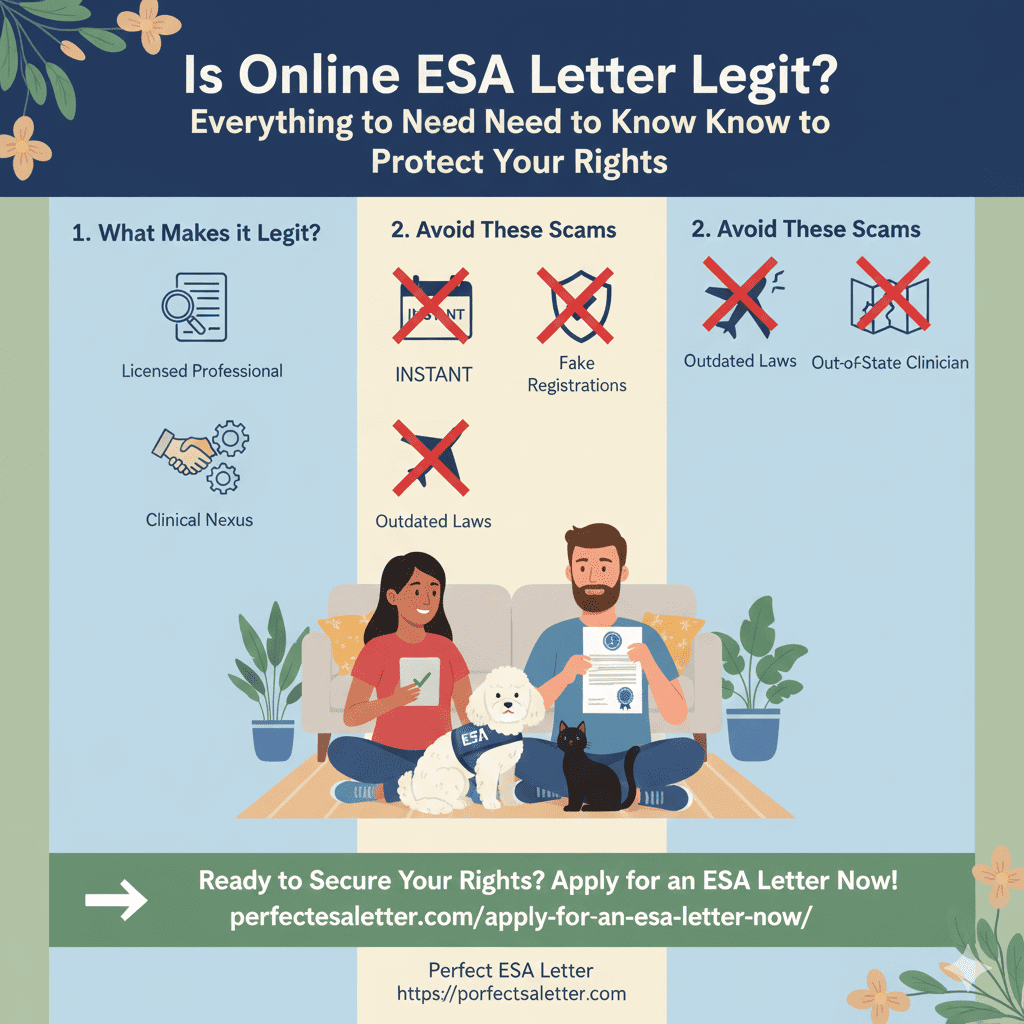
An online ESA letter is considered legitimate if it meets the following criteria:
-
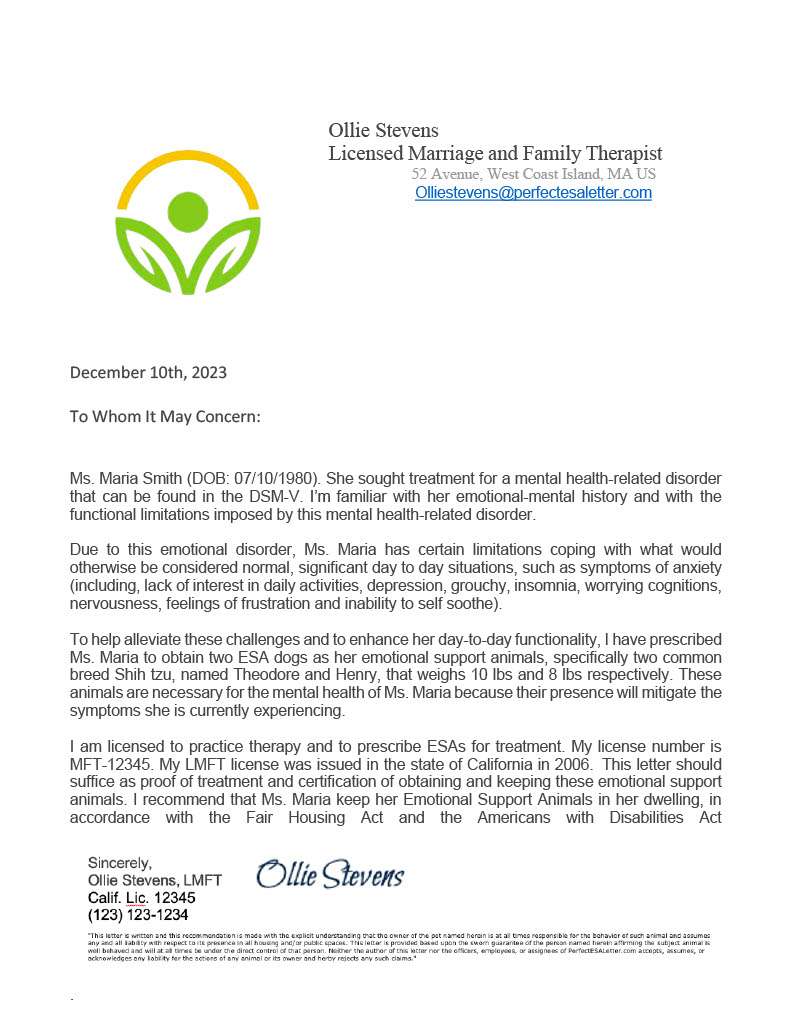
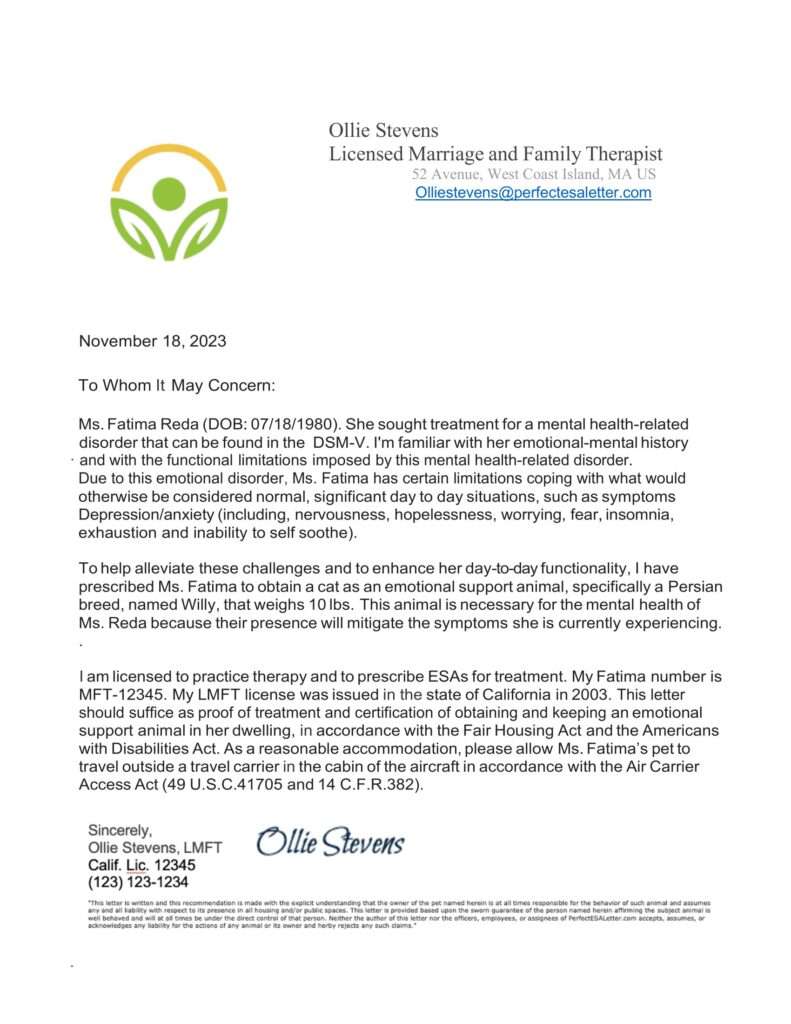
Licensed Professional: It must be written by a Licensed Mental Health Professional (LMHP) licensed in your state.
-
Direct Evaluation: The clinician must have evaluated you through a consultation (phone or video).
-
Clinical Nexus: The letter must establish a clear connection between your disability and the relief the animal provides.
-
Official Credentials: The document must include the clinician’s license number, practice address, and contact information.
Warning Signs: How to Spot a Fake ESA Website
When questioning is an online ESA letter legit, the biggest red flags usually come from websites that treat the process like a retail purchase rather than a medical evaluation.
1. “Instant” Approval or Downloads
A real healthcare professional needs time to review your history and conduct a consultation. Any site promising a letter in minutes without speaking to a human is a “letter mill.”
2. Selling “Registrations” or “Certificates”
There is no such thing as an official ESA registry. Websites that sell ID cards, vests, or “lifetime registrations” are selling unnecessary accessories that have zero legal standing in housing courts.
3. Outdated Legal Claims
If a site claims their letter will allow you to fly with your pet for free under the Air Carrier Access Act (ACAA), they are providing outdated information. Since 2021, ESAs are no longer legally required to be accommodated on airplanes for free.
4. Clinicians Not Licensed in Your State
Housing providers often verify the license number on your letter. If you live in New York but your letter comes from a doctor only licensed in Florida, your landlord has the right to challenge the document’s validity.
Comparing Legit vs. Scam Online ESA Services
| Feature | Legitimate Service (e.g., Perfect ESA Letter) | Common Online Scam |
| Consultation | Required (Live Phone/Video) | None (Simple Quiz Only) |
| Clinician | Licensed in your state of residence | Unlicensed or out-of-state “consultant” |
| Documentation | Signed medical letter on letterhead | “Official” ID Card or Certificate |
| Turnaround | 24–48 hours (after evaluation) | Instant / Automated |
| Registry | Clearly states registries are not required | Claims you must “register” in a database |
Internal Linking & Compliance Resources
Why Landlords Challenge Online ESA Letters
Property managers are becoming more vigilant because of the high volume of fraudulent letters. If you submit a letter from a questionable source, your landlord may:
-
Request Verification: They may call the therapist to confirm they actually wrote the letter.
-
Verify Licensure: They may check the state board to see if the clinician’s license is active.
-
Check for “Personal Knowledge”: They may ask if the clinician has actually treated or evaluated you.
If you use a legitimate service that follows HUD’s telehealth standards, your documentation will stand up to this scrutiny. A professional service will also offer support if a landlord unfairly denies your request.
The Benefits of a Legitimate ESA Letter
When you have a document that answers “yes” to is an online ESA letter legit, you gain significant financial and legal protections:
-
No Pet Rent: You can save hundreds or thousands of dollars in monthly fees.
-
No Pet Deposits: Landlords cannot charge an upfront deposit for an assistance animal.
-
Exemption from Breed/Weight Bans: You can live in properties that normally restrict large dogs or specific breeds.
-
Privacy Protections: You are protected from being forced to disclose your specific medical diagnosis or records.
Frequently Asked Questions (FAQs)
1. Can a landlord refuse an ESA letter if I got it online?
A landlord cannot refuse a letter simply because it was obtained through a telehealth service. However, they can refuse it if the clinician is not licensed in your state or if the letter lacks the required medical details.
2. How do I verify if a therapist is real?
Every legitimate ESA letter must include the clinician’s license number. You can go to your state’s official “License Verification” website (usually under the Department of Health) and search for their name and number to ensure they are in good standing.
3. Does my dog need a vest or an ID tag to be legit?
No. HUD is very clear that vests and ID tags are not required. The only legal requirement is a valid ESA letter. Using a vest is a personal choice, but it does not add any legal weight to your accommodation request.
4. Is an ESA the same as a Service Animal?
No. Service animals (like guide dogs) are trained to perform specific tasks and are protected under the ADA. ESAs provide comfort through presence and are protected primarily in housing under the FHA.
5. Can my landlord charge a “processing fee” for my ESA?
No. Under the Fair Housing Act, landlords are prohibited from charging any fees—whether it’s a deposit, monthly rent, or an administrative fee—to accommodate an assistance animal.
6. Why are some ESA letters only valid for one year?
Mental health needs can change. Most housing providers require a letter to be dated within the last 12 months to ensure that the patient still has a clinical need for the animal.
7. What happens if I have more than one animal?
You can have multiple ESAs, but your letter must explicitly state why each animal is necessary for your treatment. A generic letter for “two dogs” is often rejected; the clinician must provide a nexus for each one.
8. What is a “therapeutic relationship” in the context of an ESA?
This means the clinician has personal knowledge of your condition through an assessment. HUD allows this relationship to be established via telehealth, which is why legitimate online services are legally sound.
Secure Your Housing Rights Today
The question “Is an online ESA letter legit?” depends entirely on the provider you choose. Don’t risk your housing security or your financial well-being with a “scam” site that offers instant certificates. To protect yourself, you need a document that meets all federal HUD requirements and is signed by a verifiable, state-licensed professional.
At Perfect ESA Letter, we pride ourselves on a clinical process that stands up to any landlord’s review. Our network of licensed mental health professionals provides the evaluation and documentation you need to live peacefully with your companion.
Ready to live without the stress of pet fees or denials?
Get a legitimate, legally compliant letter from a team of professionals.