
How ESA Letters Work: Your Complete Legal & Clinical Guide
How ESA Letters Work: Your Complete Legal & Clinical Guide
For millions of Americans, a pet is more than just a companion—they are a lifeline. If you live with anxiety, depression, or PTSD, your animal provides a level of emotional stability that traditional treatments alone might not achieve. But how do you ensure that your right to live with your animal is protected, especially in a “no-pet” rental?
The answer lies in understanding how ESA letters work. In 2026, the legal landscape for Emotional Support Animals (ESAs) has become more defined. While federal laws like the Fair Housing Act (FHA) offer broad protections, the “paperwork” required to trigger those protections must meet strict clinical and legal standards to be accepted by landlords.
At Perfect ESA Letter, we specialize in the intersection of mental health and housing law. We provide legitimate, state-licensed documentation that helps you and your companion stay together. If you’re ready to secure your housing rights, apply for an ESA letter now to start your professional evaluation.
The Core Definition: What Exactly is an ESA Letter?
To understand how ESA letters work, you must first understand what they are—and what they are not.
An ESA letter is a formal prescription written by a Licensed Mental Health Professional (LMHP). It serves as legal proof that:
-
You have a diagnosed mental or emotional disability.
-
Your animal provides a specific therapeutic benefit that alleviates at least one symptom of that disability.
What an ESA Letter is NOT:
-
It is not a “registration” or “certification”: There is no such thing as an official government registry for ESAs.
-
It is not a “pet license”: It is a medical recommendation for a “reasonable accommodation.”
-
It is not a service dog vest or ID card: While these are sold online, they have zero legal standing under the Fair Housing Act.
How ESA Letters Work Under the Fair Housing Act (FHA)
The power of an ESA letter comes from the Fair Housing Act, which is overseen by the Department of Housing and Urban Development (HUD). In 2026, the FHA remains the primary law protecting your right to keep an assistance animal in your home.
1. Overriding “No-Pet” Policies
A valid ESA letter legally reclassifies your pet as an “assistance animal.” Because assistance animals are not pets, they are exempt from standard building rules that ban animals.
2. Eliminating Financial Barriers
Landlords are strictly prohibited from charging you:
-
Pet Deposits: Even if everyone else in the building pays $500, you pay $0.
-
Pet Rent: Monthly surcharges (often $50–$100) are waived.
-
One-time Fees: Application fees for animals are illegal for ESA owners.
3. Bypassing Breed and Weight Limits
If a property has a ban on “aggressive breeds” (like Pit Bulls or Huskies) or a weight limit of 20 lbs, these rules generally do not apply to your ESA. As long as your specific animal is not a direct threat to safety, its breed cannot be used to deny you housing.
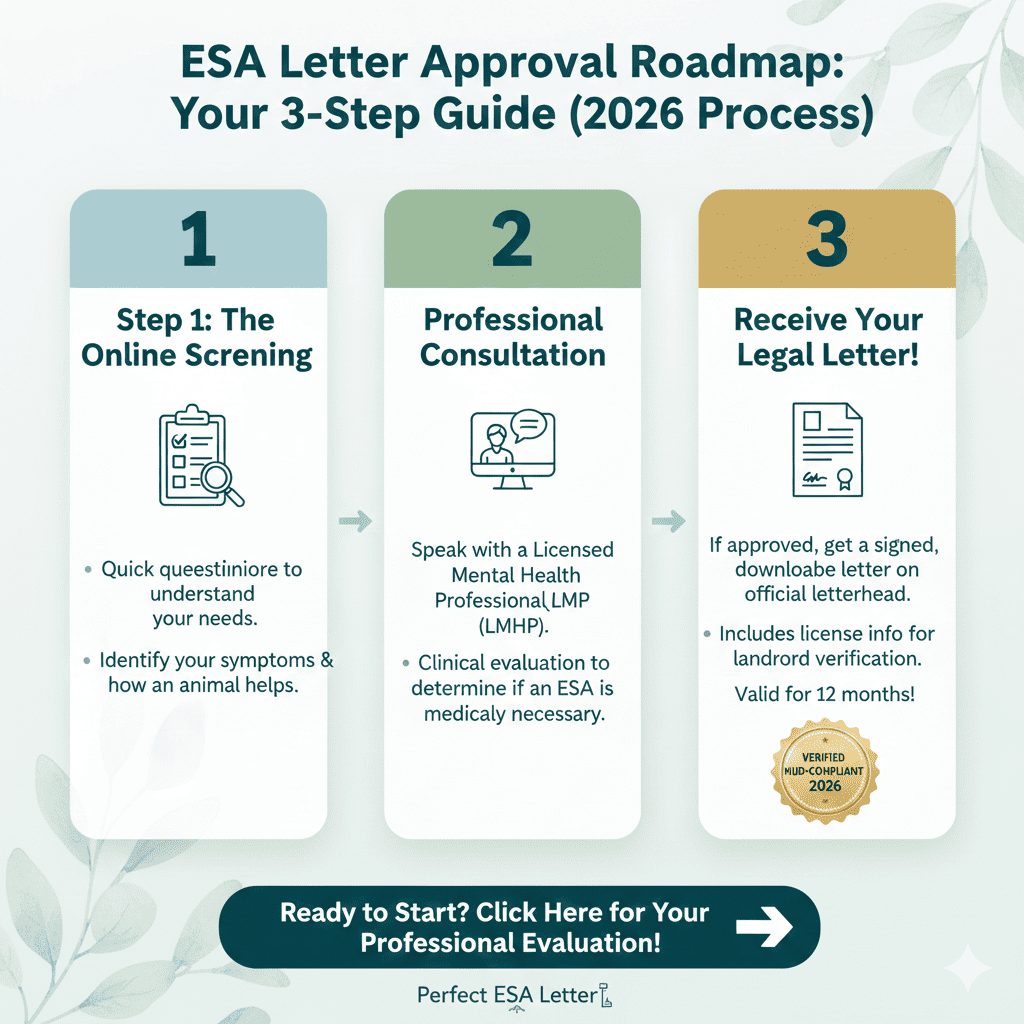
The Step-by-Step Process: How to Get a Legitimate ESA Letter
In 2026, getting a letter involves more than just a 10-minute quiz. Landlords now have the right to verify that your letter comes from a clinician with whom you have a legitimate relationship.
Step 1: The Initial Screening
You start by identifying your symptoms. Do you struggle with social anxiety? Does your animal help you sleep through night terrors? This helps a professional understand your “therapeutic nexus”—the link between your health and your pet.
Step 2: The Professional Evaluation
You must speak with a therapist or doctor licensed in your state. In 2026, telehealth is the most common and legal method for this. During the consultation, the LMHP will evaluate your mental health history and determine if an ESA is an appropriate part of your treatment plan.
Step 3: Receiving Your Documentation
If approved, you receive a letter on the professional’s official letterhead. To be valid, it must include:
-
The clinician’s License Number and state of jurisdiction.
-
The clinician’s Contact Information (for landlord verification).
-
The Date of Issuance (letters should be updated annually).
Protect your housing today—Apply for an ESA letter now
What Landlords Are Legally Allowed to Ask
A major part of knowing how ESA letters work is knowing your privacy rights. Landlords often overstep, and you need to know where to draw the line.
| Landlord CAN Ask For | Landlord CANNOT Ask For |
| A copy of the ESA letter. | Your specific medical diagnosis (e.g., “What kind of PTSD?”). |
| Verification of the doctor’s license. | Your full medical records or history. |
| Proof of vaccinations/city licenses. | A “live demonstration” of the animal’s support. |
| An annual update to the letter. | To interview your therapist directly about your secrets. |
Common Obstacles and How to Overcome Them
Even with a perfect letter, you may encounter “difficult” property managers. Here is how to handle the most common issues in 2026:
-
The “Our Insurance Won’t Allow It” Excuse: Landlords often claim their insurance doesn’t allow certain breeds. Under HUD guidelines, the landlord must provide proof that their insurance would actually be canceled or cost-prohibitive. Usually, they cannot deny you based on this.
-
The “Out-of-State Doctor” Rejection: Some states (like California) have tightened rules requiring a 30-day relationship with a provider. At Perfect ESA Letter, we match you with in-state providers to ensure your letter meets these specific 2026 mandates.
-
The “Online Registry” Trap: If you present a “registration certificate,” your landlord may legally reject it. Always present the Clinical Letter as your primary document.
Internal Linking & Strategic Resources
-
Apply for an ESA letter now for upcoming lease renewals.
Frequently Asked Questions (FAQs)
How do I know if my ESA letter is legitimate?
A legitimate letter must be written by a licensed mental health professional (LCSW, LMFT, Psychologist, or Psychiatrist) licensed in your state. It must be on their professional letterhead and include their license number. If a site offers an “instant” letter without a therapist consultation, it is likely a scam.
Can a landlord charge me a pet deposit if I have an ESA letter?
No. Under the Fair Housing Act, an ESA is not a pet. Charging a deposit or monthly pet rent for an assistance animal is considered housing discrimination.
Does an ESA letter work for flights in 2026?
No. As of 2021, the Department of Transportation (DOT) changed the rules. ESA letters generally no longer work for free air travel. To fly with your animal for free in the cabin, you typically need to qualify for a Psychiatric Service Dog (PSD).
Do I need to tell my landlord I have an ESA before I sign the lease?
You are not legally required to disclose your ESA before signing. You can request a “reasonable accommodation” at any time—before you move in, during your lease, or even if you are facing a “no-pets” violation.
Can I have more than one emotional support animal?
Yes. You can have multiple ESAs if your clinician determines that each animal provides a unique therapeutic benefit. You will need your documentation to specifically state the need for multiple animals.
What states require a 30-day relationship with a therapist?
California is the most prominent state with this requirement (AB 468). Other states are considering similar legislation to prevent “instant” letter abuse. Apply for an ESA letter now to ensure your evaluation follows these specific timelines.
Conclusion: Secure Your Peace of Mind
Understanding how ESA letters work is the first step toward a more stable, stress-free life. Your animal companion is a vital part of your health, and the law is on your side to ensure you stay together. By following the 2026 HUD and FHA guidelines, you can navigate the rental market without the fear of fees or forced separation.
Don’t let an outdated “no-pets” policy dictate your quality of life. Get the professional documentation you need to protect your home.
Ready to start your journey?