
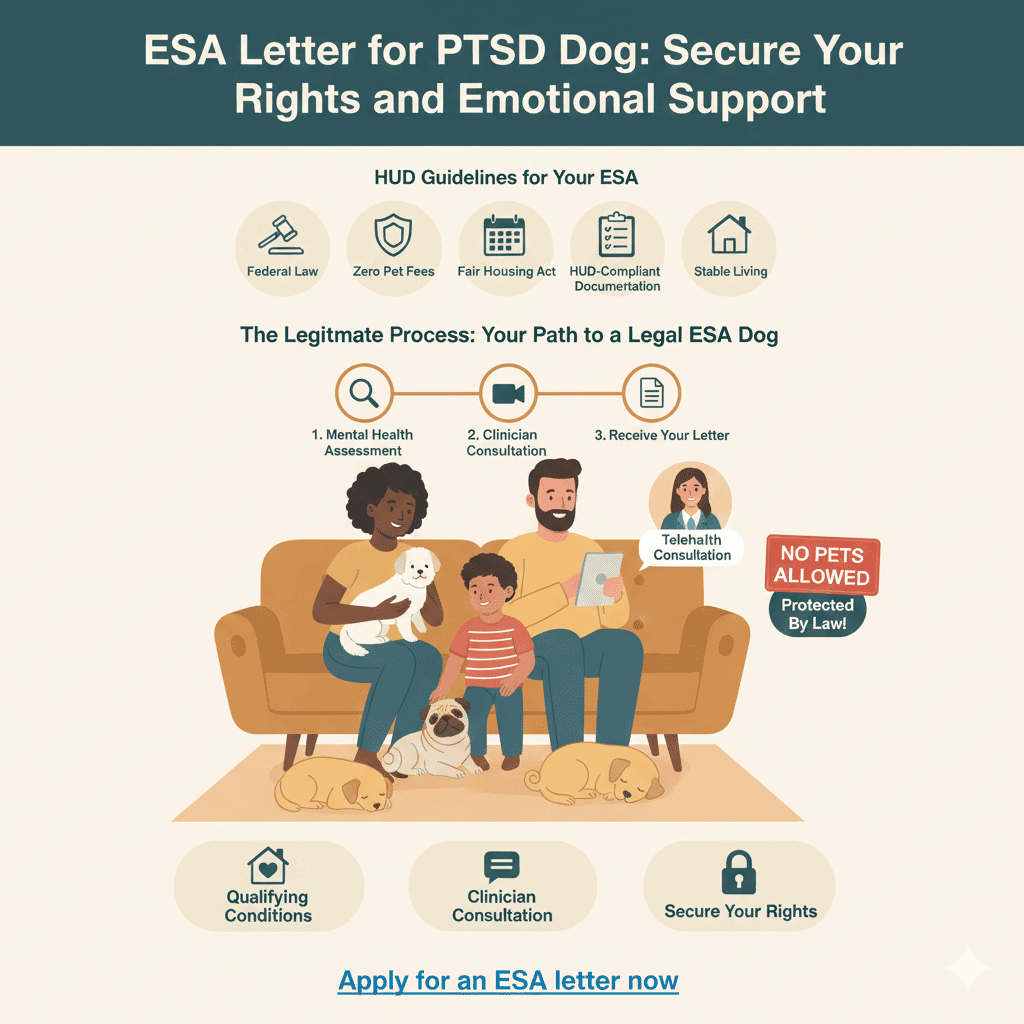
ESA Letter for PTSD Dog: Secure Your Rights and Emotional Support
ESA Letter for PTSD Dog: Secure Your Rights and Emotional Support
For survivors of trauma, the world can often feel like an unpredictable and overwhelming place. Post-Traumatic Stress Disorder (PTSD) brings with it a heavy burden of hypervigilance, flashbacks, and crippling anxiety that can make even the safety of one’s own home feel fragile. For many, a dog is the only anchor that provides true grounding—a constant, non-judgmental presence that offers a sense of security when everything else feels uncertain.
If you rely on your canine companion to manage the symptoms of trauma, an ESA letter for PTSD dog is more than just a document; it is a legal shield. Under the Fair Housing Act (FHA), this letter recognizes your dog as a vital assistance animal, ensuring you can live together without the stress of pet fees or restrictive housing rules. This guide explains how to secure a legitimate letter and the life-changing protections it provides.
Understanding the Role of an ESA for PTSD
An emotional support animal (ESA) provides therapeutic support through companionship. Unlike a service dog, which is trained to perform specific tasks (like tactile grounding or room searches), an ESA helps simply by being there. For a PTSD survivor, the presence of a dog can lower cortisol levels, reduce the frequency of nightmares, and provide the routine necessary to stay connected to the present moment.
How a Dog Alleviates PTSD Symptoms:
-
Hypervigilance Relief: Knowing a dog is alert allows the owner to relax their own “threat-scanning” behaviors.
-
Oxytocin Release: Physical contact with a dog triggers the release of bonding hormones that counteract the physiological effects of trauma.
-
Routine and Stability: The need to feed, walk, and care for a dog provides a healthy structure to days that might otherwise feel chaotic.
-
Emotional Regulation: Dogs can sense the onset of a panic attack and offer a calming presence that prevents a full spiral.
Your Legal Rights: The Fair Housing Act (FHA)
When you have a valid ESA letter for PTSD dog, your canine is legally classified as an “assistance animal” rather than a pet. This status grants you specific, ironclad protections in nearly all housing situations across the United States.
Key Protections Include:
-
Exemption from “No-Pet” Rules: You can live in apartments, condos, and rental homes that otherwise ban animals.
-
Zero Pet Deposits or Rent: Landlords are prohibited from charging you additional security deposits or monthly surcharges for your ESA.
-
Bypass Breed and Weight Limits: Even if a building has a “no large dogs” or “no Pit Bull” policy, these restrictions do not apply to a documented assistance animal.
-
Protection Against Discrimination: A landlord cannot deny your application or evict you solely because you require an ESA for your disability.
| Feature | Standard Pet | ESA for PTSD Dog |
| Housing Status | Discretionary | Mandatory Accommodation |
| Monthly Pet Rent | Often $25–$100 | $0 (Legally Exempt) |
| Breed Restrictions | Applicable | Not Applicable |
| Legal Documentation | None | Clinical ESA Letter |
How to Get a Legitimate ESA Letter for PTSD Dog
To ensure your housing request is accepted, your documentation must be HUD-compliant. This means it must come from a state-licensed mental health professional (LMHP) who has evaluated your condition.
Step 1: Professional Consultation
The process begins with an assessment by a licensed professional—such as a therapist, psychologist, or psychiatrist. Through a secure telehealth platform, you will discuss how PTSD impacts your daily life and how your dog provides essential support.
Step 2: Verification of Disability
The clinician must confirm that you have a qualifying mental health condition under the Diagnostic and Statistical Manual (DSM) and that the animal provides a specific “nexus” (link) to alleviating those symptoms.
Step 3: Issuance of the Letter
If approved, you will receive a signed letter on the clinician’s official letterhead. To be valid, it must include:
-
The professional’s license number and state of licensure.
-
The date of issuance.
-
Their contact information for potential landlord verification.
-
A statement confirming the animal is a necessary accommodation for your disability.
At Perfect ESA Letter, we connect you with licensed professionals who specialize in assistance animal evaluations, ensuring your letter is 100% legal and verifiable.
Avoiding Scams: Identifying Fraudulent Registries
Many websites offer “instant” registrations, ID cards, or vests for your dog. These are not legal documents. HUD does not recognize any “official” registry. If a site promises a letter without a consultation with a licensed doctor, it is a scam. Landlords are legally entitled to reject any documentation that does not meet clinical standards.
Red Flags to Watch For:
-
No Doctor Consultation: If you aren’t evaluated by a human clinician, the letter is invalid.
-
Lifetime Validity: Most landlords require a letter dated within the last 12 months.
-
Instant Downloads: Real clinical evaluations take time to process and verify.
Internal Linking Suggestions
-
Anchor Text: how to qualify for an emotional support animal
-
Anchor Text: Fair Housing Act protections for veterans
-
Anchor Text: difference between service dogs and ESAs
Frequently Asked Questions (FAQs)
1. Is an ESA for PTSD dog the same as a Psychiatric Service Dog (PSD)?
No. A PSD is trained to perform specific tasks (like “blocking” in public or waking an owner from a nightmare) and has public access rights under the ADA. An ESA provides comfort through presence and primarily has housing rights under the FHA.
2. Can my landlord ask about my trauma?
No. Your landlord has the right to see your ESA letter for PTSD dog, but they are legally prohibited from asking for your specific diagnosis, medical records, or the details of your trauma.
3. Does my dog need a vest?
No. Vests and harnesses are not required by law and do not make a dog an ESA. Only the letter from your therapist provides the legal protection you need.
4. Can I have an ESA in a college dorm?
Yes. The Fair Housing Act applies to university-owned housing. Students with a valid ESA letter are entitled to keep their support dog in their dorm room.
5. What if I already have a dog?
You can get an ESA letter for a dog you already own. If the animal provides the support you need for your PTSD, a clinician can evaluate you and issue the documentation for that specific dog.
6. Do ESA letters expire?
While the law doesn’t specify an expiration, most housing providers require a letter that is less than one year old to ensure the clinical need is still current.
7. Can a landlord deny my dog because it barks?
A landlord can only deny an ESA if the specific animal poses a direct threat to the safety of others or causes significant property damage. If a dog is a nuisance (incessant barking), you may be required to address the behavior or face a valid denial.
8. Is a telehealth letter valid?
Yes. HUD recognizes telehealth as a legitimate way to establish a provider-patient relationship, provided the professional is licensed in your state.
Take Control of Your Healing and Your Home
Living with PTSD is a journey of reclaiming your life, and your dog is an essential partner in that process. You should never have to face the anxiety of a “no-pets” rule or the financial burden of pet rent when your animal is a medical necessity. A legitimate ESA letter for PTSD dog provides the legal foundation you need to live with your best friend, free from discrimination and extra fees.
At Perfect ESA Letter, we are dedicated to helping survivors secure their housing rights with compassion and clinical integrity. Our process is simple, secure, and fully compliant with federal law, giving you the peace of mind you deserve.