
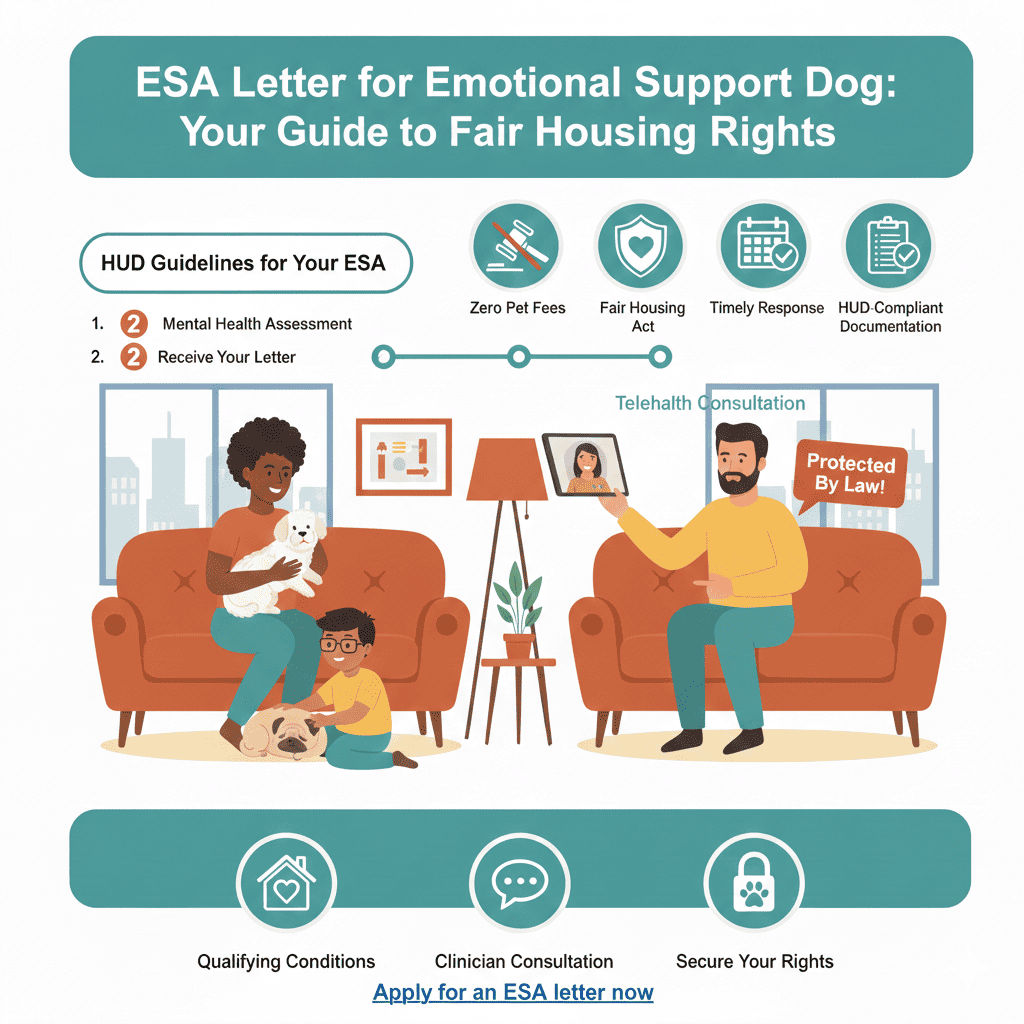
ESA Letter for Emotional Support Dog: Your Guide to Fair Housing Rights
ESA Letter for Emotional Support Dog: Your Guide to Fair Housing Rights
Navigating the rental market can be a daunting experience, especially when you have a four-legged companion who provides more than just friendship. For many individuals, a dog is a vital component of their mental health treatment, offering a stabilizing presence during times of distress. If you find yourself facing restrictive “no-pet” policies or expensive pet rents, obtaining an ESA letter for emotional support dog is the most effective legal step you can take to protect your living situation.
The Fair Housing Act (FHA) recognizes that emotional support animals are not pets, but essential assistance animals. However, to exercise your rights, you must provide your landlord with a valid recommendation from a licensed healthcare professional. In this comprehensive guide, we will walk you through the process of securing a legitimate letter, the legal protections you’re entitled to, and how to ensure your documentation is fully HUD-compliant.
What is a Legitimate ESA Letter for Emotional Support Dog?
A legitimate ESA letter for emotional support dog is a formal document issued by a licensed mental health professional (LMHP). This includes therapists, psychologists, psychiatrists, and clinical social workers. The letter serves as a “prescription” that verifies your need for an animal to help alleviate symptoms of a mental or emotional disability.
It is important to distinguish between a legal clinician-backed letter and the “registries” or “certificates” often found online. Federal agencies like the Department of Housing and Urban Development (HUD) do not recognize ID tags, vests, or registry entries. Only a signed letter from a professional licensed in your state carries the weight needed to override standard pet rules.
Why You Need This Documentation
-
Financial Protection: Avoid paying hundreds of dollars in pet deposits and monthly pet fees.
-
Housing Security: Live in apartments or condos that traditionally ban dogs.
-
Peace of Mind: Ensure you are never forced to choose between your home and your support system.
-
Legal Shield: Protect yourself against unfair eviction or discrimination based on your need for an assistance animal.
How to Get an ESA Letter for Emotional Support Dog
The process of obtaining an ESA letter for emotional support dog has become significantly more accessible through telehealth, provided you follow a clinical path. Here is the blueprint for a successful application:
Step 1: Professional Mental Health Assessment
The journey begins with an evaluation of your mental health. You will discuss your history and current symptoms—such as anxiety, depression, or PTSD—with a licensed professional. They will determine if your condition meets the criteria for a disability under the FHA and if a dog provides a specific therapeutic benefit.
Step 2: Confirmation of the “Nexus”
For a letter to be valid, the clinician must establish a “nexus” or connection. This means they must state how the dog’s presence specifically mitigates one or more symptoms of your condition. For example, a dog might provide grounding during panic attacks or offer the routine necessary to combat depression.
Step 3: Issuance of the Official Letter
Once approved, the clinician writes the letter on their official letterhead. A valid ESA letter for emotional support dog must contain:
-
The clinician’s license type and number.
-
The state of their licensure.
-
Their contact information.
-
A clear statement of your need for the assistance animal.
Rights and Protections Under the Fair Housing Act
Once you possess a valid ESA letter for emotional support dog, you are protected by federal civil rights laws. These laws apply to almost all types of housing, including those that claim a “no-pets” policy.
Key Tenant Benefits
| Benefit | Description |
| No Pet Rent | Landlords cannot charge monthly fees for an assistance animal. |
| No Pet Deposit | You are exempt from paying upfront “pet security” fees. |
| No Breed Bans | Breed and weight restrictions (e.g., against Pit Bulls or large dogs) do not apply to ESAs. |
| Reasonable Accommodation | Landlords must make an exception to their rules to accommodate your needs. |
Avoiding Scams: How to Spot a “Letter Mill”
As you search for an ESA letter for emotional support dog, you will encounter many websites promising instant results. Be wary of the following red flags:
-
“Instant” Approval: Legitimate letters require a review by a real clinician.
-
Registration Schemes: There is no official federal registry for ESAs. If a site sells a “registration number,” it is likely a scam.
-
No Clinician Contact: If you don’t speak with a licensed professional, the letter is fraudulent.
-
Lifetime Validity: Most landlords require a letter dated within the last 12 months.
At Perfect ESA Letter, we ensure 100% compliance with HUD guidelines by connecting you with state-licensed professionals for real evaluations.
Frequently Asked Questions (FAQs)
1. Can a landlord deny my ESA letter for emotional support dog?
A landlord can only deny an ESA if the specific animal poses a direct threat to the health and safety of others or would cause “undue financial burden” to the property. They cannot deny it based on breed, size, or a general “no-pets” rule.
2. Is a letter from an online doctor legal?
Yes. HUD explicitly states that documentation from a licensed healthcare professional provided via telehealth is a reliable source of information, provided the clinician is licensed in the patient’s state.
3. Do I need to buy a vest or ID tag for my dog?
No. Under the law, vests and ID tags are not required and do not prove that an animal is an ESA. The only document that provides legal protection is your signed ESA letter for emotional support dog.
4. What conditions qualify for an ESA?
A wide range of conditions qualify, including Generalized Anxiety Disorder (GAD), Depression, PTSD, Panic Disorder, Bipolar Disorder, and social phobias. If the condition limits a major life activity, you may qualify.
5. Can I have more than one emotional support dog?
Yes. If you have a clinical need for more than one animal, a clinician can provide a letter justifying multiple ESAs. You must be able to explain how each animal provides unique support.
6. Do I have to tell my landlord I have an ESA before I sign the lease?
You are not legally required to disclose your ESA during the application process. Many tenants wait until after approval to avoid potential (though illegal) discrimination.
7. Does the letter have to name my specific dog?
While not strictly required by the FHA, it is standard practice for a clinician to mention the type of animal to ensure there is no confusion with the landlord.
8. What if my landlord asks for my medical records?
Your landlord is not entitled to your medical records or a detailed history of your diagnosis. They are only entitled to the information provided in the ESA letter.
Secure Your Peace of Mind and Your Housing Rights
The bond you share with your dog is a vital part of your mental health journey. You should never have to face the stress of choosing between your home and your source of comfort. By obtaining a legitimate ESA letter for emotional support dog, you gain the legal protection necessary to bypass restrictive pet rules and eliminate unnecessary fees.
At Perfect ESA Letter, we specialize in connecting individuals with compassionate, state-licensed professionals who understand the nuances of the FHA. Our process is designed to be discreet, efficient, and—most importantly—legally sound. Take the first step toward a more secure and supportive living environment today.