
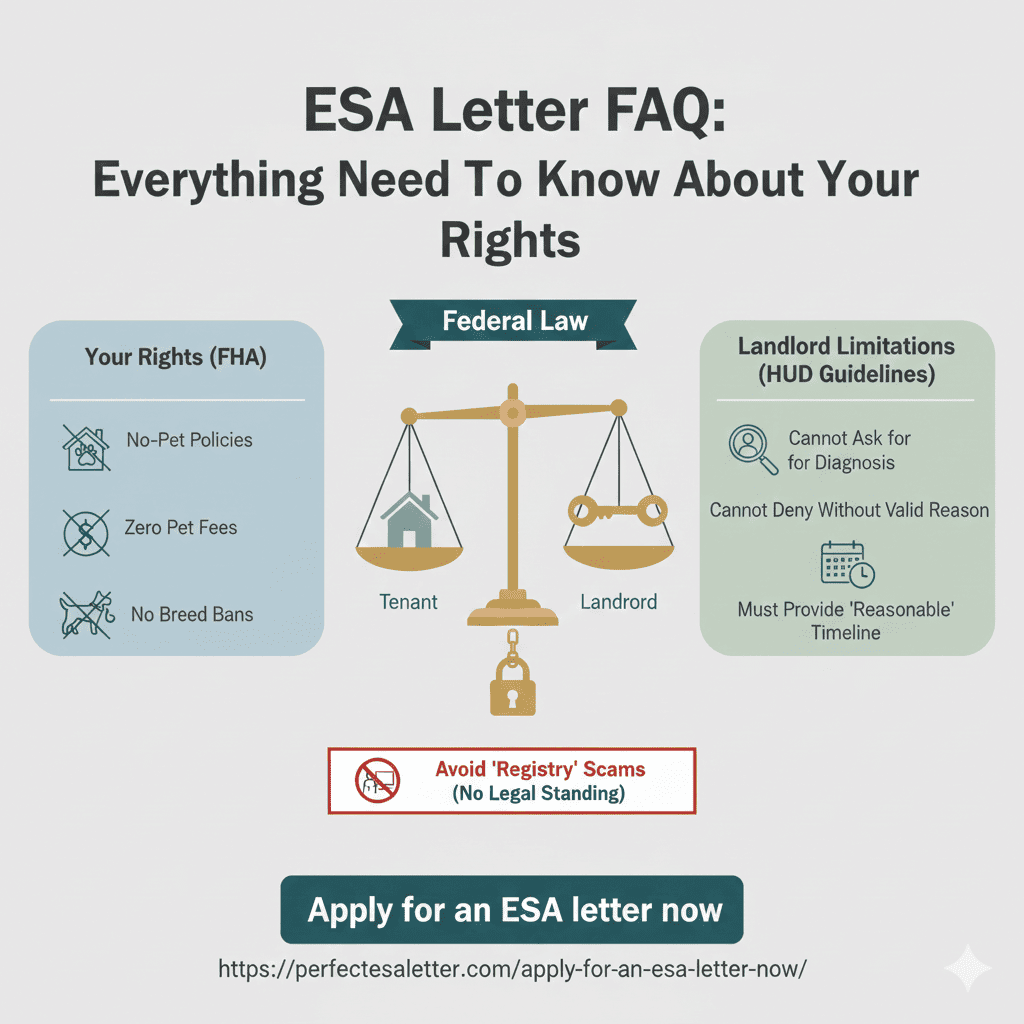
ESA Letter FAQ: Everything You Need to Know About Your Rights
ESA Letter FAQ: Everything You Need to Know About Your Rights
If you are a renter living with a mental health condition, your animal companion is likely more than just a pet—they are a vital source of emotional stability. However, the world of “assistance animals” is filled with confusing terminology, aggressive landlord requests, and online scams. To help you navigate these waters, we have compiled the ultimate ESA letter FAQ.
This guide is designed to empower you with the facts about the Fair Housing Act (FHA) and the Department of Housing and Urban Development (HUD) guidelines. Whether you are wondering if you can bypass a “no-pets” policy or if you truly need to pay that monthly pet rent, the answers below will help you protect your rights and your peace of mind.
The Basics: What is an ESA Letter?
An Emotional Support Animal (ESA) letter is a legal document written by a Licensed Mental Health Professional (LMHP). It confirms that you have a mental or emotional disability and that your animal provides a therapeutic benefit that alleviates one or more symptoms of that condition.
Why You Need a Legitimate Letter
Under federal law, specifically the Fair Housing Act, an ESA is classified as an assistance animal, not a pet. To claim this legal status, you must provide your housing provider with a valid letter. Without this documentation, a landlord is under no legal obligation to waive pet fees or allow your animal in a pet-free building.
Top ESA Letter FAQ for Renters
Understanding your rights is the first step toward a stress-free living situation. Here are the most critical questions every tenant should know.
1. Can a landlord deny my ESA because of a “no-pets” policy?
No. One of the primary protections of the FHA is that assistance animals are exempt from standard “no-pets” rules. As long as you provide a legitimate letter, the landlord must provide “reasonable accommodation” for your animal.
2. Do I have to pay pet rent or pet deposits for my ESA?
No. Because an ESA is not a pet, they are exempt from all pet-related financial obligations. This includes:
-
Monthly pet rent.
-
Upfront pet deposits.
-
One-time pet fees.
-
Liability insurance premiums specifically for pets.
3. Can my landlord place breed or weight restrictions on my ESA?
No. Federal guidelines state that assistance animals cannot be restricted based on their breed, size, or weight. Even if a building has a ban on “aggressive breeds” like Pitbulls or a 25-pound weight limit, those rules do not apply to documented emotional support animals.
ESA vs. Service Animal: A Quick Comparison
It is common to confuse these two categories, but the legal requirements for each are different.
| Feature | Emotional Support Animal (ESA) | Service Animal |
| Species Allowed | Any common household animal | Dogs (and miniature horses) |
| Training Required | No specialized training | Must be task-trained |
| Primary Protection | Housing (FHA) | Public Access (ADA) & Housing |
| Documentation | ESA Letter (Required) | No letter required for public access |
| Pet Fee Waiver | Yes | Yes |
Internal Linking Suggestions
-
Anchor Text: how to qualify for an emotional support animal
-
Anchor Text: Fair Housing Act requirements for landlords
-
Anchor Text: legitimate ESA letter vs. registry scams
Detailed ESA Letter FAQ
1. Who is qualified to write an ESA letter?
A valid letter must come from a Licensed Mental Health Professional (LMHP) currently in practice. This includes:
-
Psychologists and Psychiatrists.
-
Licensed Clinical Social Workers (LCSW).
-
Licensed Professional Counselors (LPC).
-
Licensed Marriage and Family Therapists (LMFT).
-
Licensed Mental Health Counselors (LMHC).
-
In some cases, your primary care physician or a nurse practitioner.
2. Can I get a legitimate ESA letter online?
Yes, but you must be careful. A legitimate online service will connect you for a live consultation (via phone or video) with a clinician licensed in your state. HUD explicitly warns against websites that sell “instant” certificates or “registration” without a professional evaluation.
3. Does my ESA letter expire?
While the FHA does not explicitly state that letters expire, most housing providers request an updated letter every 12 months. Keeping your documentation current ensures that your “reasonable accommodation” request remains valid in the eyes of property management.
4. Can a landlord call my therapist?
A landlord has the right to verify that the letter is authentic and that the clinician is indeed licensed. However, they cannot ask for your specific diagnosis, medical records, or details about your treatment. Your privacy is protected by HIPAA and HUD regulations.
5. Can I have more than one emotional support animal?
Yes, it is possible to have multiple ESAs. However, your clinician must provide a justification for each animal, explaining how each one serves a different therapeutic purpose for your condition.
6. Can a landlord deny my request if they think the animal is “dangerous”?
A landlord can only deny an ESA if there is objective evidence that the specific animal poses a direct threat to the safety of others or would cause substantial physical damage to the property. They cannot deny an animal based on a “fear” of a certain breed.
7. Am I responsible for damages caused by my ESA?
Yes. While you do not have to pay pet deposits or rent, you are still financially responsible for any damage your animal causes to the apartment (such as stained carpets or chewed baseboards). Landlords can deduct these costs from your standard security deposit upon move-out.
8. Does an ESA letter work for air travel?
As of recent changes to the Air Carrier Access Act (ACAA), airlines are no longer required to recognize ESAs. Most airlines now treat ESAs as standard pets. If you need your dog to fly in the cabin for free, you must qualify for a Psychiatric Service Dog (PSD), which requires task training.
Signs of a Fake ESA Service to Avoid
As you research the answers to your ESA letter FAQ, be on the lookout for these red flags:
-
“Instant” Approval: Legit letters require a clinical review and consultation.
-
Registry/ID Cards: HUD does not recognize “registries.” A certificate is not a letter.
-
Unusually Low Prices: Professional clinicians charge for their time and expertise; “budget” sites often use fake license numbers.
-
No State-Specific Match: Your provider must be licensed in the state where you live.
Protect Your Housing Rights Today
The bond between you and your animal is a cornerstone of your mental health. You shouldn’t have to choose between a roof over your head and the companion that helps you get through the day. By following this ESA letter FAQ, you now have the knowledge to stand up to unfair housing practices and secure the legal protections you deserve.
At Perfect ESA Letter, we specialize in connecting you with the right professionals to ensure your documentation is 100% HUD-compliant and legally defensible. Don’t let a “no-pets” policy or expensive pet fees stand in your way. Take the first step toward a more secure, animal-friendly home.