
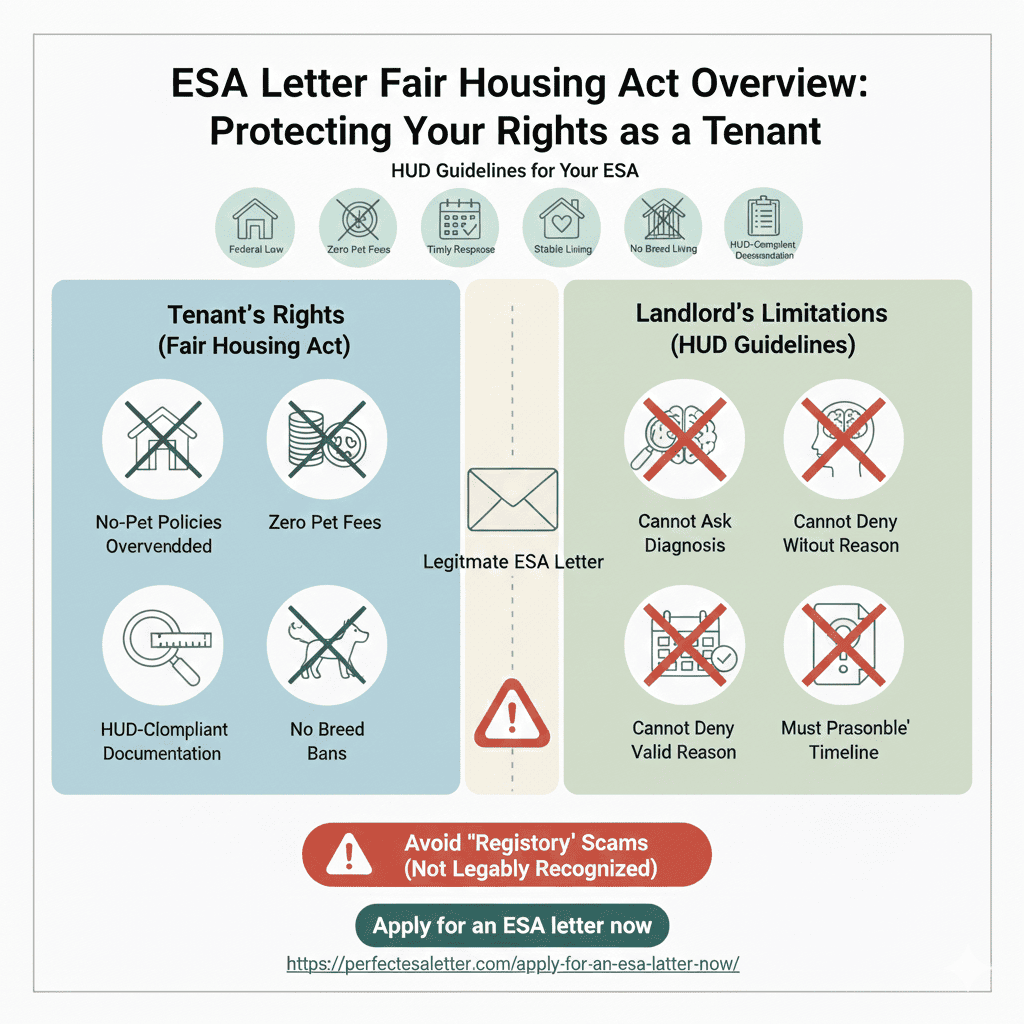
ESA Letter Fair Housing Act Overview: Protecting Your Rights as a Tenant
ESA Letter Fair Housing Act Overview: Protecting Your Rights as a Tenant
For many people, an emotional support animal (ESA) is more than just a companion; they are a vital part of a mental health treatment plan. However, the path to living peacefully with your animal often involves navigating complex legal terrain. If you have ever worried about being denied housing or forced to pay exorbitant pet fees, understanding the ESA letter Fair Housing Act overview is the first step toward securing your peace of mind.
The Fair Housing Act (FHA) is a federal law that prohibits discrimination in housing. While many people think of this law in terms of race or religion, it also provides robust protections for individuals with disabilities—including those who require the support of an assistance animal. This guide breaks down the legal framework of the FHA and how it applies to your emotional support animal.
What is the Fair Housing Act?
The Fair Housing Act was established to ensure that everyone has an equal opportunity to enjoy their home without facing unfair barriers. Under this act, housing providers are required to make “reasonable accommodations” for people with disabilities. In the context of emotional support animals, a reasonable accommodation usually means waiving a “no-pets” policy or ignoring pet-related fees.
ESAs vs. Pets: The Legal Distinction
A critical part of any ESA letter Fair Housing Act overview is understanding that federal law does not view an ESA as a pet. Instead, an ESA is classified as an “assistance animal.” This distinction is what allows you to bypass standard apartment rules. Because the animal is considered a medical necessity rather than a luxury, the laws that apply to pets do not apply to your ESA.
Your Rights Under the Fair Housing Act
When you have a valid ESA letter, the FHA grants you several powerful protections. These laws apply to most types of housing, including private rentals, apartments, condos, and even university dorms.
1. Exemption from “No-Pet” Policies
If a landlord has a policy that prohibits animals, they must make an exception for your emotional support animal. You cannot be evicted or denied an application simply because you have a documented need for your ESA.
2. Waiver of Pet Rent and Deposits
Because federal law classifies ESAs as assistance animals, landlords are legally prohibited from charging:
-
Monthly Pet Rent: You are exempt from the typical $25–$100 monthly surcharge.
-
Upfront Pet Deposits: You do not have to pay a special “pet security deposit” to have your animal in the home.
-
Non-refundable Pet Fees: Any “pet admission fee” is waived under the FHA.
3. Protection from Breed and Weight Bans
Many housing complexes have “aggressive breed” lists or strict weight limits (e.g., only dogs under 30 lbs). Under the FHA, these restrictions generally do not apply to assistance animals. A landlord cannot deny your ESA based on its breed or size unless they can prove the specific animal poses a direct threat.
The Role of the HUD Guidelines
The Department of Housing and Urban Development (HUD) is the federal agency that enforces the FHA. HUD has released specific guidelines (Notice FHEO-2020-01) that explain exactly what a landlord can ask for when you request an accommodation for an ESA.
What Documentation is Required?
If your disability is not “readily apparent” (which is the case for most mental health conditions), the landlord is entitled to ask for reliable documentation. This is where your ESA letter comes in. A valid letter must:
-
Be written by a Licensed Mental Health Professional (LMHP).
-
Include the professional’s license number and state of licensure.
-
Confirm that you meet the definition of a person with a disability under the FHA.
-
Explain how the animal alleviates symptoms of your condition.
At Perfect ESA Letter, we focus on providing letters that meet every HUD requirement, ensuring that your documentation is legally defensible and professionally prepared.
Common Landlord Objections and the Law
Even with an ESA letter Fair Housing Act overview in hand, some landlords may try to push back. Here is the legal reality regarding common objections:
| Landlord Objection | The Legal Reality |
| “I only accept service dogs.” | The FHA covers both trained service dogs and untrained ESAs. |
| “You need to pay a registration fee.” | There is no “official” registration; charging a fee for an ESA is illegal. |
| “Your doctor is in another state.” | HUD allows telehealth as long as the provider is licensed in your state. |
| “I need to see your medical records.” | Landlords are prohibited from asking for your private diagnosis or history. |
Internal Linking Suggestions
-
Anchor Text: how to qualify for an emotional support animal
-
Anchor Text: HUD guidelines for emotional support animals
-
Anchor Text: difference between service animals and ESAs
Frequently Asked Questions (FAQs)
1. Does every landlord have to follow the Fair Housing Act?
Most do, but there are minor exceptions. The FHA generally does not apply to:
-
Owner-occupied buildings with four or fewer units (the “Mrs. Murphy” exemption).
-
Single-family homes sold or rented by the owner without a broker (under specific conditions).
-
Housing operated by religious organizations or private clubs that limit occupancy to members.
2. Can a landlord deny my ESA if they have a “No-Pet” rule?
No. A “no-pets” rule is exactly the type of policy that must be modified as a “reasonable accommodation” under the FHA. As long as you have a valid letter, the landlord must allow the animal.
3. Do I need to tell my landlord about my ESA before signing the lease?
You are not legally required to disclose your ESA during the application process. You can request a reasonable accommodation at any time—before moving in, during your lease, or even after a landlord sends a “notice to quit” for a pet violation.
4. Can a landlord require my animal to be trained?
No. Unlike service animals, which must be task-trained, emotional support animals do not require any specialized training. Their role is to provide comfort through their presence.
5. What if my landlord asks for a “certificate” or “registration”?
You should inform them that under HUD guidelines, registration and certificates are not required and have no legal standing. The only document required is a letter from a licensed healthcare professional.
6. Can I have more than one ESA under the Fair Housing Act?
Yes. You can have multiple assistance animals, but your clinician must document the specific need for each animal and how they each help manage your symptoms.
7. Am I responsible for damages caused by my ESA?
Yes. While you don’t pay pet fees, you are still liable for any actual damage the animal causes. The landlord can deduct repair costs from your standard security deposit when you move out.
8. Can a landlord deny an ESA based on an insurance policy?
Generally, no. A landlord cannot deny an ESA simply because their insurance agent says so. They would have to prove that allowing the animal would cause a “fundamental alteration” or “undue financial burden,” which is a very high legal bar to clear.
Take Control of Your Housing Rights
Understanding the ESA letter Fair Housing Act overview gives you the tools to stand up for yourself and your animal. You shouldn’t have to face the threat of eviction or pay hundreds of dollars in illegal fees just to keep the companion that helps you stay healthy. The law is on your side, and having the right documentation is the key to unlocking those protections.
At Perfect ESA Letter, we make the process simple and legally secure. We connect you with state-licensed mental health professionals who specialize in FHA-compliant documentation. Don’t let a misinformed landlord or a “no-pets” policy jeopardize your well-being. Get a letter that works and live with the support you deserve.