
ESA Letter Documentation Required: Your Complete Guide to Housing Approval
ESA Letter Documentation Required: Your Complete Guide to Housing Approval
Moving into a new apartment or navigating “no-pet” housing can be an overwhelming experience for emotional support animal (ESA) owners. While federal laws like the Fair Housing Act (FHA) offer strong protections, they also place the burden of proof on the tenant. To successfully secure a reasonable accommodation, you must present the specific ESA letter documentation required by the Department of Housing and Urban Development (HUD).
Many renters mistakenly believe that a simple vest, an ID card, or an online “registration” certificate is enough to satisfy a landlord. In reality, none of these items carry legal weight. A landlord or property manager is only legally obligated to waive pet fees and bypass breed restrictions when presented with a legitimate, clinician-signed ESA letter. In this guide, we break down exactly what documentation you need, the legal standards it must meet, and how to ensure your request is never denied.
The Core ESA Letter Documentation Required for Housing
Under the FHA, an emotional support animal is not a pet; it is an assistance animal. However, because the need for an ESA is often related to a “non-observable” disability (like anxiety, depression, or PTSD), housing providers are entitled to request reliable documentation.
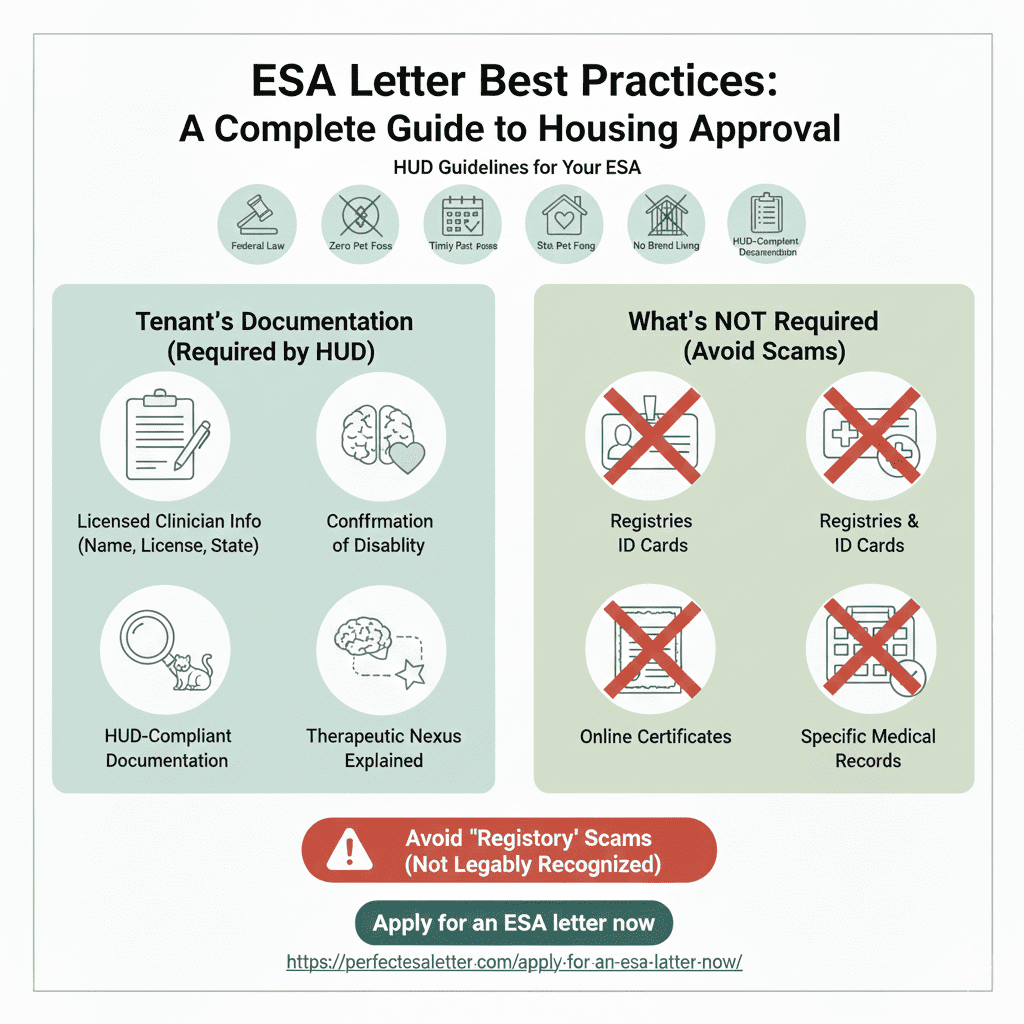
According to HUD guidelines, a valid ESA letter must contain the following specific elements:
1. Professional Letterhead and Contact Info
The letter must be written on the official letterhead of a Licensed Mental Health Professional (LMHP). This letterhead should clearly display the practice’s name, physical address, and a direct phone number. If a landlord cannot easily verify the source of the letter, they may legally delay or deny the request.
2. Clinician’s License Information
This is arguably the most critical part of the ESA letter documentation required. The document must include:
-
The clinician’s full name and professional title (e.g., LCSW, LMFT, Psychologist).
-
Their specific license number.
-
The state in which they are licensed (which must typically be the same state where the tenant resides).
3. Confirmation of a Disability-Related Need
The letter must state that the individual has a physical or mental impairment that substantially limits one or more major life activities. Crucially, the clinician does not need to disclose your specific diagnosis. They simply need to confirm that you meet the legal definition of having a disability under the FHA.
4. The “Therapeutic Nexus”
A compliant letter must explain the “nexus”—the connection between your condition and the animal. The professional must state that the animal provides emotional support or performs a function that alleviates at least one symptom of your disability.
What Documentation is NOT Required (and Why It Matters)
Understanding what you don’t need is just as important as knowing the ESA letter documentation required. Presenting unnecessary items can actually raise “red flags” with savvy landlords.
| Item | Is it Required? | The Legal Reality |
| ESA Registration | No | There is no official government registry for ESAs. |
| ID Cards & Certificates | No | HUD explicitly states these “certificates” are not reliable documentation. |
| Vests & Harnesses | No | ESAs are not required to wear identifying gear. |
| Training Certificates | No | Unlike service dogs, ESAs do not require specialized training. |
| Medical Records | No | Landlords are prohibited from asking for your private medical records. |
At Perfect ESA Letter, we focus on providing exactly what the law requires—a clinician-signed letter—without the fluff of meaningless “registries.”
Legal Standards: Licensed Professionals vs. Online Scams
The HUD 2020-01 guidance made it clear: documentation from the internet is not always sufficient. To be considered “reliable,” the professional writing your letter must have “personal knowledge” of your condition.
-
Legitimate Services: Use telehealth to connect you with a professional licensed in your state for a one-on-one consultation.
-
Scam Services: Sell “instant” letters based on an automated quiz with no clinical interaction.
To meet the ESA letter documentation required by modern property managers, your clinician should be a treating professional. This includes psychologists, psychiatrists, clinical social workers, and in some cases, primary care physicians or nurse practitioners.
How Landlords Verify Your Documentation
When you submit your request, a landlord has the right to verify the legitimacy of your letter. Knowing their process helps you prepare.
-
License Check: They will look up the clinician’s license number on the state’s professional licensing board website.
-
Verification Call: They may call the provider to confirm they actually wrote the letter.
-
Authenticity Review: They will check that the letterhead and signature appear genuine.
Internal Linking Suggestions
-
Anchor Text: how to qualify for an emotional support animal
-
Anchor Text: Fair Housing Act requirements for assistance animals
-
Anchor Text: ESA letter vs. Psychiatric Service Dog letter
Frequently Asked Questions (FAQs)
1. Does the documentation need to specify the breed of my animal?
Generally, no. An ESA letter is for the individual, not a specific pet. However, if you have a “unique” animal (anything other than a dog, cat, small bird, rabbit, or common rodent), HUD requires additional documentation explaining why that specific animal is necessary.
2. Can a landlord require me to use their own form?
No. HUD rules state that housing providers cannot require a healthcare professional to use a specific form, provide notarized statements, or sign documents under penalty of perjury. A standard letter on professional letterhead is sufficient.
3. Is a digital signature acceptable?
Yes. In the era of telehealth, digital signatures are legally binding and accepted by the vast majority of housing providers and courts.
4. What if my clinician is licensed in a different state?
One of the key ESA letter documentation required standards is that the clinician should be licensed in the state where you reside. If you are moving to a new state, it is a best practice to get an updated letter from a professional licensed in that state.
5. How long is an ESA letter valid?
While the FHA doesn’t set an expiration date, it is widely recommended to renew your letter every year. Landlords typically view documentation as “current” if it was issued within the last 12 months.
6. Can a landlord charge a fee to process my ESA letter?
No. Charging a “processing fee” for a reasonable accommodation request is considered a form of discrimination and is strictly prohibited under federal law.
7. Does the letter need to disclose my specific diagnosis?
No. Your medical privacy is protected. The letter only needs to state that you have a mental health disability as defined by the FHA. It should not mention specific conditions like “Bipolar Disorder” or “Major Depressive Disorder.”
8. What happens if my landlord denies my legitimate documentation?
If you have provided a letter that meets all the ESA letter documentation required criteria and are still denied, you can file a formal complaint with the HUD Office of Fair Housing and Equal Opportunity (FHEO).
Get the Correct Documentation Today
Securing your housing shouldn’t be a source of stress. Your emotional support animal is a vital part of your well-being, and having the right paperwork is the only way to ensure they are protected. Don’t risk your home on “instant” certificates or “registry” websites that landlords are trained to reject.
At Perfect ESA Letter, we specialize in providing 100% HUD-compliant documentation. We match you with state-licensed mental health professionals for a genuine telehealth evaluation, ensuring your letter contains every legal component necessary for approval. Protect your rights, save on pet fees, and live in peace with your animal companion.