
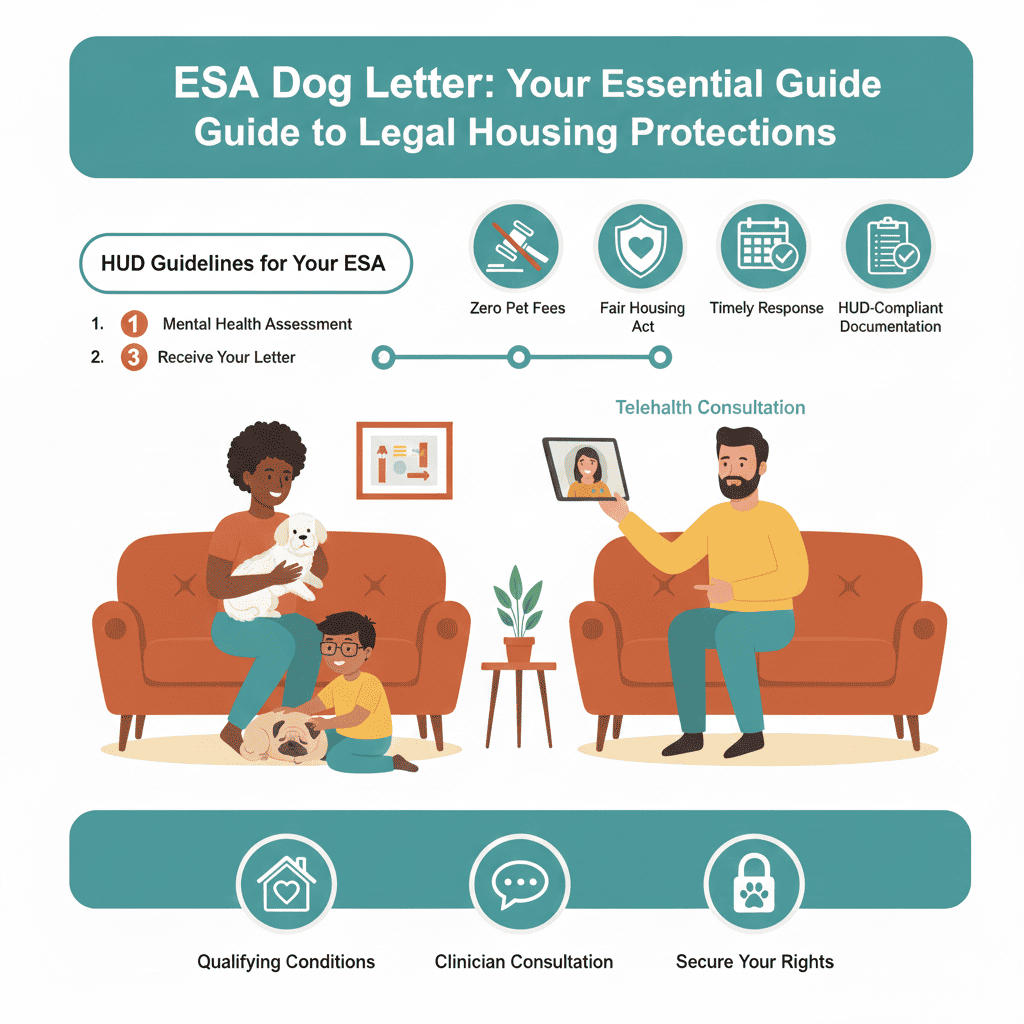
ESA Dog Letter: Your Essential Guide to Legal Housing Protections
ESA Dog Letter: Your Essential Guide to Legal Housing Protections
Finding a home that welcomes both you and your canine companion can be one of the most stressful parts of renting. For many, a dog is not just a pet—it is a vital source of emotional stability that helps manage conditions like anxiety, depression, or PTSD. If you rely on your dog for mental health support, an ESA dog letter is the legal key that unlocks your housing rights under the Fair Housing Act (FHA).
But in an era of “instant” online certificates and confusing registries, how do you know your documentation is actually valid? A legitimate ESA letter is more than just a piece of paper; it is a clinical recommendation that protects you from housing discrimination and saves you thousands in pet-related costs. In this comprehensive guide, we’ll break down exactly how to get a valid letter, what laws protect you, and how to spot common scams.
What is an ESA Dog Letter?
An ESA dog letter is a formal document issued by a state-licensed mental health professional (LMHP). It serves as medical verification that you have a mental or emotional disability and that your dog provides specific support that alleviates its symptoms.
Unlike service dogs, emotional support dogs do not require specialized training to perform tasks. Their “work” is their presence. However, to be legally recognized, the animal must be “prescribed” by a clinician who has evaluated your mental health.
Key Benefits of a Legitimate ESA Letter:
-
Exemption from “No-Pet” Policies: You can live in apartments, condos, and houses that otherwise ban dogs.
-
Zero Pet Deposits: Landlords cannot charge you an upfront fee to have your ESA.
-
No Monthly Pet Rent: You are exempt from the $25–$100 monthly surcharges many buildings impose.
-
Bypass Breed and Weight Limits: Even if a building has a “no large dogs” or “no Pit Bulls” policy, those rules do not apply to a documented ESA.
Qualifying Conditions for an ESA Dog Letter
To qualify for an ESA dog letter, an individual must have a diagnosable mental or emotional impairment that substantially limits one or more major life activities (such as sleeping, working, or social interaction).
Common conditions that clinicians evaluate for include:
-
Anxiety Disorders: Helping to lower heart rates and ground the owner during panic attacks.
-
Depression: Providing a sense of purpose and routine that combats social isolation.
-
Post-Traumatic Stress Disorder (PTSD): Offering a sense of safety and reducing hyper-vigilance.
-
Panic Disorder: Providing immediate tactile comfort during an episode.
-
Bipolar Disorder: Assisting with emotional regulation through consistent companionship.
-
Chronic Stress: Lowering cortisol levels through daily interaction and play.
How to Get a Legitimate ESA Dog Letter Online
The Department of Housing and Urban Development (HUD) recognizes that telehealth is a valid way to establish a clinician-patient relationship. Here is the legal 3-step process to securing your letter:
Step 1: Complete a Mental Health Assessment
The process starts with a secure intake form where you describe your symptoms and how your dog assists you. This information helps the clinician prepare for your evaluation.
Step 2: Live Consultation with a Licensed Professional
You must speak with a professional licensed in your state (e.g., a therapist, psychologist, or psychiatrist). During this ESA dog letter evaluation, they will determine if you meet the FHA criteria for a disability.
Step 3: Receive Your HUD-Compliant Letter
If approved, the clinician will issue a letter on their official letterhead. To be valid, the letter must include:
-
The professional’s license type and number.
-
The state of their licensure.
-
Their contact information for landlord verification.
-
A statement of your disability-related need for the animal.
Warning: Avoiding “Instant” ESA Scams
As you search for an ESA dog letter, you will see many sites promising “instant approval” or “official registration.” Be careful. | Red Flag | Why It’s a Scam |
| :— | :— |
| Instant Download | A letter is only legal if a real clinician reviews your case. |
| Registration/ID Cards | There is no such thing as a “federal ESA registry.” These items have no legal standing. |
| No Clinician Contact | If you don’t speak with a doctor, the letter is fraudulent and will likely be rejected. |
| Lifetime Validity | Most landlords require a letter dated within the last 12 months. |
At Perfect ESA Letter, we ensure every letter is backed by a one-on-one clinical evaluation with a state-licensed professional, making it 100% HUD-compliant.
Your Rights vs. Your Landlord’s Rights
While an ESA dog letter provides strong protections, it is important to understand the balance of rights between you and your housing provider.
Your Rights:
-
You do not have to disclose your ESA until after you sign the lease.
-
You do not have to provide your medical records or a detailed diagnosis.
-
You can have more than one ESA if a clinician confirms the need for multiple animals.
The Landlord’s Rights:
-
They can verify the clinician’s license is active.
-
They can deny an animal that has a history of aggression or causes significant property damage.
-
They can require that the animal follows basic building rules (e.g., being leashed in common areas).
Internal Linking Suggestions
-
Anchor Text: how to qualify for an emotional support animal
-
Anchor Text: Fair Housing Act for ESA owners
-
Anchor Text: difference between service dogs and ESAs
Frequently Asked Questions (FAQs)
1. Is an ESA dog letter the same as a service dog certification?
No. Service dogs are trained to perform specific tasks (like leading the blind) and have public access rights. An ESA dog provides emotional comfort and primarily has housing rights under the FHA.
2. Can my landlord charge me a “pet fee” if I have a letter?
No. Under the Fair Housing Act, landlords are prohibited from charging pet deposits, application fees, or monthly pet rent for a documented emotional support animal.
3. Do I need to buy a vest or a tag for my dog?
No. Vests and tags are not legally required and do not make your dog an ESA. The only document that matters to a landlord is the ESA dog letter from your therapist.
4. Can a landlord deny my dog because of its breed?
Generally, no. Breed and weight restrictions do not apply to ESAs. A landlord can only exclude a specific animal if it is a direct threat to the safety of others or the property.
5. Does my clinician need to be in the same state as me?
Yes. HUD guidelines specify that the health care professional should be licensed in the state where the patient resides to ensure they are following local regulations.
6. Can I get an ESA letter for an existing pet?
Yes. If your current pet provides you with emotional support that helps manage a mental health condition, a clinician can evaluate you and “prescribe” that pet as an ESA.
7. How long does the process take?
With a reputable telehealth service, you can typically complete your evaluation and receive a digital copy of your ESA dog letter within 24 to 48 hours.
8. What happens if my landlord refuses my letter?
If you have a valid letter from a licensed professional and your landlord refuses it, they may be in violation of the Fair Housing Act. You can file a formal complaint with HUD’s Office of Fair Housing and Equal Opportunity.
Don’t Let Housing Rules Separate You from Your Support
Your dog is a vital part of your mental health journey, and you shouldn’t have to choose between a roof over your head and the companion that keeps you stable. By securing a legitimate ESA dog letter, you take a proactive step in protecting your lifestyle, your finances, and your well-being.
At Perfect ESA Letter, we make the process simple, discreet, and legally airtight. Our network of licensed professionals is ready to provide the compassionate evaluation you need to live life with your best friend by your side—without the stress of pet fees or restrictive rules.