
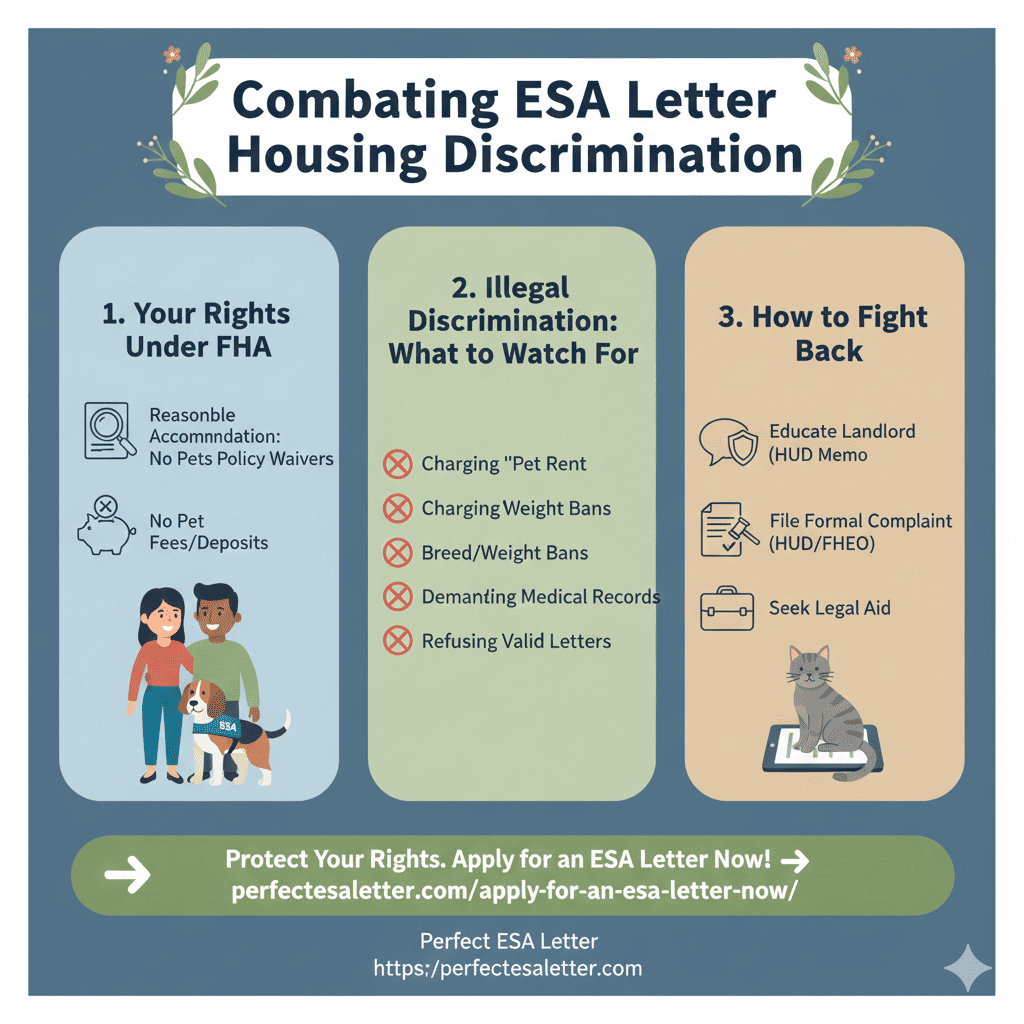
Combating ESA Letter Housing Discrimination: A Guide for Tenants
Combating ESA Letter Housing Discrimination: A Guide for Tenants
For many individuals living with mental health conditions, an emotional support animal is not a choice—it is a necessity. However, despite federal protections, many tenants face ESA letter housing discrimination when trying to secure a home or keep their existing companion. From illegal pet fees to outright denials based on breed, discrimination can take many forms, making an already stressful situation feel overwhelming.
The Fair Housing Act (FHA) was designed to prevent exactly this. It ensures that individuals with disabilities have an equal opportunity to use and enjoy their dwellings. If you have a valid ESA letter from a licensed healthcare professional, your animal is an assistance animal, not a pet, and you are entitled to “reasonable accommodation.”
At Perfect ESA Letter, we empower tenants by providing the legitimate documentation needed to stand up against unfair treatment. Apply for an ESA letter now to protect your rights and your peace of mind.
What is ESA Letter Housing Discrimination?
Housing discrimination occurs when a housing provider treats a tenant or applicant unfavorably because of their disability or their need for an assistance animal. ESA letter housing discrimination can be subtle or overt, but it is illegal under federal law.
Common Examples of Discrimination
-
Charging Pet Fees: Forcing a tenant with a valid ESA letter to pay pet rent, pet deposits, or move-in fees.
-
Breed and Weight Restrictions: Denying an animal simply because it is a “restricted breed” (like a Pit Bull) or exceeds a certain weight limit.
-
Invasive Questioning: Demanding to see medical records or asking for details about a tenant’s specific diagnosis.
-
Delayed Processing: Intentionally ignoring or delaying a request for reasonable accommodation to force a tenant to move or get rid of their animal.
-
Inappropriate Documentation Demands: Requiring the animal to be “certified,” “registered,” or “specially trained.”
Your Rights Under the Fair Housing Act (FHA)
The FHA is the primary federal law that shields you from ESA letter housing discrimination. It applies to most types of housing, including apartments, condos, and single-family homes.
Reasonable Accommodation
A “reasonable accommodation” is a change in rules, policies, or practices that allows a person with a disability to have an equal opportunity to use a dwelling. For ESA owners, this means the landlord must waive “no-pet” policies and fees.
HUD Guidelines
The U.S. Department of Housing and Urban Development (HUD) provides the framework that landlords must follow. HUD states that as long as your documentation is “reliable”—meaning it comes from a licensed professional with personal knowledge of your condition—the landlord must grant the accommodation unless the animal poses a direct threat.
How to Identify and Handle Discrimination
If you believe you are a victim of ESA letter housing discrimination, it is important to document every interaction.
Signs Your Landlord is Discriminating
-
They tell you “we only allow service dogs, not ESAs.” (This is false; ESAs are protected in housing).
-
They ask for a “notarized” letter. (Not required by law).
-
They demand you buy liability insurance specifically for the animal. (Often used as a deterrent).
Steps to Take
-
Educate the Landlord: Sometimes discrimination is born of ignorance. Provide them with HUD’s 2020 memo on assistance animals.
-
Submit a Formal Request: Always make your request for accommodation in writing so there is a paper trail.
-
File a HUD Complaint: If the landlord remains defiant, you can file a formal complaint with the Office of Fair Housing and Equal Opportunity (FHEO).
Comparison: Legal vs. Illegal Landlord Actions
| Landlord Action | Legal | Illegal (Discrimination) |
| Verification | Calling the doctor to confirm the letter’s authenticity. | Asking for a list of your medications or therapy notes. |
| Fees | Charging for actual damages the animal caused to the carpet. | Charging a $50/month “Pet Rent” for an ESA. |
| Rules | Requiring the owner to clean up waste in common areas. | Restricting the ESA from common areas used by humans. |
| Denial | Denying an animal that has bitten another tenant. | Denying an animal because of its breed or size. |
The Importance of Valid Documentation
The best defense against ESA letter housing discrimination is a bulletproof document. Landlords are much more likely to discriminate if they suspect your letter is from a “scam” registry or an illegitimate source.
A Legitimate Letter Must Include:
-
The clinician’s signature and license information.
-
Official practice letterhead.
-
The clinician’s contact information for verification.
-
A clear statement that the animal provides support for a mental health condition.
Using a professional service like Perfect ESA Letter ensures that your documentation meets every legal threshold, making it much harder for a landlord to deny your request.
Internal Linking & Knowledge Base
Frequently Asked Questions (FAQs)
1. Can a landlord refuse an ESA if the lease says “no pets”?
No. Under the FHA, an ESA is not considered a pet. It is an assistance animal. Therefore, a “no pets” policy does not apply to ESAs, and landlords must make an exception for them.
2. Is it discrimination if my landlord asks for my medical records?
Yes. Landlords are prohibited from asking for your specific diagnosis, medical records, or a detailed history of your condition. They are only entitled to a letter confirming that you have a disability and a need for the animal.
3. Can a landlord charge me a pet deposit for my ESA?
No. Charging any fee—whether it’s a monthly “pet rent” or a one-time “pet deposit”—is considered ESA letter housing discrimination. However, you are still liable for any actual damage the animal causes.
4. What types of housing are exempt from the FHA?
Small owner-occupied buildings (four units or fewer) and single-family homes sold or rented without a broker are sometimes exempt. This is known as the “Mrs. Murphy” exemption.
5. Can a landlord require my ESA to be “certified”?
No. There is no official certification for ESAs. A landlord who demands a “certificate” is often using it as a tactic to deny the request. The only legal requirement is a letter from a licensed healthcare professional.
6. Can my landlord evict me for having an ESA?
Not if you have a valid ESA letter and have followed the proper request process. If a landlord attempts to evict you solely because of your assistance animal, they are likely violating federal law.
7. Does my ESA need to wear a vest or ID tag?
No. Vests and ID tags are not legally required. While some owners use them to identify their animals, they do not provide any additional legal protection and are not a substitute for a valid letter.
8. What should I do if my landlord denies my request?
First, ask for the denial in writing and the reason for it. Then, contact a fair housing advocate or file a complaint with HUD. Often, a letter from a legal representative or a reputable ESA service is enough to resolve the issue.
Stop Discrimination Before It Starts
Don’t let ESA letter housing discrimination stand between you and your mental well-being. The most effective way to avoid a confrontation with your landlord is to provide documentation that is beyond reproach.
At Perfect ESA Letter, we bridge the gap between mental health support and legal compliance. Our clinicians are licensed in your state and understand the nuances of the Fair Housing Act, ensuring your letter is professional, verifiable, and legally binding.
Ready to live comfortably with your companion?
Ensure your documentation is 100% compliant and protected by federal law.