
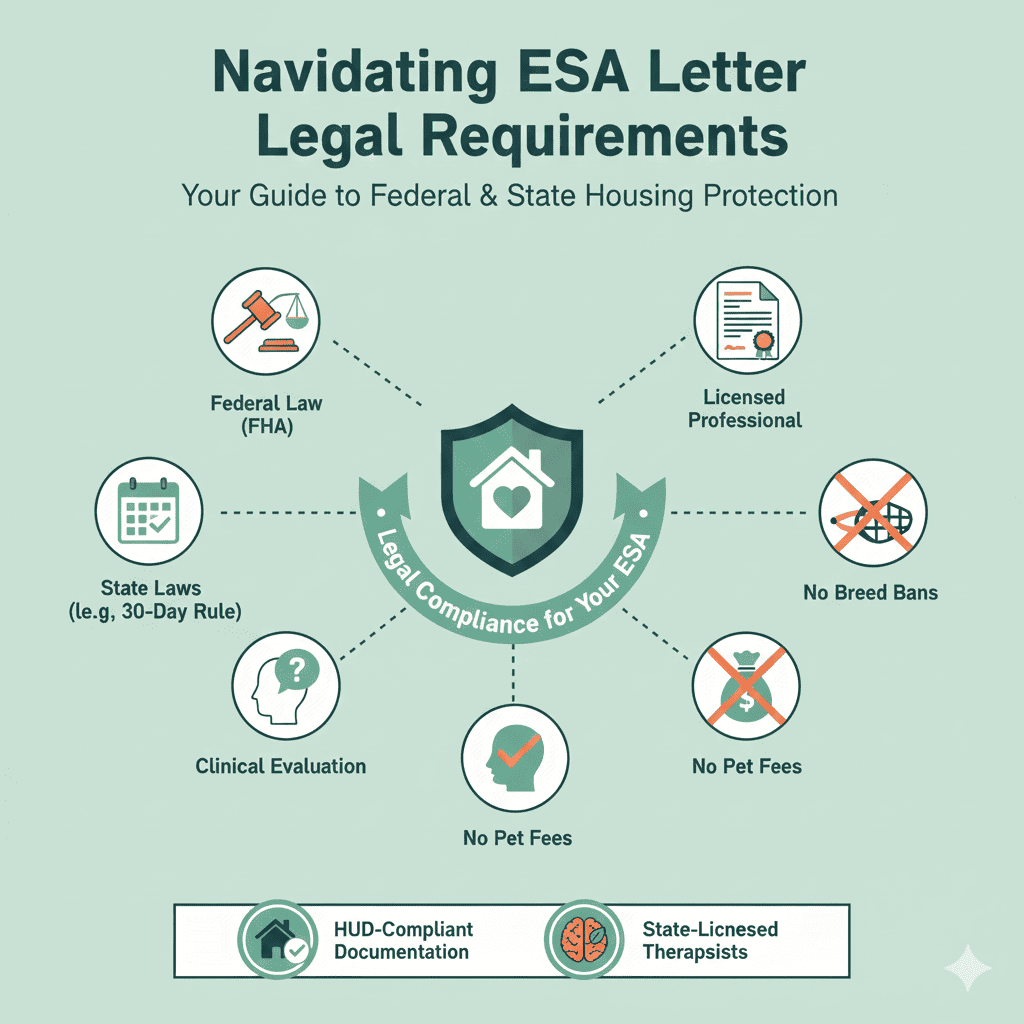
Navigating ESA Letter Legal Requirements: Your 2025 Guide to Housing Protection
Navigating ESA Letter Legal Requirements: Your 2025 Guide to Housing Protection
For millions of Americans, an emotional support animal (ESA) is a lifeline—a constant source of comfort that makes managing mental health challenges possible. However, as the popularity of ESAs has grown, so has the scrutiny from landlords and property managers. Understanding the specific ESA letter legal requirements is no longer just a suggestion; it is a necessity for anyone looking to protect their housing rights.
The landscape of emotional support animal laws is shaped by federal mandates and an increasing number of state-specific regulations. If your documentation doesn’t meet every single legal checkmark, you risk high pet fees, breed-based rejection, or even the stress of a housing denial. This guide will walk you through the essential legal standards to ensure your animal companion stays by your side, legally and securely.
The Foundation: Federal ESA Letter Legal Requirements
The Fair Housing Act (FHA) is the primary federal law that governs emotional support animals in residential settings. Under the FHA, an ESA is not a “pet.” Instead, it is classified as an “assistance animal”—a category that also includes service dogs.
HUD Guidelines for a Valid Request
The U.S. Department of Housing and Urban Development (HUD) provides the framework for what constitutes a “reasonable accommodation” request. According to HUD, a housing provider may request documentation if the tenant’s disability-related need for the animal is not readily apparent.
To meet federal ESA letter legal requirements, your documentation must prove two things:
-
The Existence of a Disability: You must have a physical or mental impairment that substantially limits one or more major life activities (e.g., anxiety, depression, PTSD).
-
The Therapeutic Connection (Nexus): There must be a clear relationship between your disability and the relief or support the animal provides.
The 7 Essential Elements of a Legal ESA Letter
To be considered a valid legal document, an ESA letter cannot be a generic PDF or a “certificate.” It must be a formal recommendation written specifically for you.
1. Licensed Professional Signature
The letter must be written by a Licensed Mental Health Professional (LMHP) or a healthcare provider. This includes psychiatrists, psychologists, Licensed Clinical Social Workers (LCSW), and Licensed Professional Counselors (LPC).
2. State-Specific Licensure
One of the most critical ESA letter legal requirements is that the professional must be licensed to practice in your state of residence. A landlord can legally reject a letter signed by a therapist who is only licensed in a different state.
3. Professional Letterhead
The document must be on the official letterhead of the practitioner, containing their office address, phone number, and email.
4. License Number and Type
The letter must clearly state the provider’s license type and their specific license number. Landlords often use state databases to verify these numbers before approving an accommodation.
5. Statement of Disability-Related Need
The letter must confirm that the patient has a mental or emotional condition recognized in the DSM-5 and that the animal is a necessary part of their treatment plan.
6. Date of Issuance
While the FHA does not explicitly state an expiration date, HUD guidelines suggest that documentation should be “current.” Most property managers require a letter dated within the last 12 months.
7. Direct Clinical Evaluation
Federal and state laws are increasingly cracking down on “ESA mills.” A legal letter requires an individualized assessment. This means a real consultation (in-person or via telehealth) took place between you and the provider.
State-Specific Laws: The 30-Day Rule and More
While federal law provides the baseline, several states have passed additional laws to prevent fraud. Failure to follow these state-specific ESA letter legal requirements can lead to immediate rejection.
| State | Unique Requirement | Legal Citation |
| California | Requires a 30-day therapeutic relationship before a letter can be issued. | AB 468 |
| Montana | Also mandates a 30-day established relationship with the provider. | HB 703 |
| Florida | Specifically prohibits “online-only” certificates without a valid clinical evaluation. | Statute 760.27 |
| Illinois | Requires a “therapeutic relationship” and prohibits misrepresentation. | Assistance Animal Integrity Act |
At Perfect ESA Letter, we ensure our clinicians are fully briefed on these state nuances, so your letter is compliant no matter where you live.
What Landlords Can and Cannot Legally Ask
Knowing your rights means knowing when a landlord is overstepping the law.
Landlords CAN Legally:
-
Verify the authenticity of the letter with the signing professional.
-
Ask for a new letter if yours is more than a year old.
-
Ask for the provider’s license number and state of issuance.
Landlords CANNOT Legally:
-
Ask for your specific diagnosis: Your medical privacy is protected.
-
Request detailed medical records: They are not entitled to see your history or treatment notes.
-
Require a specific form: HUD has explicitly stated that a valid ESA letter is sufficient; landlords cannot force your doctor to fill out their proprietary forms.
-
Charge pet fees: This includes upfront deposits and monthly “pet rent.”
Why “Registration” is a Legal Red Flag
In your search for an ESA letter, you will find dozens of sites offering “Official ESA Registration.” It is vital to understand that there is no such thing as a legal ESA registry.
The federal government does not recognize ID cards, vests, or “certificates of registration” as valid proof of an ESA. In fact, many property managers view these items as a red flag for fraud. The only document that satisfies ESA letter legal requirements is a signed letter from a licensed professional based on an evaluation.
Internal Linking Suggestions
-
Anchor Text: how to qualify for an ESA (Link to conditions/eligibility page)
-
Anchor Text: Fair Housing Act overview (Link to legal rights page)
-
Anchor Text: telehealth for ESA letters (Link to how-it-works page)
Frequently Asked Questions (FAQs)
1. Does my ESA letter need to be from a doctor in my own state?
Yes. To meet the most stringent ESA letter legal requirements, the professional must be licensed in the state where you currently reside or are moving to.
2. Can a landlord deny my ESA because of its breed?
Generally, no. The FHA overrides breed, size, and weight restrictions. A landlord can only deny an ESA if they have proof that the specific animal is dangerous or causes “undue financial burden” (such as their insurance policy being canceled).
3. Do I have to re-evaluate every year?
While the law doesn’t explicitly say “every 12 months,” HUD guidelines suggest that accommodation requests should be supported by current information. Most landlords will ask for an annual renewal to ensure the clinical need still exists.
4. Is a telehealth consultation legal for an ESA letter?
Yes. HUD specifically acknowledges that licensed healthcare professionals can provide services remotely, provided they perform an “individualized assessment.”
5. What is the “30-day rule” in California?
California law requires that a mental health professional have a relationship with a client for at least 30 days before they can issue an ESA housing letter. This ensures the recommendation is based on a real clinical bond.
6. Can my landlord charge me a cleaning fee at the end of my lease?
While they cannot charge an upfront “pet deposit,” they can charge you for actual damages caused by the animal (beyond normal wear and tear) when you move out, just as they would for a human tenant.
7. Does an ESA letter work for hotels or Airbnb?
No. The FHA only applies to “long-term dwellings.” Hotels and short-term rentals fall under the ADA, which only requires the acceptance of trained Service Dogs, not ESAs.
8. What if my landlord doesn’t believe I have a disability?
If your disability is “non-observable” (like anxiety), the landlord is legally entitled to ask for documentation—your ESA letter. Once you provide a valid letter that meets all legal requirements, they must accept it.
Secure Your Housing with Clinical and Legal Integrity
The journey to keeping your support animal in your home shouldn’t be a legal minefield. By ensuring your documentation meets all federal and state ESA letter legal requirements, you remove the landlord’s ability to say “no.”
At Perfect ESA Letter, we don’t take shortcuts. We connect you with state-licensed professionals who conduct thorough, legal evaluations. We provide letters on professional letterheads that include every detail a property manager needs to verify your rights. Don’t risk your housing on a “cheap” certificate—do it the right way and protect your peace of mind.