
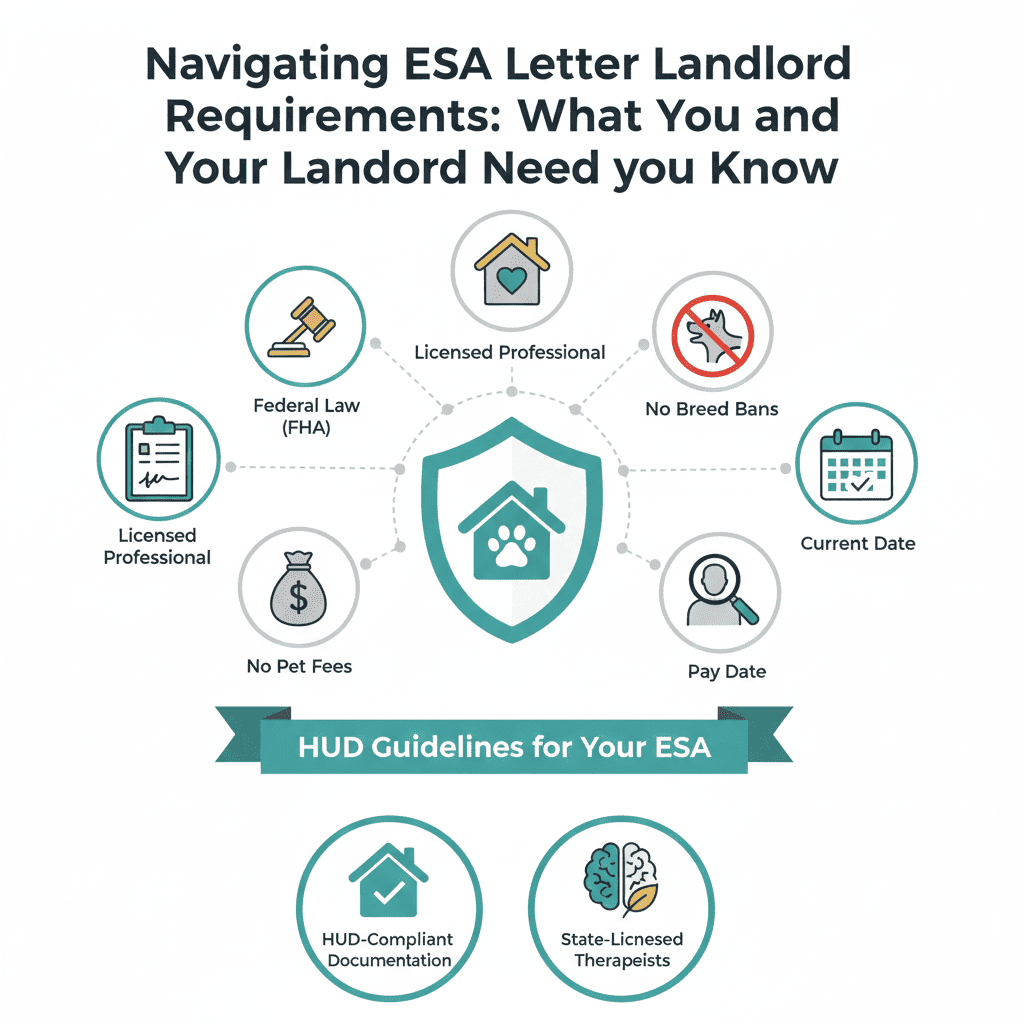
Navigating ESA Letter Landlord Requirements: What You and Your Landlord Need to Know
Navigating ESA Letter Landlord Requirements: What You and Your Landlord Need to Know
For individuals relying on emotional support animals (ESAs) for mental health, securing housing can sometimes feel like an uphill battle. While federal law protects your right to live with your ESA, many landlords are either unaware of or misinterpret their obligations. Understanding the specific ESA letter landlord requirements is crucial for both tenants and property managers to ensure a smooth, legal, and stress-free housing experience.
The Department of Housing and Urban Development (HUD) provides clear guidance on how landlords must handle requests for emotional support animals. These guidelines clarify what constitutes a legitimate ESA letter, what information a landlord can legally request, and what accommodations they are obligated to provide. This knowledge empowers you to confidently assert your rights and helps landlords comply with federal law, avoiding potential legal disputes.
The Foundation: Federal ESA Letter Landlord Requirements Under the FHA
The cornerstone of ESA housing rights is the Fair Housing Act (FHA). Under the FHA, an emotional support animal is considered an “assistance animal,” not a pet. This distinction is critical because it means ESAs are exempt from standard “no-pet” policies, pet fees, and breed restrictions.
What Landlords MUST Do:
-
Provide Reasonable Accommodation: Housing providers must allow an ESA to live with its handler, even if they have a strict “no pets” policy. This is considered a reasonable accommodation for a disability.
-
Waive Pet-Related Fees: Landlords cannot charge pet deposits, pet rent, or any other fees specifically for an ESA.
-
Bypass Breed/Weight Restrictions: Unless there’s a documented direct threat, landlords cannot deny an ESA based on its breed, size, or weight.
-
Process Requests Promptly: Landlords are expected to respond to reasonable accommodation requests in a timely manner (typically within 10-30 days).
What a Legitimate ESA Letter Requires (From the Landlord’s Perspective)
For a landlord to approve an ESA accommodation, they need to verify that the request is legitimate. This primarily means ensuring the ESA letter meets specific criteria. A landlord can request documentation if the tenant’s disability and the disability-related need for the animal are not readily apparent.
Key Elements Landlords Look For:
-
Written by a Licensed Professional: The letter must come from a licensed mental health professional (LMHP) or healthcare provider (e.g., psychiatrist, psychologist, LCSW, LMFT, physician).
-
Professional Letterhead & Contact Info: The letter should be on the provider’s official letterhead, including their name, title, address, phone number, and professional license number.
-
State of Licensure: The professional must be licensed in the state where the tenant resides or is seeking housing. Landlords will often verify this.
-
Confirmation of Disability: The letter must affirm that the tenant has a mental or emotional disability.
-
Nexus Statement: It must clearly state how the animal provides support that alleviates at least one symptom or effect of the tenant’s disability.
-
Current Date: While there’s no official expiration, landlords typically expect the letter to be reasonably current (e.g., within the last 12 months) to reflect an ongoing need.
| Landlord Verification Action | Legally Permitted? | Why? |
| Verify Professional License | YES | To prevent fraud and ensure legitimacy. |
| Contact the Professional | YES | To confirm the letter’s authenticity. |
| Request “ESA Registration” | NO | No federal registry exists, a common scam. |
| Demand Specific Diagnosis | NO | Violates medical privacy (HIPAA). |
What Landlords CANNOT Legally Demand
Understanding these limitations is vital for tenants to protect their rights and for landlords to avoid discriminatory practices. When reviewing ESA letter landlord requirements, remember that over-asking for information can lead to legal issues for the property owner.
Prohibited Demands from Landlords:
-
Your Medical Records or Specific Diagnosis: They cannot ask about the nature or severity of your disability. The letter provides sufficient information.
-
An “ESA Registration” or Certificate: There is no official federal registration for emotional support animals. Any site offering one is likely a scam.
-
Specific ESA Training or Certification: ESAs do not require specialized training to perform tasks; their presence provides the benefit.
-
A “Trial Period” for the Animal: Once approved, the ESA is part of your reasonable accommodation.
-
Requiring Their Own Specific ESA Form: While a landlord can provide a form, they cannot compel your licensed professional to complete it if your existing ESA letter already contains all the necessary information.
How to Handle Potential Landlord Pushback
Even with clear HUD guidelines, some landlords may still be hesitant or resistant. Knowing how to respond calmly and factually can often resolve the issue without further escalation.
-
Educate, Don’t Confront: Provide the landlord with copies of HUD’s guidance on assistance animals.
-
Document Everything: Keep records of all communications, including dates, times, names, and what was discussed.
-
Offer Verification: Reassure the landlord that the professional who wrote your letter is available for verification (within legal limits).
-
Mention Fair Housing Complaint: If resistance continues, politely inform the landlord of your intent to file a complaint with HUD or a local fair housing agency.
Internal Linking Suggestions
-
Anchor Text: Fair Housing Act protections (Link to a comprehensive FHA guide)
-
Anchor Text: qualifying for an ESA (Link to eligibility criteria)
-
Anchor Text: common ESA landlord myths (Link to a debunking article)
Frequently Asked Questions (FAQs)
1. Does my landlord have to accept my ESA if they have a “no pets” policy?
Yes. Under the Fair Housing Act, an ESA letter landlord requirement is to make a reasonable accommodation by waiving “no pets” policies for emotional support animals.
2. How many ESAs can I have in my apartment?
You can have multiple ESAs, but your ESA letter must provide a clinical justification for each animal, demonstrating how each one specifically alleviates symptoms of your disability.
3. Can my landlord charge me a pet deposit or monthly pet rent for an ESA?
No. Landlords are prohibited from charging any fees, deposits, or surcharges for an emotional support animal because it is considered an assistance animal, not a pet.
4. What if my landlord’s insurance company has a breed restriction?
This is a common but often invalid reason for denial. HUD guidelines state that a landlord cannot deny an ESA based on general breed restrictions. They must show that the specific animal poses a direct threat or that their insurance policy would actually be canceled due to that specific animal, not just any animal of that breed.
5. How long does a landlord have to approve my ESA request?
While there’s no strict federal deadline, landlords are expected to process reasonable accommodation requests in a “timely manner,” typically interpreted as 10 to 30 days.
6. Do I need to get a new ESA letter every year?
While not explicitly mandated by federal law, it is common practice for landlords to request an updated letter annually. This ensures the clinical need for the ESA is still current.
7. Can my landlord ask me to remove my ESA if it’s destructive?
Yes. You are responsible for the behavior of your ESA. If the animal causes significant damage beyond normal wear and tear, or poses a direct threat that cannot be mitigated, the landlord may have grounds to deny or revoke the accommodation.
8. Is a therapy dog the same as an emotional support animal under FHA?
No. “Therapy animals” typically visit facilities like hospitals or nursing homes. An ESA provides support specifically to its owner in their home. The FHA only covers ESAs and service animals for housing.
Your Path to Stress-Free Housing with Your ESA
Understanding ESA letter landlord requirements is the best way to ensure your housing rights are protected. You deserve to live comfortably and securely with the animal that provides you essential emotional support, free from discriminatory practices.
At Perfect ESA Letter, we streamline the process of obtaining a legitimate, HUD-compliant ESA letter from a state-licensed mental health professional. We ensure your documentation meets all federal and state requirements, empowering you to confidently navigate interactions with landlords and secure the housing you need. Don’t let confusion or misinformation stand between you and your cherished companion.