
Mental Health Conditions That Qualify for ESA: Your Guide
Mental Health Conditions That Qualify for ESA: Your Guide
In 2026, the importance of mental health has never been more recognized, and for many, the most effective “prescription” isn’t found in a pharmacy—it’s found in the companionship of an animal. If you are struggling with emotional or psychiatric challenges, you may have heard that an Emotional Support Animal (ESA) can help. But what exactly are the mental health conditions that qualify for ESA housing protections?
Under the Fair Housing Act (FHA), an ESA is a vital part of a treatment plan for individuals with disabilities. However, simply “loving your pet” isn’t enough to qualify for legal protection against pet fees and “no-pet” policies. You must have a documented condition that a licensed professional confirms is alleviated by your animal’s presence.
At Perfect ESA Letter, we believe everyone deserves the comfort of their companion. If you believe your condition warrants an assistance animal, apply for an ESA letter now to begin a confidential evaluation with a state-licensed clinician.
What Qualifies as a Disability Under the Fair Housing Act?
To understand how mental health conditions that qualify for ESA status work, we have to look at the legal definition of a “disability.” According to HUD (the U.S. Department of Housing and Urban Development), a disability is a physical or mental impairment that substantially limits one or more “major life activities.”
Major life activities include, but are not limited to:
-
Sleeping and eating
-
Working and learning
-
Interacting with others
-
Managing self-care
-
Concentrating or thinking
If your mental health makes any of these daily tasks difficult, an ESA may be a legally justifiable part of your recovery.
The List of Mental Health Conditions That Qualify for ESA Status
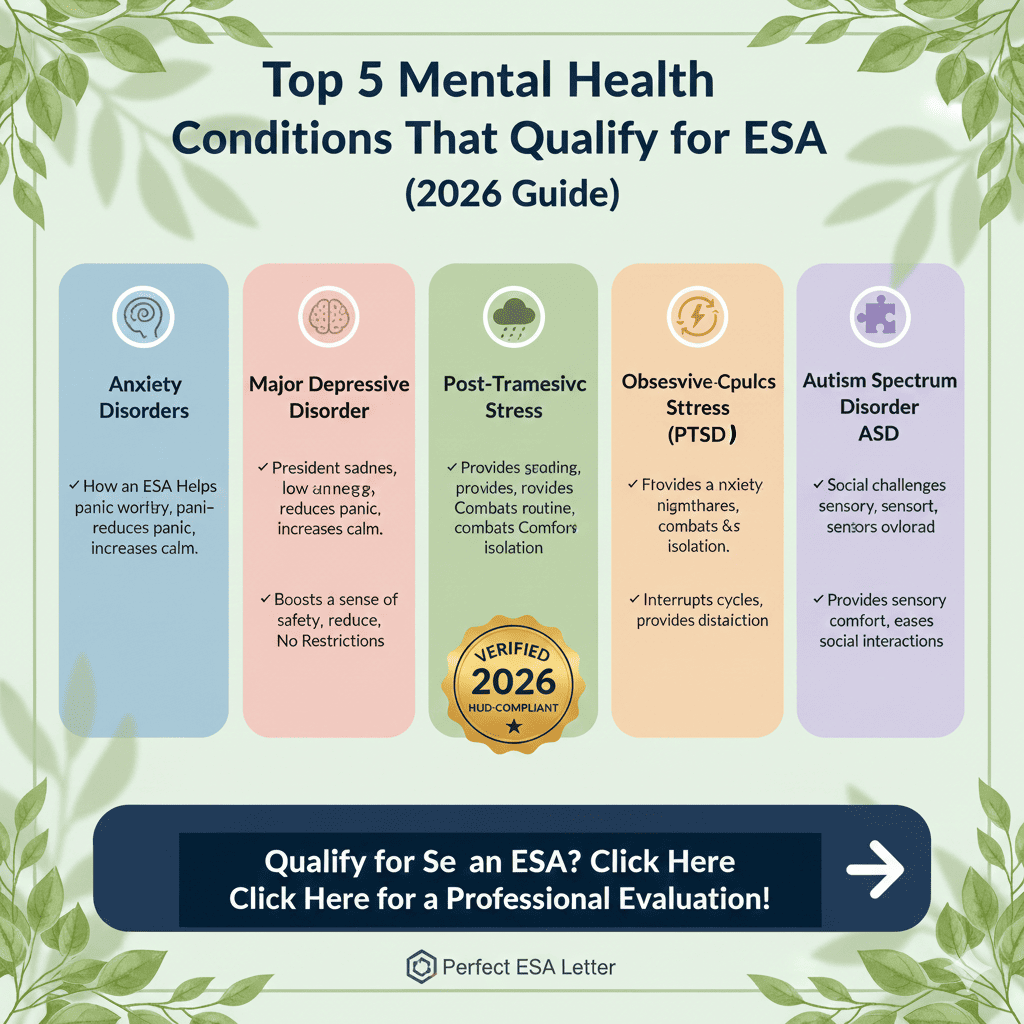
While the law does not provide a rigid “checklist,” most qualifying conditions are found in the DSM-5 (Diagnostic and Statistical Manual of Mental Disorders). Here are the most common conditions that licensed professionals recognize for ESA recommendations in 2026:
1. Anxiety Disorders
Anxiety is the leading reason for ESA requests. This includes:
-
Generalized Anxiety Disorder (GAD): Chronic, exaggerated worry about everyday life.
-
Social Anxiety Disorder: Intense fear of social situations or being judged.
-
Panic Disorder: Frequent, unexpected panic attacks.
-
Phobias: Debilitating fear of specific objects or environments (e.g., Agoraphobia).
2. Mood Disorders
Depression and mood swings can make it nearly impossible to maintain a routine. Qualifiers include:
-
Major Depressive Disorder (MDD): Persistent feelings of sadness and loss of interest.
-
Bipolar Disorder (I & II): Extreme mood swings ranging from depressive lows to manic highs.
-
Dysthymia: Long-term, chronic depression.
3. Trauma and Stressor-Related Disorders
The presence of an animal provides a sense of safety that is often missing for trauma survivors:
-
Post-Traumatic Stress Disorder (PTSD): Flashbacks, night terrors, and severe anxiety following a traumatic event.
-
Acute Stress Disorder: Intense, unpleasant, and dysfunctional reactions beginning shortly after a traumatic event.
4. Other Common Qualifying Conditions
-
Attention-Deficit/Hyperactivity Disorder (ADHD): Difficulty with focus, hyperactivity, and impulsivity.
-
Obsessive-Compulsive Disorder (OCD): Repetitive, unwanted thoughts and behaviors.
-
Autism Spectrum Disorder (ASD): Challenges with social skills and repetitive behaviors.
-
Chronic Stress: When life-altering stress leads to significant functional impairment.
Qualifying Conditions Comparison Table
| Category | Common Condition | How an ESA Helps |
| Anxiety | Social Anxiety | Provides a “grounding” presence in stressful environments. |
| Mood | Depression | Provides a reason to get out of bed and maintain a routine. |
| Trauma | PTSD | Offers a sense of security and reduces hyper-vigilance. |
| Cognitive | ADHD/Autism | Helps regulate sensory overload and improves focus. |
How the Evaluation Process Works in 2026
Knowing the mental health conditions that qualify for ESA is only the first step. To legally protect your housing, you must follow the 2026 clinical protocol:
Step 1: Clinical Assessment
You must speak with a Licensed Mental Health Professional (LMHP) licensed in your state. They will ask questions about how your symptoms affect your life. Apply for an ESA letter now to start this process online.
Step 2: Establishing the “Nexus”
The clinician must determine if there is a “therapeutic nexus”—a direct link between your condition and the animal. For example, if your depression causes isolation, a cat that provides companionship directly alleviates that symptom.
Step 3: Receiving the Letter
If you meet the criteria, you’ll receive an official ESA letter. In 2026, landlords are trained to look for:
-
Clinician’s license number and state.
-
Official letterhead and signature.
-
Clear statement of the disability-related need (without disclosing your specific diagnosis).
Internal Linking & Patient Resources
-
The Difference Between an ESA and a Psychiatric Service Dog.
-
Apply for an ESA letter now for 100% compliant housing documentation.
Frequently Asked Questions (FAQs)
What is the most common mental health condition that qualifies for ESA?
Anxiety and depression are the most frequently cited conditions. Because these disorders significantly impact “major life activities” like sleeping and social interaction, they align perfectly with FHA requirements.
Can I qualify for an ESA if I have a learning disability?
Yes. Cognitive and learning disabilities (like Dyslexia or severe ADHD) qualify if the animal helps you manage the emotional frustration or focus issues associated with the condition.
Does “stress” count as a qualifying condition?
Standard everyday stress usually does not qualify. However, “Chronic Stress” or “Adjustment Disorder” that is diagnosed by a professional and limits your ability to function does qualify.
Can a landlord ask for my medical records?
No. A landlord is legally allowed to see your ESA letter, but they cannot demand your full medical history, a list of your medications, or a detailed description of your symptoms.
What if I have multiple conditions?
Many people have co-occurring disorders (e.g., Anxiety and Depression). This makes your case for an ESA even stronger, as the animal may provide multi-faceted support.
Is a physical disability required?
No. The Fair Housing Act explicitly protects those with “non-observable” or “invisible” disabilities, which includes almost all mental health conditions.
Conclusion: You Don’t Have to Manage Alone
Identifying the mental health conditions that qualify for ESA is about more than just legal paperwork—it’s about validating your struggle and finding a path to a better quality of life. Whether you are dealing with the weight of depression or the sharp edges of PTSD, your animal is a legitimate part of your healthcare team.
At Perfect ESA Letter, we bridge the gap between your needs and the law. Our network of state-licensed professionals is here to help you navigate the 2026 housing landscape with ease and dignity.
Take the first step toward a protected home today.
👉 Start Your Professional ESA Evaluation Now