
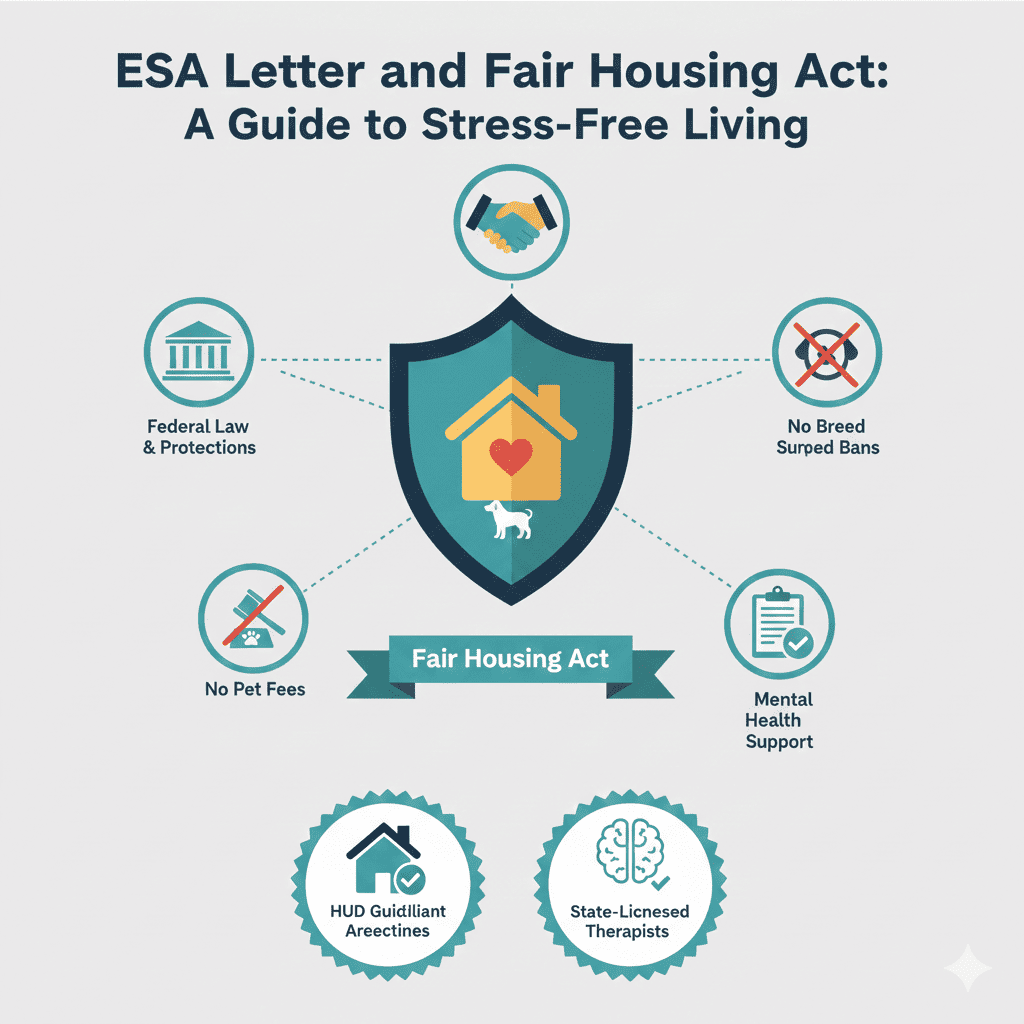
Mastering Your ESA Letter and the Fair Housing Act: A Guide to Stress-Free Living
Mastering Your ESA Letter and the Fair Housing Act: A Guide to Stress-Free Living
For many individuals living with mental health challenges, an emotional support animal (ESA) is a vital part of their treatment plan. However, the path to housing security with an animal can feel like a legal maze. The key to unlocking your rights lies in the intersection of a professional ESA letter and the Fair Housing Act.
If you are a renter, you know the frustration of finding a perfect apartment only to be met with a “no-pet” policy or an exorbitant monthly “pet rent” fee. The Fair Housing Act (FHA) was designed specifically to prevent this type of discrimination. By obtaining a legitimate ESA letter, you transition from being a “pet owner” to a “tenant with an assistance animal,” granting you federal protections that most landlords cannot ignore.
What is the Fair Housing Act (FHA)?
The Fair Housing Act is a federal law managed by the U.S. Department of Housing and Urban Development (HUD). Its primary mission is to protect buyers and renters from discrimination. Under the FHA, it is illegal for a housing provider to refuse to rent or sell to a person because of a disability—including mental and emotional disabilities.
How the FHA Defines an Emotional Support Animal
Unlike the Americans with Disabilities Act (ADA), which only covers service dogs in public spaces, the FHA recognizes emotional support animals as a category of “assistance animals.”
-
Not a Pet: Legally, an ESA is considered an assistive aid, similar to a wheelchair.
-
No Training Required: Unlike service dogs, ESAs do not need to be trained to perform specific tasks. Their mere presence provides the therapeutic benefit.
-
Broad Species Range: While dogs and cats are most common, the FHA can cover birds, rabbits, and other small domesticated animals.
Your Rights Under an ESA Letter and the Fair Housing Act
When you present a valid ESA letter under the Fair Housing Act, you are requesting what is known as a “Reasonable Accommodation.” Once this request is granted, you are entitled to several significant benefits:
1. Exemption from “No-Pet” Policies
Even if a lease explicitly states “No Pets Allowed,” the FHA mandates that landlords make an exception for your ESA. This allows you to live in your preferred neighborhood without compromising your mental health.
2. Waiver of All Pet-Related Fees
One of the most immediate financial benefits of an ESA letter is the elimination of:
-
Pet Deposits: You cannot be charged an upfront security deposit for your animal.
-
Pet Rent: Monthly fees (often $25–$100) are waived.
-
Move-in Fees: Any one-time administrative pet fees are prohibited.
3. Immunity to Breed and Weight Restrictions
Landlords often have policies against “aggressive breeds” (like Pit Bulls or German Shepherds) or animals over a certain weight (e.g., 25 lbs). Under the FHA, these blanket restrictions do not apply to assistance animals. Your landlord can only deny a specific animal if it has a documented history of being dangerous or destructive.
Comparison: Pets vs. ESAs Under Federal Law
| Feature | Standard Pet | Emotional Support Animal (ESA) |
| Legal Status | Personal Property | Assistance Animal |
| Protected by FHA | No | Yes |
| Monthly Pet Rent | Often Required | Legally Waived |
| Pet Deposits | Often Required | Legally Waived |
| Breed Bans Apply | Yes | No |
How to Get a Legally Compliant ESA Letter
To trigger your ESA letter Fair Housing Act protections, your document must meet specific criteria set by HUD. A “certificate” from a registry website is not a legal document and is frequently rejected by property managers.
Requirements for a Valid Letter:
-
Licensed Professional: The letter must be written by a Licensed Mental Health Professional (LMHP) such as a therapist, psychologist, or psychiatrist.
-
State Licensure: The clinician must be licensed to practice in your specific state.
-
Current Date: Most landlords require the letter to be dated within the last 12 months.
-
The “Nexus”: The letter must state that you have a disability and that the animal provides support that alleviates at least one symptom of that disability.
At Perfect ESA Letter, we specialize in connecting you with state-licensed professionals who provide HUD-compliant documentation that stands up to landlord scrutiny.
Internal Linking Suggestions
-
Anchor Text: how to qualify for an ESA (Link to conditions/eligibility page)
-
Anchor Text: ESA vs. Service Dog guide (Link to comparison article)
-
Anchor Text: what to do if a landlord denies your ESA (Link to the denial support page)
Frequently Asked Questions (FAQs)
1. Can a landlord ask me what my disability is?
No. Under the Fair Housing Act, a landlord is allowed to ask for documentation confirming you have a disability-related need for the animal, but they cannot ask for your specific diagnosis, medical records, or the severity of your condition.
2. Are all types of housing covered by the FHA?
Most housing is covered, including apartments, condos, and single-family homes. However, there are a few exemptions, such as owner-occupied buildings with four or fewer units (the “Mrs. Murphy” exemption) and some private clubs or religious organizations.
3. Do I have to tell the landlord about my ESA before I sign the lease?
You are not legally required to disclose your ESA during the application process. Many tenants wait until after the lease is signed to submit their request for reasonable accommodation to avoid potential “stealth” discrimination.
4. Can my landlord charge me if my ESA damages the apartment?
Yes. While they cannot charge a pre-emptive pet deposit, you are still financially responsible for any actual damage your animal causes to the property, which can be deducted from your standard security deposit.
5. Can I have more than one ESA under the Fair Housing Act?
Yes, you can have multiple ESAs. However, your ESA letter must specifically justify the need for each animal. For example, one animal might help with panic attacks while another helps with insomnia.
6. Does an ESA letter work for airlines?
The FHA only covers housing. For air travel, the laws changed recently, and most airlines now only allow Psychiatric Service Dogs (PSDs) to fly for free. ESAs are typically treated as pets by airlines.
7. What if my landlord says their insurance doesn’t allow “dangerous” breeds?
HUD is very strict on this. A landlord cannot deny an ESA based on a general insurance policy. They must provide proof that their specific insurance carrier would actually cancel the policy or significantly increase the premium because of your specific animal.
8. How long does a landlord have to respond to my request?
Landlords are expected to respond to a “Reasonable Accommodation” request within a reasonable timeframe, usually considered to be 10 to 30 days.
Secure Your Right to a Happy Home
Navigating the relationship between an ESA letter and the Fair Housing Act doesn’t have to be a source of anxiety. The law was created to ensure that your mental health needs are respected in the place where you should feel safest: your home.
By obtaining a legitimate, clinician-signed letter, you are not just asking for a favor—you are exercising a federal right. Don’t let confusing jargon or intimidating property managers keep you from the support you deserve. At Perfect ESA Letter, we provide the clinical expertise and legal compliance you need to live life on your own terms with your animal by your side.