
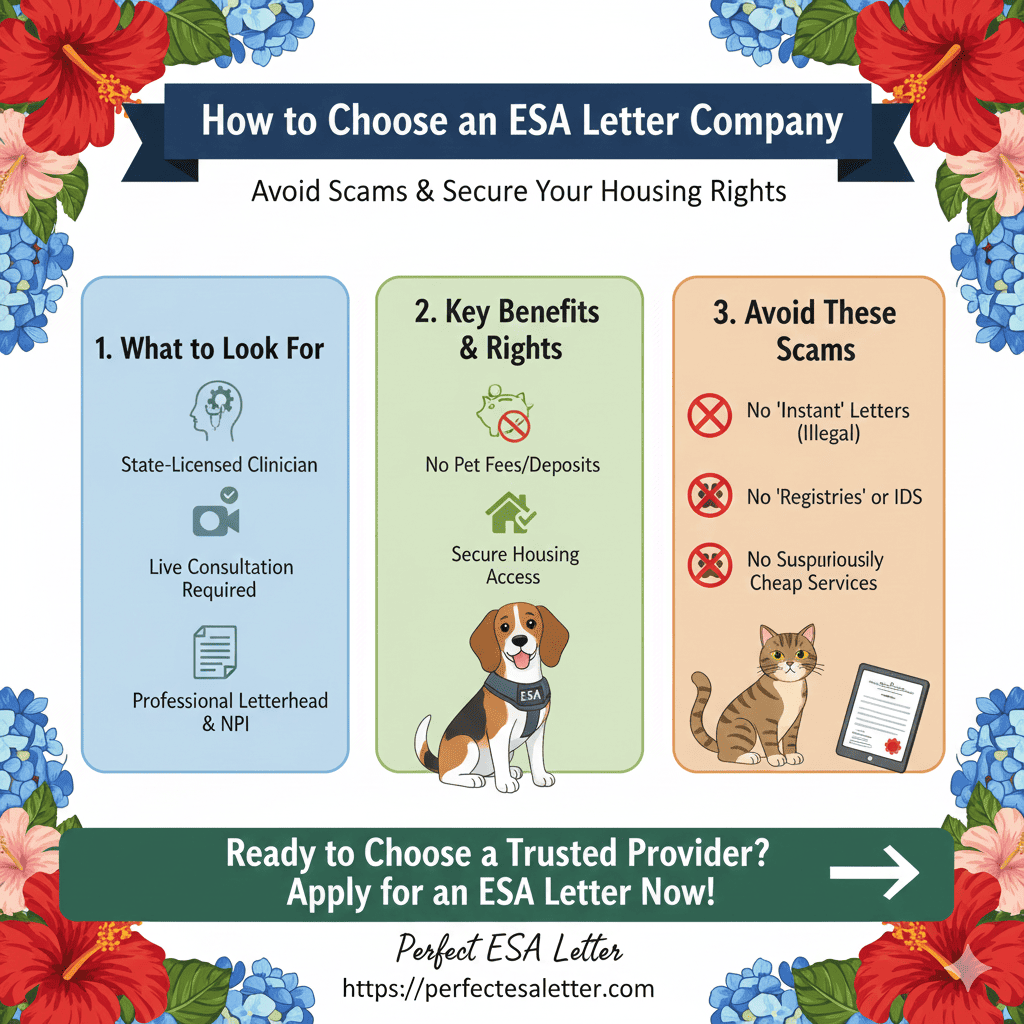
How to Choose an ESA Letter Company: A Guide to Avoiding Scams
How to Choose an ESA Letter Company: A Guide to Avoiding Scams
Finding a safe, stable place to live should be a right, not a struggle—especially when your mental health depends on the presence of an emotional support animal (ESA). However, as more people seek the therapeutic benefits of these animals, the internet has become flooded with companies promising “instant” letters and “official” certificates.
If you are currently researching how to choose an ESA letter company, you likely already know that not all services are created equal. Choosing the wrong provider doesn’t just result in a loss of money; it can lead to legal headaches, housing denials, and stressful confrontations with your landlord. To protect yourself, you need to look beyond flashy marketing and understand the federal requirements that make a letter legally binding.
At Perfect ESA Letter, we prioritize clinical integrity and legal compliance. Apply for an ESA letter now to be matched with a state-licensed professional who understands the law.
The Golden Rule: Start with HUD and FHA Compliance
Before you dive into a comparison of different websites, you must understand the legal framework. The Fair Housing Act (FHA) and the U.S. Department of Housing and Urban Development (HUD) are the governing bodies that oversee ESA rights.
According to HUD, a legitimate ESA letter must be:
-
Written and signed by a licensed healthcare professional (e.g., psychiatrist, psychologist, LCSW, LMFT, or physician).
-
Inclusive of the professional’s license number and contact information.
-
Based on an evaluation where the provider has personal knowledge of your disability and your need for the animal.
When learning how to choose an ESA letter company, if a site skips any of these legal requirements, they are not providing a valid service.
10 Red Flags: How to Spot a Scam ESA Service
Knowing what to avoid is just as important as knowing what to look for. Watch out for these common warning signs during your search.
-
“Instant” Approval: Real clinicians need time to review your medical history and conduct an evaluation. Any site promising a letter in minutes is a “letter mill.”
-
Selling “Registries” or “Certificates”: HUD explicitly states that “registrations” and “certificates” purchased online are not sufficient documentation of a disability.
-
No Live Consultation: A legitimate provider will require a phone, video, or in-person session to establish a therapeutic relationship.
-
Suspiciously Low Prices: A licensed professional’s time is valuable. “Bargain” letters for $30-$50 are often signed by stolen or expired licenses.
-
Vests and ID Tags Included: Legitimate medical providers do not sell gear. These items are not legally required and often make landlords more suspicious.
-
Lifetime Guarantees: Most landlords require a letter to be dated within the last 12 months. A “lifetime” promise is a major red flag.
-
Out-of-State Licenses: Your clinician must be licensed to practice in your specific state of residence.
-
Generic Templates: Professional letters are written on official letterhead with specific clinical language linking your condition to the animal’s support.
-
No Landlord Verification: Reputable companies provide a way for your property manager to verify the letter’s authenticity.
-
Lack of HIPAA Compliance: Since you are sharing medical data, the platform must follow strict privacy laws.
Essential Checklist for Choosing an ESA Company
Use this table to evaluate any service you are considering.
| Feature to Verify | Why it Matters |
| State-Licensed LMHP | Landlords can (and do) verify license numbers in state databases. |
| One-on-One Evaluation | HUD requires the provider to have personal knowledge of your need. |
| Official Letterhead | Shows the clinician’s practice name, address, and credentials. |
| 30-Day Rule Knowledge | Some states (like CA) require a 30-day relationship with the clinician. |
| Privacy Standards | Ensures your mental health history isn’t sold or leaked. |
| Responsive Support | You need someone to talk to if your landlord pushes back. |
Step-by-Step: The Correct Way to Get a Valid Letter
When you follow the right process, you eliminate the risk of rejection. Here is how a legitimate company like Perfect ESA Letter operates:
Step 1: The Initial Assessment
You should start by answering questions about your mental health symptoms and how an animal helps alleviate them. This isn’t the “final” decision, but a screening to see if you are a candidate.
Step 2: Matching with a Local Professional
The company should match you with a clinician licensed in your state. This is non-negotiable for housing approval.
Step 3: The Clinical Consultation
You will speak with the clinician via phone or video. This is your opportunity to discuss your needs and for the professional to confirm that an ESA is a necessary part of your treatment plan.
Step 4: Receiving Your Document
If approved, your letter is delivered on professional letterhead with all the necessary legal disclosures required to bypass pet fees and breed restrictions.
Internal Linking Suggestions
Frequently Asked Questions (FAQs)
1. Can my landlord verify my letter with the doctor?
Yes. A landlord has the right to contact the clinician to confirm that they actually wrote the letter and that their license is active. They cannot, however, ask for your specific diagnosis or medical history.
2. Why should I avoid out-of-state providers?
Many property managers use screening services like PetScreening.com that specifically flag clinicians who are not licensed in the same state as the rental property. Using a local professional is the best way to ensure approval.
3. Do I need an ESA letter if my building is already “pet-friendly”?
Yes. Even in pet-friendly buildings, having an ESA letter exempts you from “pet rent” (often $50-$100/month) and “pet deposits.” It also protects you if the building changes its pet policy later.
4. Is there a “National Database” for ESAs?
No. Any website claiming to add your animal to a “National Database” is a scam. These databases have no legal authority and are frequently cited by HUD as an example of fraudulent documentation.
5. Can a landlord require their own specific form?
No. Under HUD guidelines, a landlord cannot require a clinician to use a specific form, nor can they require the letter to be notarized. A valid, signed letter from an LMHP is sufficient.
6. What if my mental health professional refuses to write a letter?
Not all therapists or doctors are comfortable with the legalities of ESAs. This is why specialized companies are helpful; they connect you with professionals who are experienced in assessing the need for assistance animals.
7. Does an ESA letter cover multiple pets?
It can, but the clinician must provide a justification for why each animal is necessary. It is generally harder to get approval for multiple ESAs, so you want a company that understands how to document this correctly.
8. What is the “30-Day Rule” I keep hearing about?
In states like California and Montana, new laws require that you have a professional relationship with a clinician for at least 30 days before they can issue an ESA letter. A legitimate company will be aware of this and ensure you are compliant with local laws.
Conclusion: Why Perfect ESA Letter is the Right Choice
Learning how to choose an ESA letter company comes down to one thing: trust. You are trusting a company with your housing, your money, and your mental health data.
At Perfect ESA Letter, we don’t just “sell letters.” We provide a bridge to legitimate mental health care. Our process is designed to be rigorous enough to satisfy the most demanding property managers while remaining accessible to those who need support. We stand behind our documentation and our clients, ensuring that the bond between you and your animal is never compromised by bureaucratic hurdles.
Don’t leave your housing to chance. Choose a provider that puts your rights and your animal’s well-being first.