
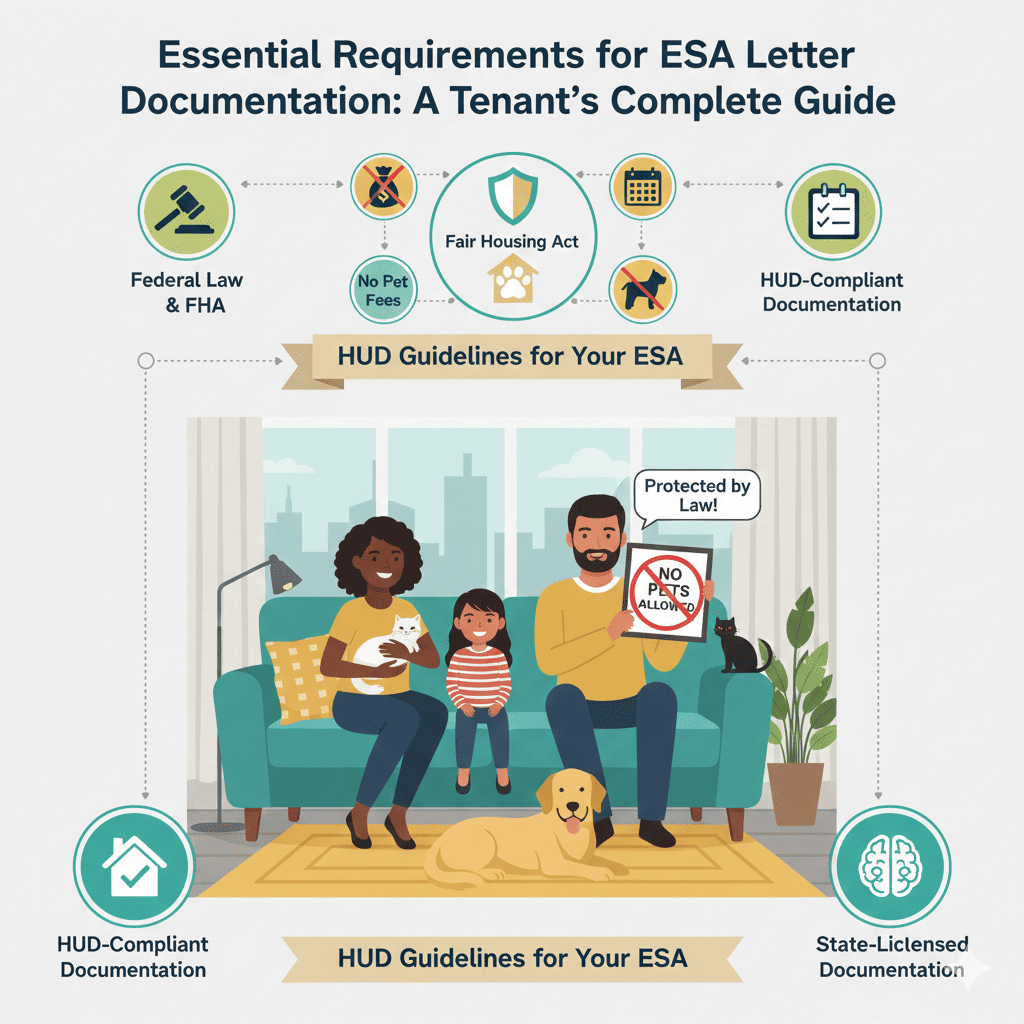
Essential Requirements for ESA Letter Documentation: A Tenant’s Complete Guide
Essential Requirements for ESA Letter Documentation: A Tenant’s Complete Guide
Navigating the rental market is challenging enough without the added stress of pet restrictions, monthly pet rent, and “no-pets” policies. For individuals living with mental health conditions like anxiety, PTSD, or depression, an animal is more than a companion—it is a vital part of their emotional stability. However, to legally bypass housing restrictions, you must understand the specific requirements for ESA letter documentation.
Under the Fair Housing Act (FHA), emotional support animals (ESAs) are not classified as pets. They are recognized as assistance animals. This legal distinction allows tenants to live with their animals even in buildings that prohibit pets, and it waives all pet-related fees. But these rights are only accessible if your documentation meets strict federal and state guidelines. In this guide, we will break down the exact criteria your letter must meet to be considered valid by landlords and property managers.
What Are the Legal Requirements for ESA Letter Acceptance?
A legitimate emotional support animal letter is not just a note from a doctor; it is a legal document that must follow specific protocols established by the U.S. Department of Housing and Urban Development (HUD). To ensure your request for “reasonable accommodation” is granted, your letter must be clinically and legally sound.
The primary requirements for ESA letter validity revolve around the person writing the letter and the information contained within it. If a document lacks these key components, a landlord is legally entitled to deny the request.
1. The Source: Who Can Write the Letter?
The most critical requirement is that the letter must be written by a Licensed Mental Health Professional (LMHP) or a medical doctor. Landlords are increasingly vigilant about verifying these credentials.
Qualifying Professionals Include:
-
Psychiatrists and Psychologists
-
Licensed Clinical Social Workers (LCSW)
-
Licensed Marriage and Family Therapists (LMFT)
-
Licensed Professional Counselors (LPC)
-
Mental Health Nurse Practitioners (PMHNP)
-
General Physicians or Primary Care Doctors
The State Licensing Requirement
One of the most overlooked requirements for ESA letter documentation is the state of licensure. The professional must be licensed to practice in the state where the tenant resides. For example, if you live in Texas, a letter from a clinician licensed only in New York may be rejected by your property manager.
2. Essential Content: What the Letter Must Include
HUD has provided clear guidelines on what information must be present for a letter to satisfy housing laws. Your documentation must be on the professional’s official letterhead and include:
-
Provider Information: Full name, practice address, contact details, and license type.
-
Licensure Details: The state of issuance and the provider’s active license number.
-
Confirmation of Disability: A statement confirming that you have a mental or emotional impairment that substantially limits one or more major life activities.
-
The Nexus: A clear explanation of how the animal provides support that alleviates at least one symptom of your condition.
-
Issue Date: The letter should be current. While the FHA doesn’t state an expiration, most landlords require letters issued within the last 12 months.
-
Signature: A physical or verifiable digital signature from the clinician.
Valid ESA Letter vs. Fake Online Registries
Many tenants fall into the trap of buying “ESA Certificates” or “Registration Badges” from automated websites. It is important to know that there is no such thing as an official ESA registry.
| Feature | Legitimate ESA Letter | Online Scam/Registry |
| Licensed Clinician Review | YES | NO |
| HUD & FHA Compliant | YES | NO |
| Waives Pet Rent/Fees | YES | NO |
| Requires Medical Evaluation | YES | NO |
| Acceptable to Landlords | YES | NO (Commonly Denied) |
At Perfect ESA Letter, we ensure all requirements for ESA letter documentation are met by connecting you with state-licensed professionals who conduct thorough evaluations.
3. The Clinical Evaluation Requirement
You cannot simply “buy” a valid letter. A fundamental requirement for ESA letter issuance is a clinical assessment. The clinician must have personal knowledge of your mental health status.
In many states, such as California and Florida, there are now laws requiring a “provider-patient relationship” to exist for at least 30 days before a letter can be issued. This is designed to prevent fraud and ensure that the recommendation is based on a genuine therapeutic need.
What Happens During an Evaluation?
-
You will discuss your mental health history and current symptoms.
-
The clinician will ask how the animal specifically helps you (e.g., grounding you during panic attacks or providing a routine for depression).
-
The professional determines if the animal is a necessary component of your wellbeing.
4. Housing Specific Protections and Limitations
Once you meet the requirements for ESA letter documentation, you are protected under the Fair Housing Act. However, there are a few nuances you should be aware of:
-
No Breed or Weight Limits: A landlord cannot deny your ESA because it is a “restricted breed” or over a certain weight limit.
-
Zero Pet Fees: You are exempt from pet deposits, move-in fees, and monthly pet rent.
-
Responsibility for Damage: While you don’t pay pet fees, you are still financially responsible if your animal causes physical damage to the apartment.
-
Exemptions: Small owner-occupied buildings (4 units or fewer) and some single-family homes sold or rented without a broker may be exempt from FHA rules.
Internal Linking Suggestions
-
Anchor Text: how to qualify for an emotional support animal (Link to eligibility page)
-
Anchor Text: Fair Housing Act guidelines for ESAs (Link to legal resource)
-
Anchor Text: ESA vs. Service Dog for renters (Link to comparison blog)
Frequently Asked Questions (FAQs)
1. Does my landlord have to accept my ESA letter?
If the letter meets all the requirements for ESA letter validity (written by a licensed professional in your state) and the property is covered by the FHA, the landlord is legally required to provide a reasonable accommodation.
2. Can a landlord call my therapist?
Yes, but they are limited in what they can ask. They can verify that the letter is authentic and that the clinician is treating you. They cannot ask for your specific diagnosis, medical records, or the severity of your condition.
3. Do I need an ESA letter for each animal?
If you have more than one emotional support animal, your documentation must justify the need for each. The letter should explain why one animal is not sufficient to alleviate your symptoms.
4. Is a vest or ID tag a requirement for an ESA?
No. Vests, ID tags, and certificates are not legal requirements. They are purely cosmetic and do not provide any legal protection. The only document that matters is the signed letter from your clinician.
5. Can I get an ESA letter for a “no-pets” dorm?
Yes. The Fair Housing Act also applies to university-owned housing and dormitories. Students who meet the requirements for ESA letter eligibility have the right to keep their animals in their dorms.
6. What if my landlord’s insurance doesn’t allow certain breeds?
HUD guidelines state that insurance restrictions are generally not a valid reason to deny an ESA. The landlord would have to prove that their insurance would actually be canceled or significantly more expensive to deny the request, which is very difficult to prove.
7. Do I have to disclose my ESA before signing the lease?
You are not legally required to disclose your ESA during the application process. Many tenants wait until after the lease is signed to submit their request for reasonable accommodation to avoid potential discrimination.
8. What should I do if my landlord denies my valid letter?
If your letter meets all the requirements for ESA letter standards and you are denied, you can file a formal complaint with HUD’s Office of Fair Housing and Equal Opportunity (FHEO).
Secure Your Rights with a Professional ESA Letter
Understanding the requirements for ESA letter documentation is the first step toward a stress-free living environment. You shouldn’t have to choose between your home and your mental health. By ensuring your letter is issued by a licensed professional and contains the necessary HUD-compliant language, you can protect yourself from unfair fees and housing instability.
At Perfect ESA Letter, we specialize in helping tenants navigate these complex legal requirements. We connect you with state-licensed mental health professionals who understand the nuances of the Fair Housing Act and can provide you with a legitimate, verifiable letter.