
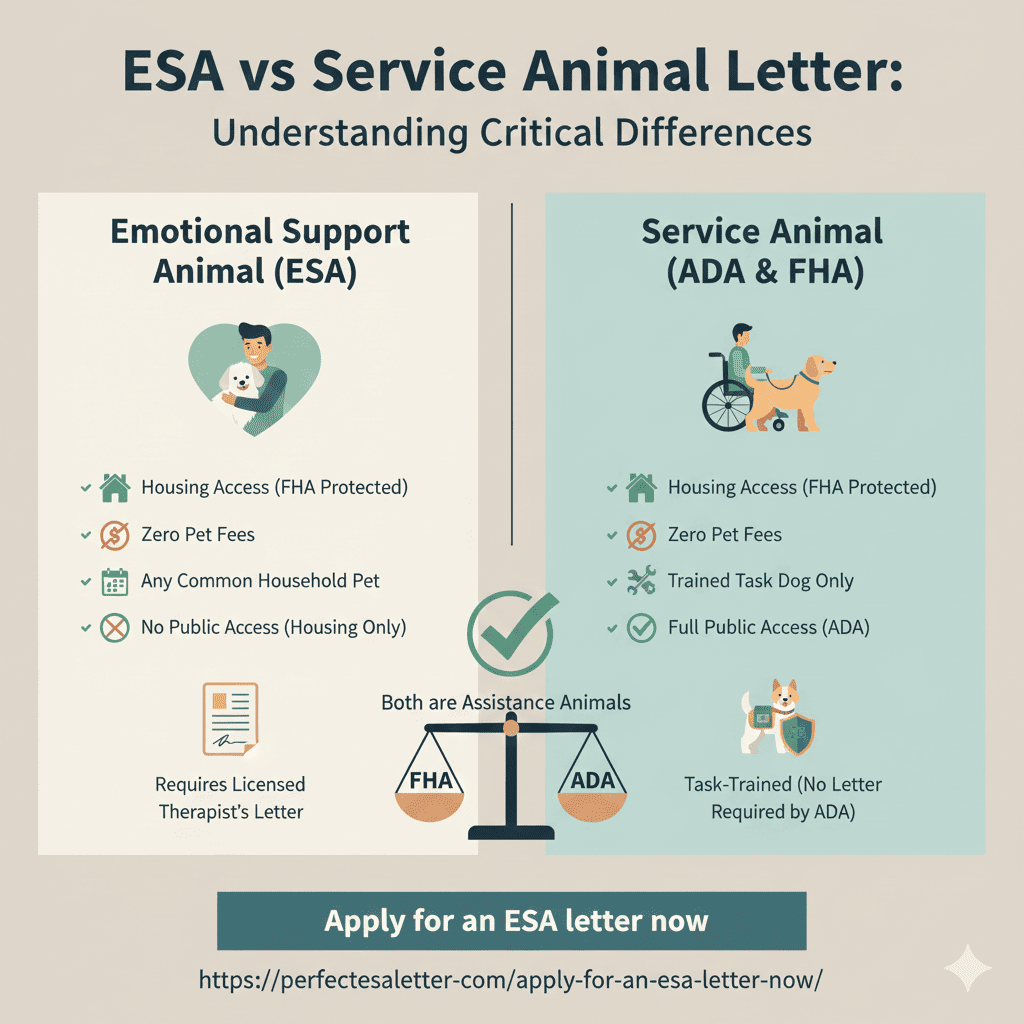
ESA vs Service Animal Letter: Understanding the Critical Differences
ESA vs Service Animal Letter: Understanding the Critical Differences
When you are looking to protect your rights to live and travel with your animal companion, the terminology can quickly become confusing. You may have heard terms like “assistance animal,” “psychiatric service dog,” or “ESA” used interchangeably. However, in the eyes of the law, an ESA vs service animal letter represents two very different levels of protection and responsibility.
Choosing the wrong type of documentation can lead to denied housing applications, issues at the airport, or being asked to leave public spaces. Whether you have a dog that is specifically trained to help with a physical disability or a cat that provides vital comfort for your anxiety, knowing which letter you need is the first step toward legal security. This guide explores the legal frameworks of the ADA and FHA to help you identify the right path for your situation.
The Core Difference: ESA vs Service Animal
At the most basic level, the difference between an ESA vs service animal letter comes down to training and species.
What is a Service Animal?
Under the Americans with Disabilities Act (ADA), a service animal is defined strictly as a dog (or in rare cases, a miniature horse) that has been individually trained to do work or perform tasks for an individual with a disability. The task must be directly related to the person’s disability.
-
Examples: Guiding a person who is blind, alerting a person to a seizure, or reminding a person with depression to take their medication (Psychiatric Service Dog).
-
Public Access: Service animals are allowed in almost all public areas, including restaurants, stores, and hospitals.
What is an Emotional Support Animal (ESA)?
An ESA can be any common household animal (dog, cat, bird, rabbit, etc.). Unlike service animals, ESAs do not require any specialized training. Their primary function is to provide therapeutic support through their presence and companionship.
-
Examples: A cat that helps alleviate symptoms of PTSD or a dog that provides comfort during panic attacks.
-
Public Access: ESAs do not have a legal right to enter public businesses like grocery stores. Their protections are primarily limited to housing.
ESA vs Service Animal Letter: Documentation Requirements
The documentation you need—and what a landlord or business is allowed to ask for—changes significantly depending on which category your animal falls into.
Documentation for Service Animals
If you have a service animal, the ADA is very restrictive about what others can ask. If your disability is obvious (like using a guide dog), a landlord or business owner cannot ask for any documentation. If it is not obvious, they may only ask two questions:
-
Is the animal a service animal required because of a disability?
-
What work or task has the animal been trained to perform?
Crucial Note: You do not technically need a “letter” for a service animal under the ADA for public access, though many people carry a psychiatric service dog (PSD) letter to facilitate housing requests or workplace accommodations.
Documentation for Emotional Support Animals
Because ESAs are not trained to perform tasks, a landlord has the legal right to request a legitimate ESA letter. This letter must be:
-
Written by a Licensed Mental Health Professional (LMHP).
-
Signed and on the professional’s official letterhead.
-
Include the clinician’s license type, number, and state of licensure.
At Perfect ESA Letter, we specialize in connecting you with state-licensed clinicians who provide the specific documentation required by HUD and the Fair Housing Act.
Housing Rights: FHA and “Assistance Animals”
While the ADA makes a sharp distinction between an ESA vs service animal letter, the Fair Housing Act (FHA) is much broader. The FHA uses the term “Assistance Animal” as an umbrella term that includes both service animals and emotional support animals.
Under the FHA, both ESAs and Service Animals are entitled to:
-
Exemption from “No-Pet” Policies: You cannot be denied housing because of your assistance animal.
-
Waiver of Pet Fees: You are exempt from pet deposits and monthly pet rent.
-
Exemption from Breed/Weight Limits: Landlords cannot enforce “aggressive breed” bans or weight restrictions on assistance animals.
| Feature | Service Animal (ADA/FHA) | Emotional Support Animal (FHA) |
| Training Required? | Yes (Specific Tasks) | No (Companionship Only) |
| Species Allowed? | Dogs (and Miniature Horses) | Any Common Household Pet |
| Public Access? | Yes (Stores, Restaurants) | No (Housing Only) |
| Housing Rights? | Yes (Protected) | Yes (Protected with Letter) |
| Pet Fees? | Waived | Waived |
Internal Linking Suggestions
-
Anchor Text: how to qualify for a psychiatric service dog
-
Anchor Text: Fair Housing Act requirements for landlords
-
Anchor Text: legitimate ESA letter vs. online registries
Frequently Asked Questions (FAQs)
1. Does a doctor’s letter turn my pet into a service animal?
No. Under the ADA, it is the specialized training that makes a dog a service animal. A doctor’s letter for a dog that provides comfort but has no task training is an ESA letter, not a service animal letter.
2. Can a landlord ask for an ESA letter but not a service animal letter?
Yes. If the disability and the task the animal performs are not obvious, a landlord can only ask about the task for a service animal. For an ESA, they can legally require a letter from a licensed mental health professional.
3. Do I need to “register” my service animal or ESA?
No. There is no official government registry for either service animals or ESAs. Websites selling “registration certificates” or “official badges” are selling documents that have no legal standing and are often rejected by landlords.
4. Can an ESA become a service animal?
Yes, but only if the animal is a dog and undergoes rigorous training to perform a specific task that mitigates your disability. If the dog is trained to help with a mental health condition, it is called a Psychiatric Service Dog (PSD).
5. Are ESAs allowed in workplaces?
The ADA does not grant ESAs access to workplaces. However, under the “reasonable accommodation” provision of the ADA, some employers may allow an ESA if you can prove the animal is necessary for you to perform your job duties.
6. Can a landlord deny my service dog based on its breed?
No. The FHA prohibits breed-based denials for assistance animals (including service dogs and ESAs). A landlord can only deny an animal if that specific animal is dangerous or destructive.
7. Does the Air Carrier Access Act (ACAA) cover ESAs?
As of recent changes, airlines are no longer required to recognize ESAs. Most airlines now treat ESAs as standard pets. However, Psychiatric Service Dogs (PSDs) are still protected and can fly for free in the cabin if they meet the airline’s requirements.
8. How do I know if I need an ESA vs service animal letter?
If your dog is trained to perform a task (like alerting you to an anxiety attack before it happens), you may qualify for a PSD/service animal letter. If your animal provides comfort simply by being there, you need an ESA letter.
Get the Right Documentation for Your Needs
Navigating the legalities of an ESA vs service animal letter can be the difference between a smooth move-in and a legal headache. While both provide essential support, the protections they offer vary significantly. If you primarily need housing protection and your animal provides emotional comfort without specific task training, a legitimate ESA letter is your best and most straightforward path.
At Perfect ESA Letter, we are committed to helping you stay together with your animal companion. Our network of state-licensed clinicians understands the nuances of the Fair Housing Act and is ready to provide the professional documentation you need to protect your housing rights.