
ESA vs. Service Animal Letter: Guide to Rights, Laws, and Requirements
ESA vs. Service Animal Letter: Guide to Rights, Laws, and Requirements
Navigating the world of assistance animals in 2026 can feel like walking through a legal maze. If you are struggling with a mental health condition, you likely know that an animal can provide life-changing support—but do you need an Emotional Support Animal (ESA) or a Psychiatric Service Dog (PSD)?
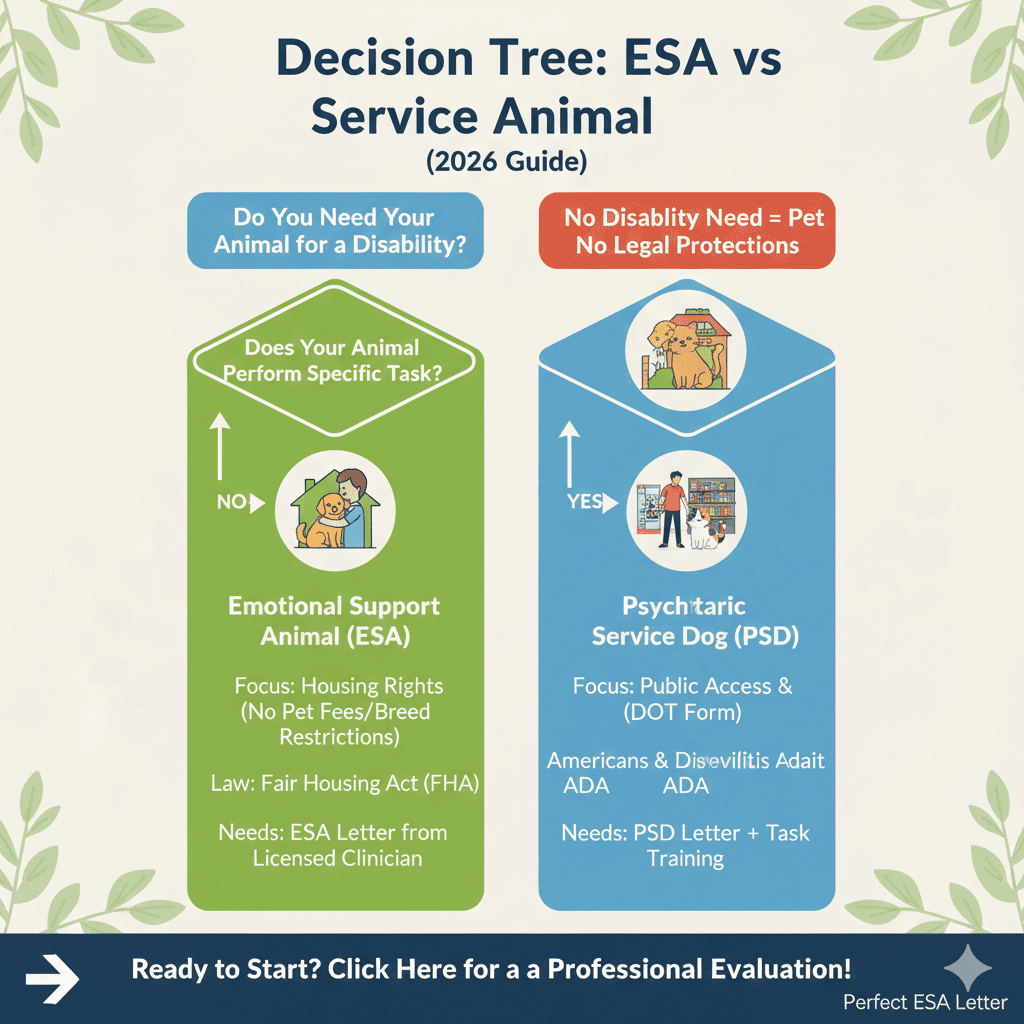
The most common point of confusion for many is the ESA vs. service animal letter. While both documents are intended to protect individuals with disabilities, they operate under entirely different federal laws. Choosing the wrong one can lead to your accommodation being denied by a landlord or being turned away at an airport.
At Perfect ESA Letter, we specialize in helping you identify exactly which legal path fits your lifestyle and therapeutic needs. If you’re ready to secure your rights, you can apply for an ESA letter now to speak with a licensed clinician who understands the 2026 landscape.
ESA vs. Service Animal Letter: The Fundamental Differences
The core difference between these two lies in the task versus the presence.
What is an ESA Letter?
An Emotional Support Animal provides therapeutic comfort through its presence alone. They do not require specific training. An ESA letter is a document written by a Licensed Mental Health Professional (LMHP) that qualifies you for housing protections under the Fair Housing Act (FHA).
What is a Service Animal (PSD) Letter?
A Service Animal (specifically a Psychiatric Service Dog) is a dog trained to perform a specific task to mitigate a disability. A PSD letter confirms that you have a qualifying disability and that your dog is part of your treatment plan, granting you access under the Americans with Disabilities Act (ADA).
Key Comparison Table (2026 Standards)
| Feature | ESA (Emotional Support Animal) | PSD (Psychiatric Service Dog) |
| Primary Law | Fair Housing Act (FHA) | Americans with Disabilities Act (ADA) |
| Training Needed | None (Presence only) | Task-specific training required |
| Public Access | No (Housing only) | Yes (Stores, Restaurants, etc.) |
| Air Travel | Treated as a pet | Permitted in-cabin (with DOT forms) |
| Species | Any domesticated animal | Dogs only |
| Documentation | Signed ESA Letter | Signed PSD Letter |
Understanding Housing Rights: FHA vs. ADA
When it comes to your home, the ESA vs. service animal letter distinction is less about “where” you can live and more about “how” you verify the animal.
Housing Protections for Both
Under the Fair Housing Act, both ESAs and Service Animals are considered “assistance animals.” This means that whether you have an ESA letter or a PSD letter, you are entitled to:
-
Exemption from “No-Pet” Policies: You can live in properties that otherwise ban animals.
-
Waiver of Pet Rent and Deposits: Landlords cannot charge you monthly fees or upfront security deposits for your assistance animal.
-
No Breed Restrictions: Standard “aggressive breed” lists do not apply to documented assistance animals.
The Verification Difference
-
For an ESA: A landlord is legally allowed to ask for an ESA letter from a licensed professional if your disability isn’t obvious.
-
For a Service Dog: A landlord may only ask two questions: (1) Is the dog a service animal required because of a disability? and (2) What work or task has the dog been trained to perform? They generally cannot ask for a “letter” if the task is obvious, but most tenants prefer having a PSD letter to prevent disputes.
Air Travel in 2026: Why the Letter Matters
If you plan on flying with your animal, the ESA vs. service animal letter debate becomes very clear. Since the 2021 DOT rule changes, which remain in effect in 2026:
-
ESAs are no longer required to be accepted in-cabin for free. Most airlines now treat ESAs as regular pets, meaning they must stay in a carrier and you must pay a pet fee.
-
Psychiatric Service Dogs (PSDs) are still protected. With a valid PSD letter and the completed DOT Service Animal Air Transportation Form, your dog can fly in the cabin at no extra cost.
If travel is a frequent part of your life, you may want to apply for an ESA letter now and ask our clinicians if you might qualify for the Psychiatric Service Dog path instead.
Training Requirements: The “Bright Line”
The most significant legal hurdle in the ESA vs. service animal letter comparison is training.
-
ESAs: Require zero training. Their only “job” is to love you and be there for you.
-
Service Animals: Must be trained to perform a task. Examples include:
-
Grounding: Tapping or leaning on you during a panic attack.
-
Interruption: Stopping repetitive behaviors or self-harm.
-
Room Searches: Checking a house for someone with PTSD before they enter.
-
Medication Reminders: Alerting you to take your meds at a specific time.
-
Internal Linking & Compliance Resources
-
Apply for an ESA letter now to secure your housing accommodation.
Frequently Asked Questions (FAQs)
Can my ESA also be a service dog?
An animal cannot be both at the same time in the eyes of the law. If your dog is trained to perform a task, it is a service animal. If it provides comfort only, it is an ESA. However, an ESA can become a service dog with the proper training.
Does an ESA letter allow me to take my dog to work?
The ADA does not cover ESAs in the workplace, but the FHA/EEOC allows you to request a “reasonable accommodation” from your employer. A valid ESA letter is usually required for this request, though approval is at the employer’s discretion.
What happens if I try to use an ESA letter for public access?
Using an ESA vs. service animal letter for public access (like a grocery store) is a common mistake. Most businesses will deny entry to an ESA. Misrepresenting an ESA as a service animal is also a crime in several states.
Do I need a vest or an ID card?
No. Neither the ADA nor the FHA requires your animal to wear a vest or carry an ID card. In fact, most 2026 landlords and airlines view these as “scam” items. The only legal proof is your letter and, for service dogs, the ability to perform a task.
How long is my letter valid?
For housing (ESA), letters are typically required to be updated every 12 months. For PSD travel, the DOT forms must be filled out for every trip, though your underlying medical letter remains valid for a year.
Can a landlord verify my letter?
Yes. A landlord can contact the clinician who signed the ESA vs. service animal letter to confirm that the letter is authentic and the doctor’s license is active. They cannot, however, ask for your medical history.
Conclusion: Choosing the Right Protection for You
When deciding between an ESA vs. service animal letter, start by looking at your daily needs. If you primarily need your animal’s support at home to manage anxiety or depression, an ESA letter is the most efficient and honest path. If your disability requires your dog to perform specific tasks and accompany you into public spaces or on flights, a Psychiatric Service Dog letter is the correct choice.
At Perfect ESA Letter, we take the stress out of the process. Our clinicians are experts in both FHA and ADA documentation, ensuring you receive the exact protection you need.
Don’t leave your housing or travel rights to chance.