
ESA Letter Template Explanation: What Your Documentation Needs to Succeed
ESA Letter Template Explanation: What Your Documentation Needs to Succeed
Navigating the legalities of emotional support animals can be a daunting task for many tenants. Whether you are moving into a new apartment or trying to secure your current home from “no-pet” policies, the document you provide to your landlord is your primary line of defense. However, simply having a note from a doctor isn’t always enough. To ensure your housing rights are protected under the Fair Housing Act (FHA), you need a specific ESA letter template explanation to understand why certain elements are non-negotiable.
Landlords and property managers are increasingly scrutinizing these documents to weed out fraudulent “registries.” A legitimate letter is much more than a permission slip; it is a clinical recommendation that connects your mental health needs to your living environment. In this guide, we will break down the anatomy of a compliant letter, explain the legal requirements of the Department of Housing and Urban Development (HUD), and show you how to identify a document that will actually hold up under review.
The Core ESA Letter Template Explanation
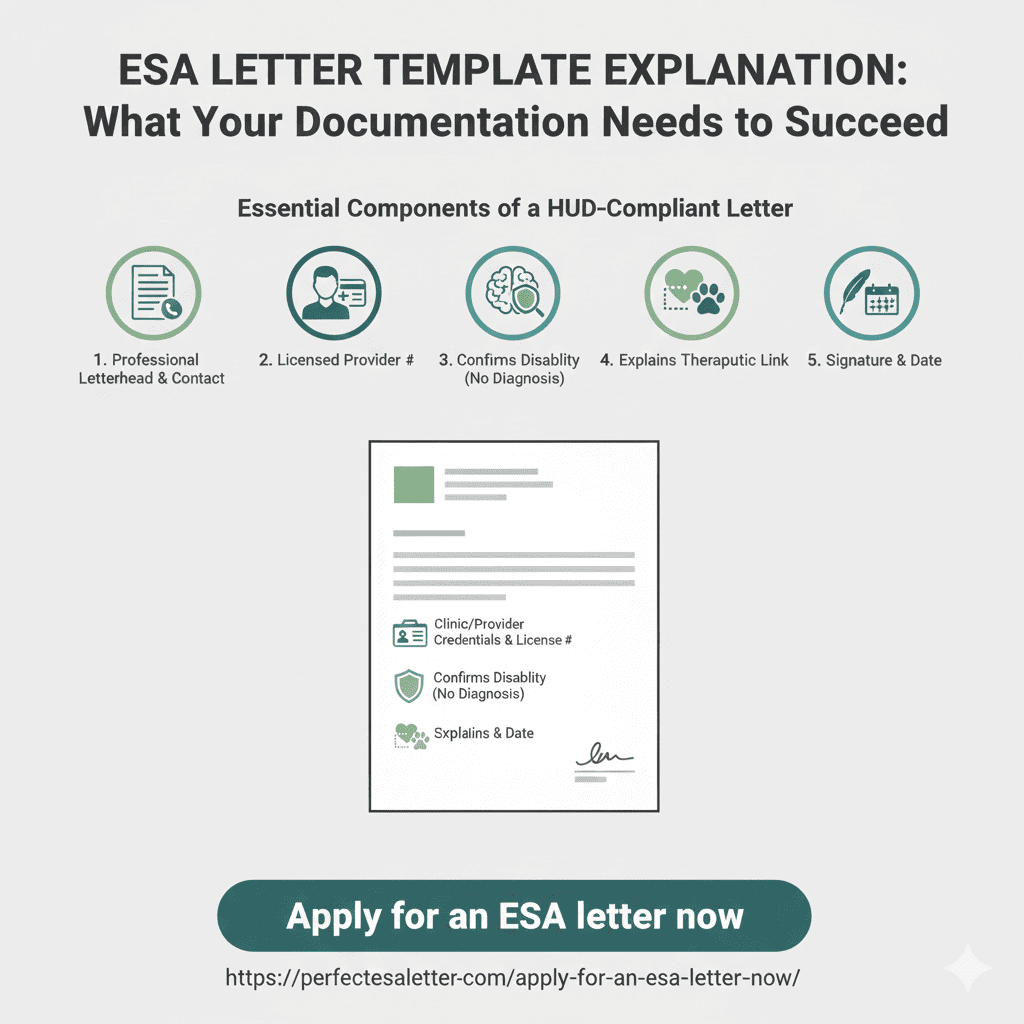
A legitimate ESA letter must follow a specific structure to be considered valid by housing providers. While there is no single “government-issued” form, HUD guidelines mandate that certain information must be present for a “reasonable accommodation” request to be granted.
1. The Professional Header
Every valid letter must begin with the clinician’s professional letterhead. This isn’t just for aesthetics; it provides the landlord with immediate proof that the document comes from a legitimate medical practice. It should include the practice name, physical address, and a direct contact phone number.
2. Provider’s License Information
This is arguably the most important part of our ESA letter template explanation. A landlord has the right to verify that the person signing the letter is a Licensed Mental Health Professional (LMHP). The letter must include:
-
The clinician’s full name and title (e.g., LCSW, LMFT, Psychologist).
-
Their specific license number.
-
The state in which they are licensed (which must typically match your state of residence).
3. Verification of Disability
The letter must state that you meet the definition of a person with a disability under the FHA. It is important to note that the clinician does not need to name your specific diagnosis (such as “Generalized Anxiety Disorder” or “Major Depressive Disorder”). A general statement regarding a mental or emotional impairment is sufficient to protect your privacy.
4. The “Nexus” or Therapeutic Link
A valid template must explain the “nexus”—the connection between your disability and the assistance the animal provides. The clinician must state that the animal’s presence alleviates at least one symptom of your disability, allowing you to have an equal opportunity to use and enjoy your dwelling.
Why You Can’t Use a Generic Online Template
While you might find a free “fill-in-the-blank” form online, using one is a significant risk. Here is why a DIY approach often fails:
-
Lack of Consultation: HUD specifically warns against letters issued without a meaningful interaction between the patient and the provider.
-
Verification Issues: Landlords often call the number on the letterhead. If it leads to a dead-end or a generic “registry” call center, your accommodation will be denied.
-
State Compliance: Some states have specific “cooling off” periods or relationship requirements. A generic template cannot account for these local nuances.
At Perfect ESA Letter, we provide more than just a template; we provide a clinical process that ensures every letter is drafted by a state-licensed professional who understands these legal requirements.
Comparison: Legitimate Letter vs. Fraudulent Registry
To help clarify this ESA letter template explanation, look at the differences between a legally binding document and the “certificates” sold by scam websites.
| Feature | Legitimate ESA Letter | Online “Registry” Certificate |
| Issuer | Licensed Clinician (LMHP) | Automated Website |
| Legal Standing | Fair Housing Act (FHA) | None |
| Clinician’s License # | Included and Verifiable | Missing or Generic |
| Therapeutic Nexus | Explained by a Professional | Not Included |
| HUD Compliance | Yes | No |
The Legal Rights Granted by a Valid Letter
Once you have a letter that matches our ESA letter template explanation, you are entitled to several federal protections that pets do not have:
-
Exemption from Pet Rent: You are no longer required to pay monthly fees for your animal.
-
No Pet Deposits: Landlords cannot charge you an upfront “pet fee” or deposit.
-
No Breed or Weight Restrictions: Your ESA cannot be denied based on its size or breed, provided it is well-behaved.
-
Access to “No-Pet” Housing: You can live in apartments that are otherwise closed to animals.
Internal Linking Suggestions
-
Anchor Text: how to qualify for an emotional support animal
-
Anchor Text: Fair Housing Act requirements for landlords
-
Anchor Text: ESA letter for anxiety and depression
Frequently Asked Questions (FAQs)
1. Does the letter need to mention my specific diagnosis?
No. Under the Fair Housing Act, your medical privacy is protected. A clinician only needs to state that you have a mental health disability that qualifies for an accommodation; they do not have to list the specific condition.
2. Can a landlord call my doctor to verify the letter?
Yes. A landlord is permitted to verify that the letter is authentic and that the clinician is licensed. However, the clinician cannot share your private session notes or medical history without your explicit consent.
3. What if my landlord has their own “ESA form”?
Some landlords provide their own paperwork for your doctor to sign. While you are not strictly required by law to use their form if your letter is already compliant, having your clinician fill it out can often make the process go faster.
4. Why is a license number required in the ESA letter template explanation?
Landlords use the license number to check the state’s online database. This confirms the doctor is in good standing and is authorized to practice in your state, which is a key requirement for a “legitimate” letter.
5. Does an ESA letter cover multiple animals?
A single letter can cover multiple animals, but the clinician must explain why each animal is necessary for your treatment. For example, one animal might assist with sleep issues while another helps with social anxiety.
6. Can I get a letter if my disability is not “obvious”?
Yes. Most ESA owners have “non-observable” disabilities like PTSD or depression. The law specifically requires landlords to accept professional documentation as proof of these invisible conditions.
7. How often should I update my ESA letter?
While the FHA does not set an expiration date, it is a best practice to renew your letter annually. This shows the landlord that your therapeutic need is ongoing and current.
8. Is a digital signature acceptable on an ESA letter?
Yes. In the modern telehealth era, digital signatures are legally binding and widely accepted by property management companies and landlords.
Secure Your Housing Rights with a Professional Evaluation
Understanding the ESA letter template explanation is the first step toward living a life free from discriminatory pet fees and housing restrictions. Your animal companion is a vital part of your support system, and they deserve the legal protection that only a legitimate, clinician-signed letter can provide.
At Perfect ESA Letter, we take the guesswork out of the process. We connect you with state-licensed mental health professionals who specialize in HUD-compliant documentation. Don’t risk your housing on a generic template or a registry scam. Get a letter that is professionally drafted, legally sound, and specifically tailored to your needs.