
ESA Letter Sample: What a Legitimate Document Should Look Like
ESA Letter Sample: What a Legitimate Document Should Look Like
Finding a reliable ESA letter sample is often the first step for individuals seeking to understand how to legally protect their housing rights. Whether you are dealing with a landlord who refuses to budge on a “no-pets” policy or you are trying to avoid paying hundreds of dollars in monthly pet rent, having the right documentation is everything.
However, a simple “sample” isn’t enough to secure your rights—you need to understand the legal anatomy of the document. Under the Fair Housing Act (FHA), an Emotional Support Animal (ESA) is considered an “assistance animal,” not a pet. To qualify for this status, your letter must meet specific criteria set by the Department of Housing and Urban Development (HUD). This guide provides a legitimate sample and breaks down exactly what your clinician needs to include to ensure your request for reasonable accommodation is granted.
What Must Be Included in a Legitimate ESA Letter?
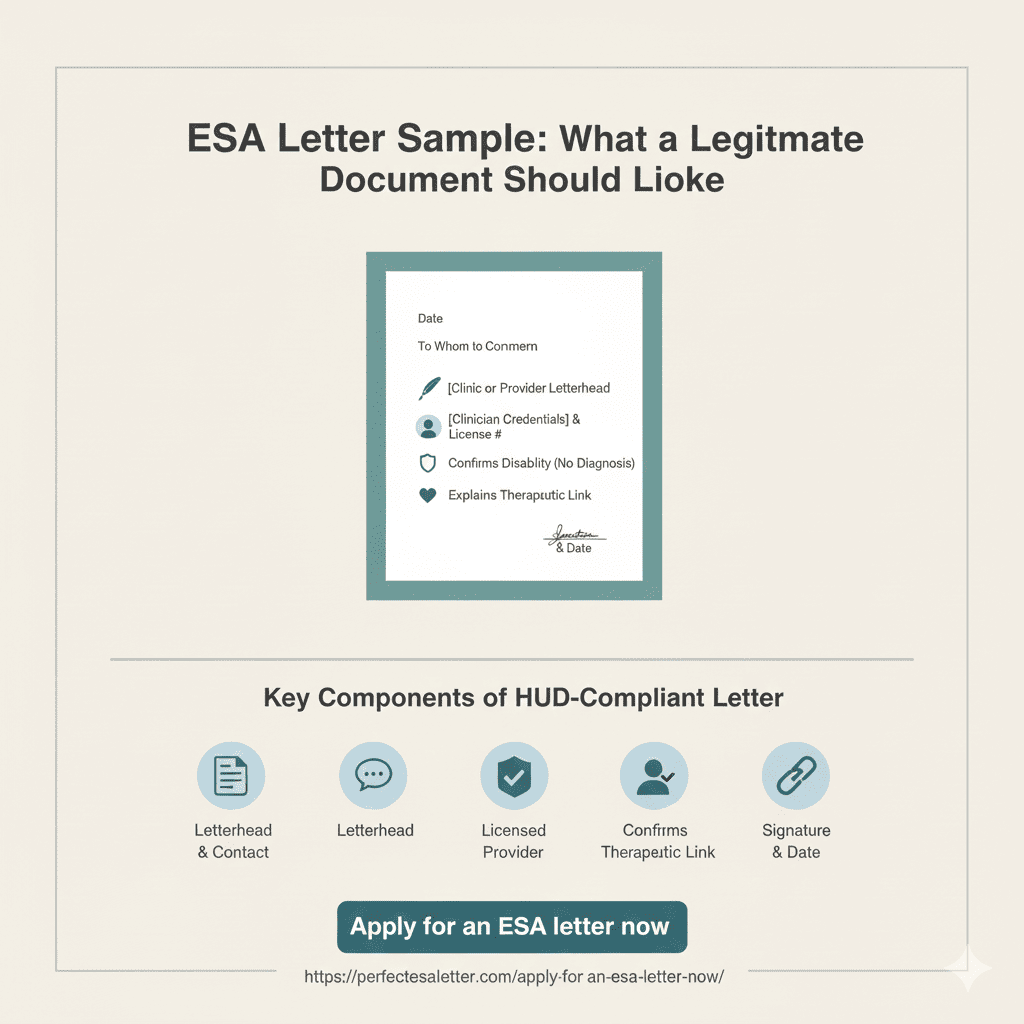
A valid ESA letter is essentially a professional recommendation from a licensed healthcare provider. It acts as a bridge between your medical need and your legal rights. Before looking at an ESA letter sample, you should know the five “pillars” of a compliant document.
1. Professional Letterhead
The letter must be written on the official letterhead of the Licensed Mental Health Professional (LMHP). This should include the name of their practice, their office address, and a reliable phone number.
2. Provider Credentials
The document must clearly state the clinician’s full name, their license type (e.g., Psychologist, LCSW, LMFT, or Psychiatrist), and their specific license number. Landlords often use this information to verify the professional’s status through state licensing boards.
3. Confirmation of Disability
The letter must confirm that you have a mental or emotional impairment that meets the definition of a disability under the FHA. Note: The clinician does not need to disclose your specific diagnosis or medical history to your landlord.
4. Therapeutic Link
The most critical part of any ESA letter sample is the explanation of how the animal helps. The clinician must state that the animal’s presence alleviates one or more symptoms of your disability, allowing you to “fully use and enjoy” your dwelling.
5. Signature and Date
A digital or “wet ink” signature is required, along with the date the letter was issued. Most housing providers prefer letters that are no more than one year old.
ESA Letter Sample for Housing Accommodation
Below is a standard template that reflects the language used by licensed professionals to ensure HUD compliance.
[Clinic or Provider Letterhead]
Date: [Current Date]
To Whom It May Concern:
I am a [Licensed Professional Type, e.g., Licensed Clinical Social Worker] in the state of [Your State], and I am currently providing professional mental health services to [Your Full Name].
I am familiar with [Your Name]’s medical history and the functional limitations imposed by their disability. [Your Name] meets the definition of a person with a disability under the Fair Housing Act and the Americans with Disabilities Act.
Due to this disability, [Your Name] experiences specific limitations that affect their activities of daily living. To help alleviate these symptoms and to enhance their ability to live independently and enjoy their dwelling, I have prescribed an emotional support animal. This animal is a necessary part of the treatment plan for [Your Name]’s disability.
In accordance with the Fair Housing Act, I recommend that [Your Name] be granted a reasonable accommodation to reside with their emotional support animal.
Should you have any questions regarding this recommendation, please feel free to contact my office.
Sincerely,
[Signature]
[Clinician’s Printed Name]
[License Type and Number]
[State of Licensure]
[Contact Phone/Email]
Why You Can’t Just Use a “Free” Sample
While viewing an ESA letter sample is helpful for education, you cannot simply copy and sign it yourself. Landlords are becoming increasingly skilled at identifying fraudulent documents.
Common Reasons for Rejection:
-
The “Out-of-State” Problem: If your letter is from a doctor in Florida but you live in Oregon, many landlords will flag it as suspicious. A legit service matches you with a clinician licensed in your specific state.
-
The “Registry” Scam: If your sample mentions a “registration number” or “official certification,” it is likely a fake. HUD explicitly states that registration certificates are not sufficient proof of a disability-related need for an animal.
-
No Consultation: If the letter was generated by an automated quiz without a live telehealth or in-person consultation, it lacks the legal weight required by HUD.
At Perfect ESA Letter, we ensure that every client receives a document that mirrors the high standards of our ESA letter sample, backed by a real clinician evaluation.
Internal Linking Suggestions
-
Anchor Text: how to qualify for an emotional support animal
-
Anchor Text: Fair Housing Act requirements for landlords
-
Anchor Text: legit ESA letter vs. online registries
Comparison: Legit Letter vs. Fraudulent Certificate
| Feature | Legitimate ESA Letter | Fraudulent “Registry” Certificate |
| Source | Licensed Clinician (LMHP) | Automated Website |
| Clinical Consultation | Yes (Required) | No |
| License Number Included | Yes | No |
| Legal Basis | Fair Housing Act | None |
| Accepted by Landlords | Yes | Frequently Denied |
Frequently Asked Questions (FAQs)
1. Does the ESA letter need to name my specific animal?
While not strictly required by HUD, many clinicians include the type of animal (e.g., “dog” or “cat”) and its name or breed to make the letter more specific to the tenant’s request. This can help prevent confusion if you have multiple animals.
2. Can I use a sample letter for my cat?
Yes. An ESA can be any common household pet, including cats, rabbits, or birds. The language in the ESA letter sample remains the same regardless of the species.
3. What if my landlord has their own form for the doctor to fill out?
Landlords cannot force a doctor to use their specific form. However, if your doctor is willing to complete it, it can sometimes speed up the approval process. A valid ESA letter on professional letterhead should be sufficient on its own.
4. Why does the letter need to mention the Fair Housing Act?
Referencing the FHA reminds the landlord of their federal obligations. It signals that you are aware of your rights and that the professional signing the letter is following established legal guidelines.
5. Can I get a letter if my condition is not “obvious”?
Yes. Most mental health conditions (anxiety, depression, PTSD) are “non-observable” disabilities. The FHA specifically protects individuals with these conditions, provided they have a letter from a professional who is familiar with their history.
6. Do I need to provide the letter before I sign my lease?
You can provide the letter at any time—during the application process, after signing the lease, or even after you have already moved in. Once you submit the letter, the landlord must process the accommodation request.
7. What happens if my landlord says the letter is “fake”?
If your letter follows the ESA letter sample provided above and is signed by a real, state-licensed professional, it is not fake. You can invite the landlord to contact the clinician’s office for verification. If they still refuse, you can file a complaint with HUD.
8. Does the letter need to be notarized?
No. There is no legal requirement for an ESA letter to be notarized. The professional signature and license number are the only verification markers needed.
Get a Legally Ironclad Letter Today
Looking at an ESA letter sample is a great way to prepare, but securing your housing rights requires a professional touch. Don’t risk a denial or a difficult conversation with your landlord by using a generic template or a “registry” scam.
At Perfect ESA Letter, we connect you with state-licensed mental health professionals who specialize in HUD-compliant evaluations. We ensure your letter contains every necessary component to guarantee your “reasonable accommodation” is accepted, allowing you to live in peace with your animal companion.