
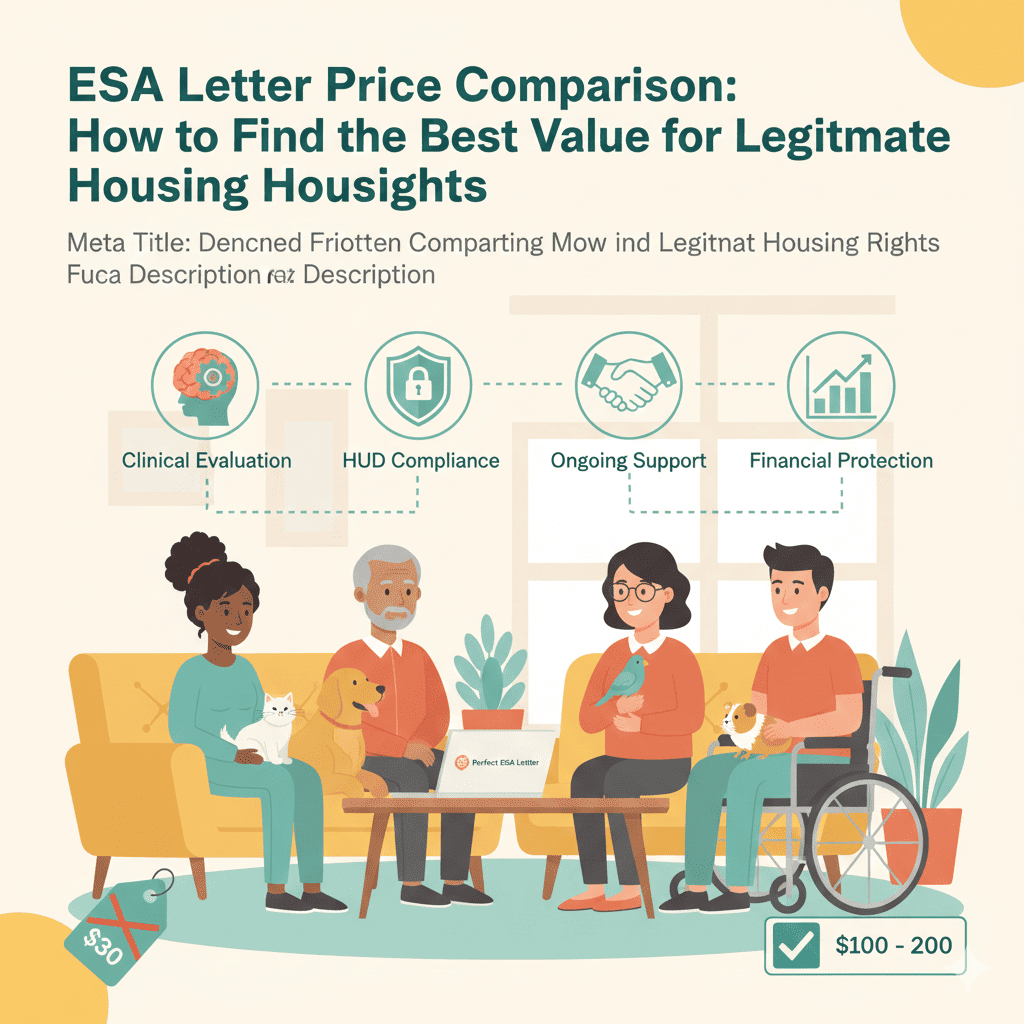
ESA Letter Price Comparison: How to Find the Best Value for Legitimate Housing Rights
ESA Letter Price Comparison: How to Find the Best Value for Legitimate Housing Rights
When you’re managing a mental health condition like anxiety, depression, or PTSD, your animal companion is more than a pet—they are a lifeline. However, securing your legal right to live with your animal in “no-pet” housing requires a legitimate recommendation from a licensed professional.
If you’ve searched online, you’ve likely noticed a massive discrepancy in costs. Some sites offer “instant” letters for $39, while others charge upwards of $200. This ESA letter price comparison guide will help you understand what a fair price looks like, what you’re actually paying for, and how to ensure your documentation is 100% HUD-compliant.
Why Does ESA Letter Pricing Vary So Much?
The market for emotional support animal documentation is divided into two main categories: legitimate clinical services and “registry” scams. Understanding this distinction is the first step in a meaningful ESA letter price comparison.
1. The Cost of Professional Expertise
A legitimate ESA letter is a medical prescription. To issue one, a Licensed Mental Health Professional (LMHP) must spend time reviewing your history and conducting a consultation. You are paying for their professional time, their state-verified license, and the legal weight of their signature.
2. Telehealth Infrastructure
Top-tier providers like Perfect ESA Letter utilize HIPAA-compliant platforms to ensure your medical data is secure. The cost of maintaining high-security systems and providing 24/7 customer support is reflected in the final price.
3. State-Specific Compliance
Laws regarding ESAs change frequently. For example, some states require a 30-day “established relationship” before a letter can be issued. Legitimate providers invest in legal research to ensure your letter is specifically tailored to the latest mandates in your state.
ESA Letter Price Comparison Table
To help you visualize the market, here is a breakdown of what you can expect to pay for different levels of service in today’s market:
| Service Level | Typical Price Range | What’s Included? | Verdict |
| “Registry” Scams | $30 – $70 | Digital “Certificate,” ID badge, vest, and “registration” on a fake database. | Avoid. Landlords are legally trained to reject these. |
| Basic Housing Letter | $120 – $160 | Screening, LMHP consultation, and a signed letter on official letterhead. | Best Value. Meets all HUD requirements. |
| Premium Support | $170 – $220 | Housing letter plus priority processing and direct landlord verification support. | Good for complex cases (multiple pets, hostile HOAs). |
| Psychiatric Service Dog (PSD) | $180 – $250 | In-depth assessment for dogs trained to perform tasks for mental health. | Necessary for air travel and broader public access. |
What are You Truly Paying for?
When you order an ESA letter, you aren’t just buying a PDF. A legitimate service provides a “Legal Defense Bundle” that includes:
-
State-Licensed Verifiability: Your landlord can look up the professional’s license number in a state database to confirm they are active and in good standing.
-
FHA Protection: Documentation written specifically to satisfy the requirements of the Fair Housing Act.
-
Landlord Interaction: If your property manager sends a 5-page “additional verification form,” a reputable provider will have their clinical team complete it on your behalf.
-
Financial Protection: A valid letter exempts you from pet deposits (often $250+) and monthly pet rent (often $50+ per month).
Expert Insight: A $150 ESA letter pays for itself in just three months if you were previously paying $50/month in pet rent.
Red Flags: How to Spot a “Too Good to Be True” Price
In our ESA letter price comparison, the lowest price is rarely the best deal. If a site offers any of the following, your “savings” could result in an eviction notice:
-
“Instant” Approval: Real clinicians do not issue prescriptions in 60 seconds. A legitimate evaluation takes human time.
-
Lifetime Validity: While the FHA doesn’t have an expiration date, landlords can legally request a letter that is “recent” (usually within the last year).
-
No Consultation: If you never speak to a human or receive a personalized assessment, the letter is likely a template that HUD warns landlords to ignore.
-
Registration Kits: HUD explicitly states that “registration” kits have no legal standing.
Managing Your ESA Budget: Ongoing Costs
While the letter is the primary legal hurdle, being a responsible ESA owner involves other expenses. When comparing the “cost of an ESA,” remember to budget for:
-
Annual Renewals: Most providers offer a discounted rate (usually $80–$120) for returning clients to keep their documentation current.
-
Veterinary Care: Routine checkups and vaccinations are essential for the health of your support animal.
-
Food and Supplies: High-quality nutrition and basic gear (leashes, bowls, beds).
Internal Linking Suggestions
-
Anchor Text: how to qualify for an ESA (Link to Eligibility/Conditions page)
-
Anchor Text: Fair Housing Act for tenants (Link to a guide on tenant rights)
-
Anchor Text: ESA vs. Service Dog differences (Link to comparison blog)
Frequently Asked Questions (FAQs)
1. Why are some ESA letters so much cheaper than others?
Cheap letters (under $100) are almost always “registrations” or “certificates” that do not involve a consultation with a licensed professional. Landlords are increasingly savvy and will reject these documents because they don’t meet HUD standards.
2. Can my landlord charge me a fee to “verify” my letter?
No. Under the Fair Housing Act, a landlord cannot charge any administrative fees or processing fees for a reasonable accommodation request.
3. Does the ESA letter price cover multiple animals?
Generally, a clinician can evaluate you for multiple animals if each animal provides a specific therapeutic benefit. Some services charge a small “add-on” fee ($30–$50) for the extra evaluation time required.
4. Is the cost of an ESA letter tax-deductible?
In some cases, yes. If the ESA is prescribed to treat a diagnosed mental health condition, the cost of the letter and certain care expenses may be considered deductible medical expenses. Consult with a tax professional for your specific situation.
5. What happens if I pay for a letter and my landlord rejects it?
A legitimate provider should offer a money-back guarantee. If your landlord rejects a compliant letter, the service should offer to communicate with the landlord to resolve the issue or provide a full refund.
6. Do I have to pay for an “Official Registry” number?
No. There is no legally recognized national or state registry for ESAs. Anyone selling you a “registration number” is selling you a product with zero legal value.
7. Why is there a price difference between ESA and PSD letters?
A Psychiatric Service Dog (PSD) letter requires a more rigorous evaluation because PSDs have broader legal rights (including air travel and public access). The higher price reflects the increased clinical time and legal liability involved.
8. How often should I renew my ESA letter?
While not strictly required by federal law, it is standard practice to renew your letter annually. This ensures that your documentation reflects your current mental health status and satisfies most landlord requirements.
Secure Your Peace of Mind Without Overpaying
Navigating the financial side of mental health support shouldn’t be stressful. While it’s tempting to look for the absolute lowest ESA letter price, the true value lies in a document that is legally bulletproof and backed by professional support.
At Perfect ESA Letter, we offer transparent, competitive pricing that covers everything you need: a thorough clinical evaluation, a state-licensed signature, and a 100% money-back guarantee. We don’t sell “certificates”—we provide the professional advocacy you need to keep your support animal by your side legally and affordably.