
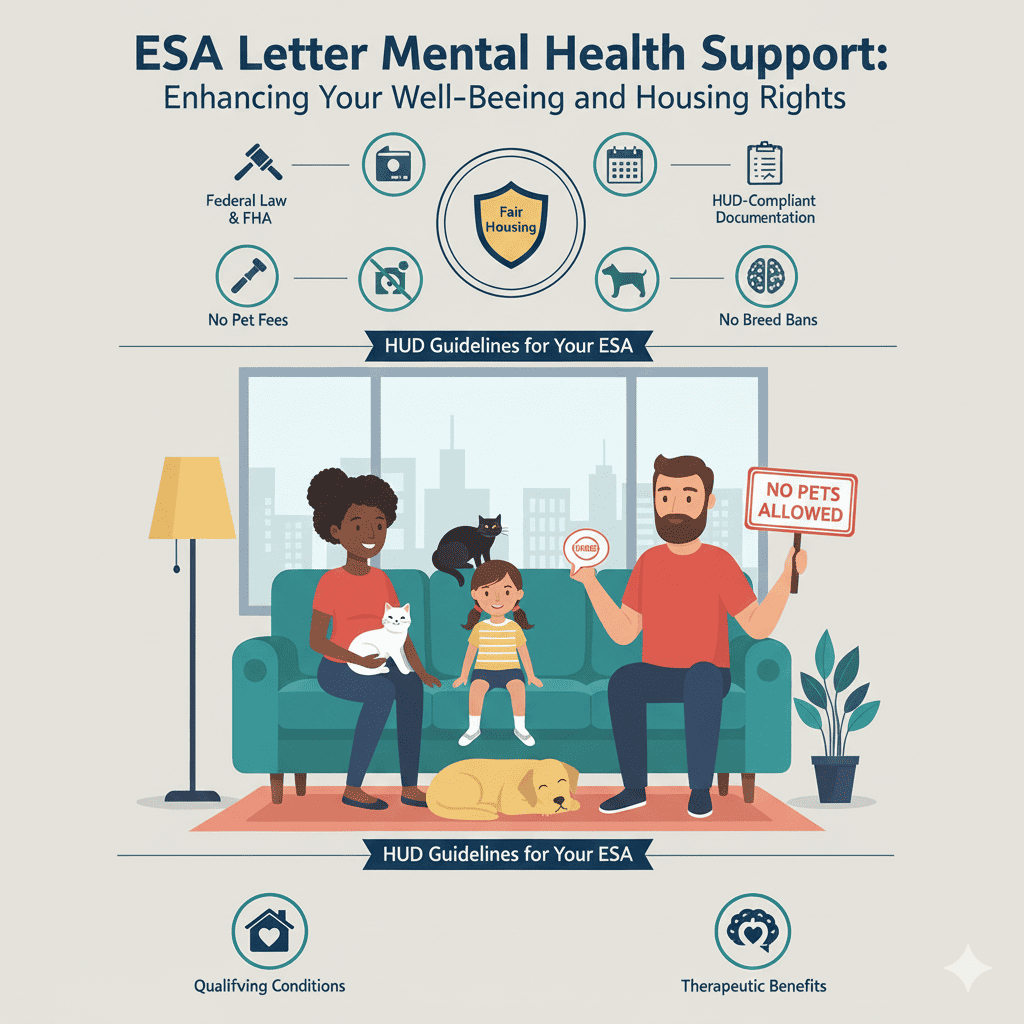
ESA Letter Mental Health Support: Enhancing Your Well-Being and Housing Rights
ESA Letter Mental Health Support: Enhancing Your Well-Being and Housing Rights
Meta Title: ESA Letter Mental Health Support | Legal Rights & Therapy Benefits
Meta Description: Discover how an ESA letter for mental health support can transform your recovery. Learn about housing protections, qualifying conditions, and how to get a legal letter.
For many individuals, the path to emotional stability isn’t found solely in a pharmacy or a therapist’s office; it is found in the wag of a tail, the purr of a cat, or the steady presence of a devoted animal companion. When traditional treatments aren’t enough, an ESA letter for mental health support provides a vital bridge between clinical care and daily living.
Beyond the immeasurable emotional bond, an ESA (Emotional Support Animal) letter serves as a formal recognition of your animal’s role in your treatment plan. Under federal law, this document ensures that your source of comfort isn’t stripped away by “no-pet” housing policies or burdened by expensive pet fees. In this guide, we explore how an ESA letter provides essential mental health support and the steps you need to take to secure your legal rights.
The Therapeutic Power of an ESA Letter for Mental Health Support
An emotional support animal is not just a pet. While pets provide general companionship, an ESA is specifically prescribed by a licensed professional to mitigate the symptoms of a mental health condition. An ESA letter for mental health support acknowledges that the animal’s presence is medically necessary for the owner’s well-being.
Scientific Benefits of Emotional Support Animals:
-
Reduction in Cortisol: Interacting with an animal can lower stress hormones and reduce physiological signs of anxiety.
-
Increased Oxytocin: Spending time with a companion animal releases “feel-good” hormones that improve mood and social bonding.
-
Routine and Purpose: The daily requirements of caring for an animal provide a sense of structure, which is critical for those managing depression.
-
Grounding during Panic: For those with PTSD or panic disorders, an animal’s physical touch provides a “grounding” effect, helping them return to the present moment.
Why an ESA Letter is Essential for Tenants
If you rely on your animal for emotional stability, your housing situation should be a sanctuary, not a source of stress. The Fair Housing Act (FHA) recognizes the importance of ESA letter mental health support and mandates that landlords provide “reasonable accommodation” for assistance animals.
Legal Protections for ESA Owners:
-
Bypass “No-Pet” Policies: Even if a building strictly prohibits pets, they must allow your ESA.
-
Exemption from Pet Fees: Landlords cannot charge you pet deposits or monthly pet rent.
-
No Breed or Weight Restrictions: Your ESA is protected regardless of its breed or size.
-
Peace of Mind: You no longer have to hide your animal or fear eviction due to your need for support.
Qualifying Conditions for ESA Letter Mental Health Support
Who is eligible for these protections? To qualify, a person must have a diagnosable mental or emotional disability that substantially limits one or more major life activities.
| Qualifying Condition | How an ESA Provides Support |
| Generalized Anxiety | Reduces heart rate and provides constant emotional reassurance. |
| Major Depression | Combats isolation and provides motivation to maintain a daily schedule. |
| PTSD | Helps the owner feel safe and provides a distraction during flashbacks. |
| Panic Disorder | Provides a calming physical presence to help “break” a panic cycle. |
| Bipolar Disorder | Offers a consistent, non-judgmental presence during mood fluctuations. |
| Social Phobia | Acts as a social “buffer,” making it easier for the owner to navigate the world. |
How to Get a Legitimate ESA Letter
To ensure your ESA letter for mental health support is accepted by property managers, it must be issued through a legitimate clinical process. A “certificate” from a registry website is not a legal document and is often rejected by landlords.
Step 1: Professional Evaluation
You must speak with a Licensed Mental Health Professional (LMHP). This can be a psychiatrist, psychologist, LCSW, or LMFT. They will assess your symptoms and determine if an ESA is an appropriate part of your mental health treatment.
Step 2: Verification of Need
The clinician must confirm that your animal provides a “nexus” of support—meaning the animal specifically helps alleviate symptoms caused by your disability.
Step 3: Formal Documentation
The resulting letter must be on the professional’s official letterhead and include:
-
The professional’s license type, number, and state of issuance.
-
The date the letter was issued.
-
A clear statement regarding your need for an assistance animal under the FHA.
At Perfect ESA Letter, we connect you with state-licensed professionals who understand HUD requirements, ensuring your letter is 100% compliant and legally sound.
Navigating Conversations with Your Landlord
Once you have your ESA letter for mental health support, you must present it to your landlord. While the law is on your side, approaching the conversation professionally can make the process smoother.
Best Practices for Submission:
-
Submit in Writing: Send a formal email or letter so you have a record of the request.
-
Timing: You can submit your letter before moving in or even after you are already living there. You are not required to disclose your ESA during the initial application phase.
-
Know Your Rights: If a landlord asks for your medical history or your animal’s “training certificates,” politely inform them that under HUD guidelines, those are not required for an ESA.
Internal Linking Suggestions
-
Anchor Text: ESA housing laws and rights
-
Anchor Text: how to qualify for an emotional support animal
-
Anchor Text: difference between service dogs and ESAs
Frequently Asked Questions (FAQs)
1. Does my ESA need special training?
No. Unlike service dogs, ESAs do not require specialized task training. Their primary “work” is to provide comfort through their presence. However, they must be well-behaved and not a nuisance to other tenants.
2. Can my landlord deny my ESA letter?
A landlord can only deny an ESA letter for mental health support if the animal poses a direct threat to the safety of others, causes significant property damage, or if the accommodation would cause “undue financial burden” to the landlord. They cannot deny it based on breed or general “no-pet” rules.
3. Is an online ESA letter legitimate?
Yes, provided it comes from a licensed professional who evaluates you via telehealth. HUD’s 2020 guidance explicitly allows for telehealth evaluations as long as the provider is licensed and has personal knowledge of the patient.
4. Do I need to renew my ESA letter?
While the Fair Housing Act doesn’t state an expiration date, most landlords request an updated letter every 12 months to verify that the mental health need is still current.
5. Can I have more than one ESA?
Yes. If you have multiple animals that provide different types of support for your condition, a clinician can write a letter justifying the need for more than one assistance animal.
6. Does an ESA have the right to go into restaurants?
No. An ESA letter for mental health support primarily provides housing protections under the FHA. It does not grant the same public access rights as the Americans with Disabilities Act (ADA) provides for service dogs.
7. What if my landlord says their insurance doesn’t allow the breed?
Under HUD guidelines, a landlord cannot deny an ESA based on breed-specific insurance policies unless the insurance company can prove that having that specific animal would result in the cancellation of the policy. This is a very difficult standard for landlords to meet.
8. Can I get an ESA letter for a cat?
Absolutely. While dogs are common, cats, rabbits, birds, and other common household animals can all qualify as emotional support animals.
Protect Your Mental Health and Your Home Today
An animal’s love is a powerful tool for recovery, but the fear of housing discrimination can dampen the healing process. Obtaining an ESA letter for mental health support is a proactive step in protecting your peace of mind and ensuring that your therapy animal remains by your side, no matter where you live.
Don’t let “no-pet” policies or expensive fees stand in the way of your well-being. At Perfect ESA Letter, we make the process of connecting with a licensed professional simple, secure, and legally compliant. Take the first step toward a more supportive home environment today.