
ESA Letter Legality: Understanding Your Rights Under the Fair Housing Act
ESA Letter Legality: Understanding Your Rights Under the Fair Housing Act
For millions of Americans living with mental health conditions, an emotional support animal (ESA) is more than just a companion—they are a vital part of a treatment plan. However, as the popularity of ESAs grows, so does the confusion surrounding ESA letter legality. With countless websites offering “instant registrations” and “official vests,” it is easy for well-meaning owners to accidentally purchase documentation that has zero legal standing.
If you are a tenant looking to waive pet fees or live in a “no-pet” building, understanding the laws that protect you is essential. The legality of an emotional support animal is governed primarily by the Fair Housing Act (FHA) and overseen by the Department of Housing and Urban Development (HUD). To be legally protected, you don’t need a “registry” or a “certificate”; you need a specific type of recommendation from a licensed professional.
At Perfect ESA Letter, we focus on 100% legal compliance. We connect you with state-licensed clinicians who provide the only documentation recognized by federal law. If you need to secure your housing rights, apply for an ESA letter now to schedule a professional evaluation.
The Foundation of ESA Letter Legality: The Fair Housing Act
The primary law governing ESA letter legality is the Fair Housing Act (FHA). This federal law prohibits discrimination against individuals with disabilities in housing. Under the FHA, emotional support animals are not considered “pets”—they are “assistance animals.”
Key Protections Under the FHA:
-
Access to No-Pet Housing: Landlords must make a “reasonable accommodation” to allow an ESA to live with you, even if the building has a strict no-pet policy.
-
Exemption from Pet Fees: You cannot be charged pet rent, pet deposits, or one-time pet fees for your ESA.
-
No Breed or Weight Restrictions: A landlord cannot deny your ESA based on its breed or size, provided the animal does not pose a direct threat to safety.
Important Note: While the FHA protects you in your home, it does not apply to restaurants, stores, or hotels. Only service animals (primarily dogs trained for specific tasks) have public access rights under the Americans with Disabilities Act (ADA).
HUD Guidelines: What Makes an ESA Letter Legally Valid?
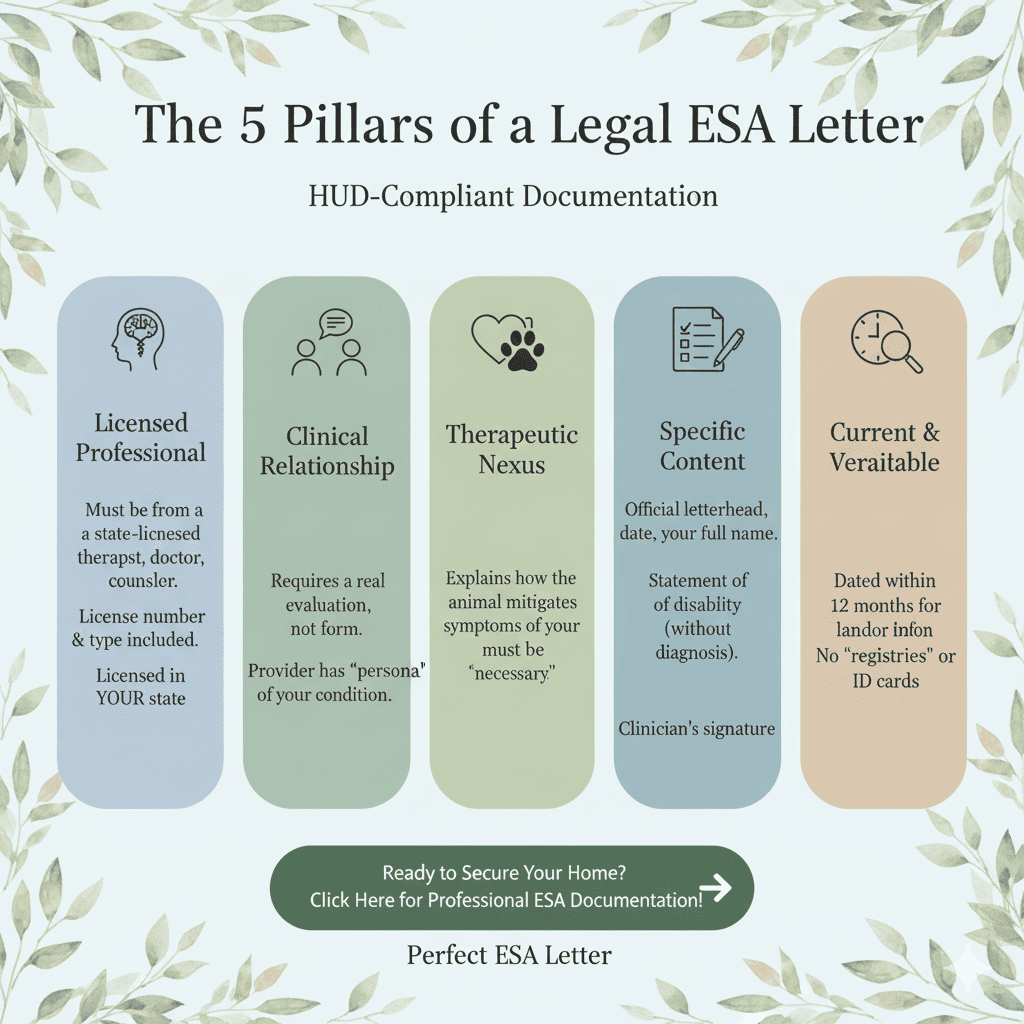
In 2020, HUD released updated guidance to clarify ESA letter legality and help landlords distinguish between legitimate requests and fraudulent ones. According to these standards, a letter is only legal if it meets the following criteria:
1. Issued by a Licensed Healthcare Professional
The letter must be written by a professional with a valid license in your state. This includes:
-
Psychiatrists and Psychologists
-
Licensed Clinical Social Workers (LCSW)
-
Licensed Professional Counselors (LPC)
-
Licensed Marriage and Family Therapists (LMFT)
-
Nurse Practitioners and Primary Care Physicians
2. Established Clinical Relationship
The professional must have “personal knowledge” of your condition. This means they must conduct an evaluation of your mental health. Many states have recently passed laws requiring a 30-day relationship with the clinician before a letter can be issued.
3. Necessary Content Requirements
A legally binding letter must be on the provider’s official letterhead and include:
-
The clinician’s full name and license type.
-
The clinician’s license number and state of issuance.
-
The date the letter was issued (letters should be updated annually).
-
A statement that you have a mental or emotional impairment that limits a major life activity.
-
A clear recommendation that the animal provides therapeutic support.
Legality vs. Scams: How to Spot a “Fake” ESA Service
The internet is flooded with “ESA Registries” and “Official Certificates.” It is crucial to know that there is no such thing as a legal ESA registry.
| Feature | Legitimate ESA Letter | Online Scam/Registry |
| Legal Basis | Fair Housing Act (FHA) | None (Purely Marketing) |
| Requirement | Evaluation by a Licensed Professional | A simple fee and “registration” |
| Documentation | Signed letter from a therapist | ID Cards, Vests, and Certificates |
| Landlord Acceptance | High (Legally required) | Extremely Low (Frequently rejected) |
| Price | Covers professional consultation | Usually ultra-cheap ($30-$60) |
If a website offers “instant approval” or tells you that you only need an ID card to live with your pet, they are not providing a legal service. Using these services can lead to your housing request being denied and, in some states, may even result in fines for fraud.
State-Specific Laws and Recent Updates
While the FHA is a federal law, several states have enacted additional statutes to strengthen ESA letter legality and prevent abuse.
-
California & Montana: These states require a clinician to have a 30-day clinical relationship with a patient before issuing a letter for an emotional support dog.
-
Florida: It is now a second-degree misdemeanor to provide fraudulent information or documentation for an emotional support animal.
-
Illinois: The Assistance Animal Integrity Act allows landlords to request further documentation if the initial letter is from a source that doesn’t have a history of treating the tenant.
At Perfect ESA Letter, our clinicians are trained in these state-specific nuances to ensure your letter isn’t just “legal” on a federal level, but compliant with your local regulations as well.
Internal Linking & Compliance Checklist
-
Apply for an ESA letter now to get a legally compliant document.
Frequently Asked Questions (FAQs)
Is an ESA letter legally required to live in an apartment?
Yes. If the building has a “no-pet” policy or charges pet fees, the only way to be legally exempt is to provide a valid ESA letter from a licensed professional.
Can a landlord verify the legality of my ESA letter?
Yes. Landlords have the right to verify that the clinician who signed the letter is indeed licensed and that they actually issued the document. They cannot, however, ask for your medical records or specific diagnosis.
Does an ESA letter lose its legality after a year?
While the FHA doesn’t explicitly state an expiration date, HUD guidance suggests that documentation should be “current.” Most landlords and property managers require a letter dated within the last 12 months.
Do I need to register my ESA on a government website?
No. There is no official government registry for ESAs. Any site claiming to be a “national registry” is a private company selling products that have no legal weight in housing court.
Can a landlord deny a legal ESA letter?
A landlord can only deny a request if the animal poses a “direct threat” to the health and safety of others, would cause substantial physical damage to the property, or if the accommodation creates an “undue financial burden.” They cannot deny you simply because of the animal’s breed.
Is it legal to get an ESA letter through telehealth?
Yes. HUD explicitly recognizes telehealth as a valid way to receive a mental health evaluation, provided the clinician is licensed in your state and follows professional standards of care.
What happens if I use a fake ESA letter?
If you submit a fraudulent letter, your landlord can legally deny your request, charge you back-rent for pet fees, or even move to evict you for a lease violation. In some states, it is also a punishable crime.
Ensure Your Peace of Mind with a Legally Compliant ESA Letter
Navigating ESA letter legality shouldn’t be a gamble. Your housing security and your relationship with your support animal are too important to leave to chance. By working with a service that understands HUD requirements and federal law, you protect yourself from rejection and legal headaches.
At Perfect ESA Letter, we provide the gold standard in ESA documentation. Our process is thorough, professional, and designed to stand up to any landlord’s scrutiny.
Don’t settle for a “certificate” that won’t work.
👉 Get a Legally Verified ESA Letter from a Licensed Professional Today