
ESA Letter Legal Guide: Navigating Your Rights Under Federal Law
ESA Letter Legal Guide: Navigating Your Rights Under Federal Law
For many individuals living with mental health conditions, an emotional support animal is not just a pet—it is a vital component of their therapeutic recovery and daily functioning. However, despite the clear benefits these animals provide, many owners face significant legal hurdles when trying to secure housing. Navigating the complexities of federal and state laws can be overwhelming, especially when confronted with skeptical landlords or conflicting information online.
This ESA letter legal guide is designed to provide you with a clear, authoritative roadmap to your rights. By understanding the Fair Housing Act (FHA) and the specific guidelines set by the Department of Housing and Urban Development (HUD), you can confidently advocate for yourself and your animal companion. Whether you are looking to bypass a “no-pet” policy or eliminate unfair pet fees, the law is on your side—provided you have the correct legal documentation.
The Legal Foundation: The Fair Housing Act (FHA)
The primary federal law protecting emotional support animal owners is the Fair Housing Act. Unlike the Americans with Disabilities Act (ADA), which focuses on service animals in public spaces, the FHA specifically addresses “assistance animals” in a residential context.
What the FHA Guarantees
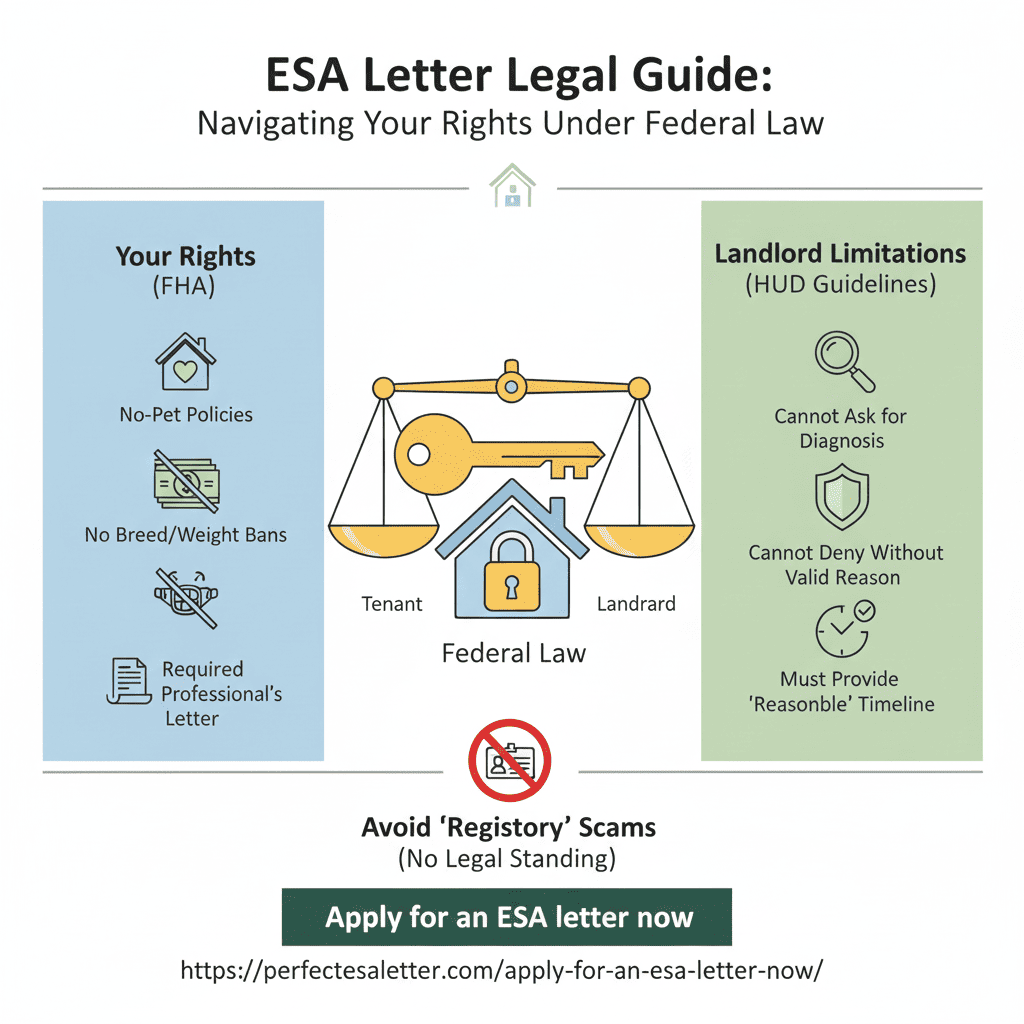
Under the FHA, housing providers are prohibited from discriminating against tenants based on a physical or mental disability. This means that landlords, property managers, and even Homeowners’ Associations (HOAs) must provide “reasonable accommodation” for an emotional support animal, even if the building has a strict no-pets policy.
Key Legal Protections for ESA Owners:
-
Exemption from “No-Pets” Rules: A valid ESA letter allows you to live with your animal in housing that otherwise bans pets.
-
Waiver of Financial Penalties: Landlords cannot charge “pet rent,” pet deposits, or upfront pet fees for an assistance animal.
-
Overriding Breed and Weight Restrictions: Federal law prevents landlords from denying an ESA based solely on its breed, size, or weight.
HUD Requirements: What Makes a Letter Legitimate?
The Department of Housing and Urban Development (HUD) provides the specific regulatory framework for how these laws are enforced. According to this ESA letter legal guide, a landlord is only required to grant an accommodation if the tenant provides reliable documentation from a licensed professional.
The Mandatory Components of a Legal Letter
To be considered legally sufficient under HUD standards, your letter must meet these criteria:
-
Written by a Licensed Healthcare Professional: This includes psychologists, psychiatrists, LCSWs, LMFTs, or even your primary care physician.
-
Official Letterhead: The document must feature the provider’s practice name, address, and contact information.
-
License Verification: The letter must state the professional’s license type, license number, and the state of their licensure.
-
The “Therapeutic Nexus”: The professional must confirm that you have a qualifying disability and that the animal provides a specific therapeutic benefit that alleviates your symptoms.
At Perfect ESA Letter, we ensure that every evaluation is performed by a state-licensed clinician who understands these exact HUD mandates, protecting you from legal challenges.
Legal Guide to Dealing with Landlords
One of the most stressful parts of being an ESA owner is the initial request to a landlord. Knowing what they can and cannot legally ask is your best defense.
What Landlords CAN Legally Ask:
-
Proof of Need: If your disability is not “readily apparent” (e.g., anxiety or PTSD), they can ask for a legitimate ESA letter.
-
Verification of License: They can verify with the state board that the clinician signing your letter is currently licensed and in good standing.
What Landlords CANNOT Legally Ask:
-
Specific Diagnosis: They cannot ask for your medical records or demand to know your specific diagnosis.
-
Detailed Medical History: They cannot inquire about the severity of your condition or your past treatments.
-
Specialized Training Proof: Because ESAs do not require training, a landlord cannot ask for “certification” of the animal’s skills.
-
Mandatory Forms: Landlords cannot require your doctor to use a specific, property-owned form. A standard letter on professional letterhead is sufficient.
Comparison Table: ESA Legal Rights vs. Standard Pet Owner Rights
| Category | Standard Pet Owner | ESA Owner (with Valid Letter) |
| Protected by FHA? | No | Yes |
| Must Pay Pet Rent? | Yes | No |
| Subject to Breed Bans? | Yes | No |
| Access to “No-Pet” Housing? | No | Yes |
| Medical Privacy? | N/A | Protected by HUD/HIPAA |
Avoiding the “Registry” Trap: A Legal Warning
A critical part of any ESA letter legal guide is warning against the “registry” scam. Many websites offer “official registration” for your animal, complete with a plastic ID card or a certificate.
The Legal Reality: There is no such thing as an official government registry for emotional support animals. HUD explicitly states that “registration certificates” purchased online without a clinical evaluation are not sufficient to establish a disability-related need for an animal. Using these documents can lead to your housing request being denied and, in some states, may even carry legal penalties for misrepresentation.
Internal Linking Suggestions
-
Anchor Text: how to qualify for an emotional support animal
-
Anchor Text: Fair Housing Act guidelines for renters
-
Anchor Text: identifying legitimate ESA services
Frequently Asked Questions (FAQs)
1. Can a landlord refuse my ESA because of its breed?
No. Under the FHA, breed, size, and weight limitations do not apply to assistance animals. A landlord can only deny an ESA if that specific animal has a documented history of aggression or if its presence would cause “undue financial or administrative burden” to the property.
2. Is an ESA letter from an online doctor legal?
Yes, as long as the service is legitimate. HUD recognizes letters from professionals who provide services via telehealth, provided they are licensed in your state and have conducted a proper clinical evaluation.
3. Do I have to tell the landlord about my ESA before I sign the lease?
You are not legally required to disclose your ESA before signing. However, many legal experts recommend making the request early to ensure a smooth transition. You can make the request at any time—even after you have already moved in.
4. What is the difference between a service animal and an ESA legally?
Service animals (dogs only) are covered by the ADA and have public access rights. ESAs (any common animal) are primarily covered by the FHA for housing protections. ESAs do not have a legal right to enter restaurants or grocery stores.
5. Can my HOA block my emotional support animal?
No. HOAs are subject to the Fair Housing Act just like traditional landlords. They must make reasonable accommodations for residents with valid ESA documentation, regardless of their internal pet bylaws.
6. Can a landlord charge a “processing fee” for my ESA letter?
No. Charging a fee to process a request for reasonable accommodation is considered a form of discrimination and is prohibited under federal law.
7. Does my ESA letter expire?
While the FHA doesn’t explicitly state an expiration date, it is highly recommended to update your letter every year. Most housing providers consider a letter to be “current” if it was issued within the last 12 months.
8. What should I do if my landlord denies my request?
If you have provided a legitimate letter and were denied, you can file a formal complaint with the HUD Office of Fair Housing and Equal Opportunity (FHEO). They investigate claims of housing discrimination at no cost to you.
Secure Your Rights Today
You deserve to live in a home where your mental health needs are respected and your animal companion is welcome. Don’t let confusing terminology or aggressive property management prevent you from exercising your rights under the Fair Housing Act. Using this ESA letter legal guide as your foundation, you can take the necessary steps to protect your living situation.
At Perfect ESA Letter, we specialize in providing the legally compliant documentation you need to succeed. Our network of state-licensed clinicians is well-versed in HUD regulations and ready to help you secure the reasonable accommodation you are entitled to. Stop paying pet fees and start living with peace of mind.