
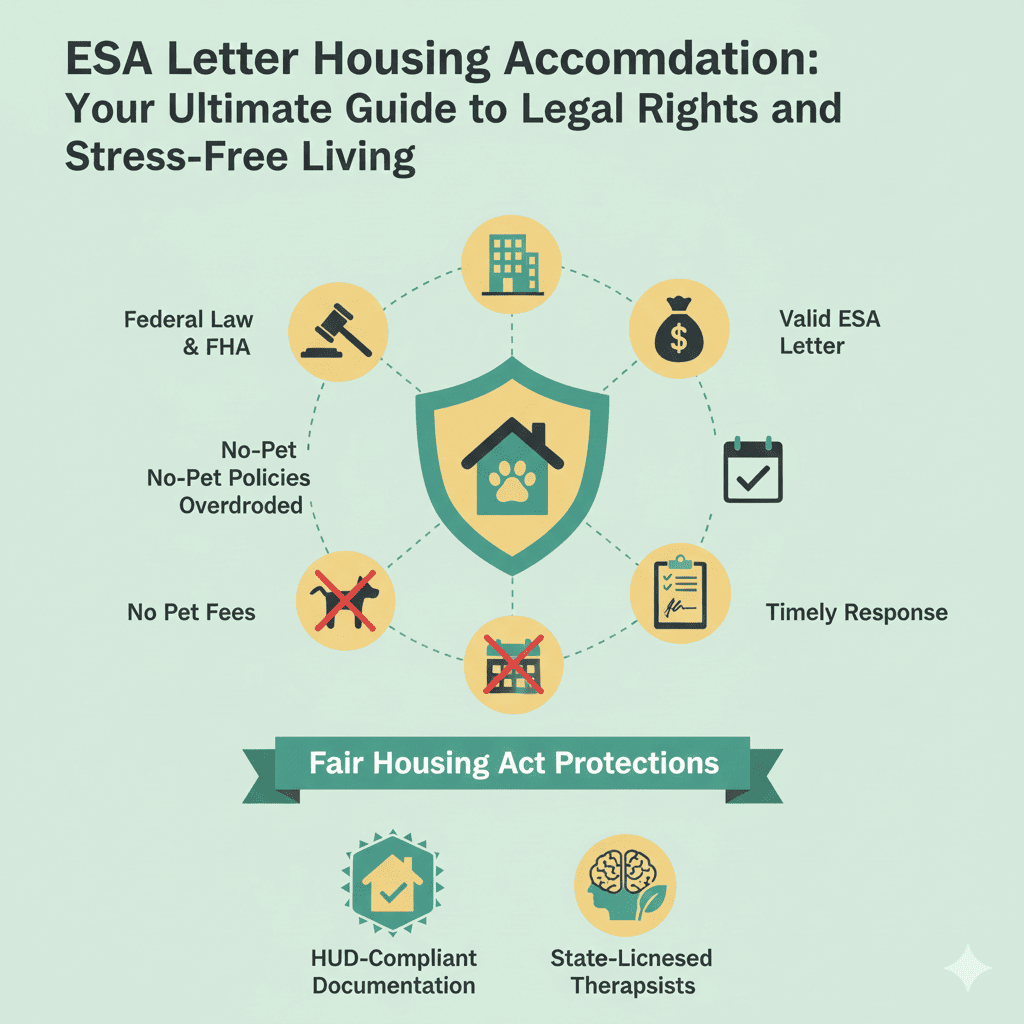
ESA Letter Housing Accommodation: Your Ultimate Guide to Legal Rights and Stress-Free Living
ESA Letter Housing Accommodation: Your Ultimate Guide to Legal Rights and Stress-Free Living
For many individuals navigating mental health challenges like anxiety, depression, or PTSD, an emotional support animal (ESA) is far more than a companion—it is a vital component of their daily stability and well-being. However, the prospect of finding a home or staying in your current residence can become a source of immense stress when faced with strict “no-pet” policies or expensive monthly fees.
The solution lies in securing a formal ESA letter housing accommodation. Under federal law, your support animal is not a pet; it is an assistance animal that grants you specific legal protections. This guide will walk you through everything you need to know about your rights under the Fair Housing Act (FHA) and how to ensure your housing provider respects your need for a support animal.
What is an ESA Letter Housing Accommodation?
An ESA letter housing accommodation is a formal request for a “reasonable accommodation” under the Fair Housing Act. When you provide a landlord or property manager with a legitimate ESA letter signed by a Licensed Mental Health Professional (LMHP), you are legally informing them that you have a disability-related need for your animal.
Unlike service animals, which are trained to perform specific tasks, emotional support animals provide therapeutic benefits simply through their presence. Federal law recognizes this necessity and requires housing providers to adjust their rules to allow you and your animal to live together.
Your Legal Rights Under the Fair Housing Act (FHA)
The FHA is the primary federal law that protects your ESA letter housing accommodation request. It prohibits discrimination against individuals with physical or mental disabilities in nearly all types of housing.
Key Protections You Should Know:
-
Exemption from “No-Pet” Policies: Even if a building has a strict “no animals” rule, they must make an exception for your ESA.
-
Waiver of Pet Fees: Landlords are prohibited from charging pet deposits, monthly pet rent, or one-time pet move-in fees for an ESA.
-
Bypass of Breed and Weight Limits: Blanket bans on “aggressive breeds” (like Pit Bulls or Dobermans) or weight restrictions (e.g., “no dogs over 25 lbs”) do not apply to emotional support animals.
-
Coverage for Most Housing Types: This includes private rentals, apartments, condos, and even university dorms.
Why a Legitimate ESA Letter is Non-Negotiable
To successfully exercise your ESA letter housing accommodation rights, your documentation must be legally airtight. HUD (the Department of Housing and Urban Development) has cracked down on “online registries” and “certificates” that do not involve a real clinical evaluation.
What Makes a Letter Legally Valid?
A valid ESA letter must be written by a Licensed Mental Health Professional (LMHP) licensed in your state. It must include:
-
Professional Letterhead: Including the clinician’s contact info.
-
License Information: The practitioner’s license type and number.
-
The Clinical Connection: A statement confirming that you have a mental or emotional disability and that the animal provides support that alleviates at least one symptom.
-
Recency: Most landlords require the letter to be dated within the last 12 months.
At Perfect ESA Letter, we bridge the gap by connecting you with state-licensed professionals who provide HUD-compliant letters that landlords must respect.
How to Submit Your Accommodation Request
Requesting an ESA letter housing accommodation should be handled professionally. While the law does not require you to use “magic words,” following a structured process ensures you are protected.
Step-by-Step Submission Guide:
-
Secure Your Letter First: Never bring an animal into a no-pet home without the letter in hand.
-
Submit a Written Request: While you can ask verbally, a written request (via email or certified mail) creates a vital legal paper trail.
-
Use a Clear Subject Line: Example: “Request for Reasonable Accommodation – Emotional Support Animal.”
-
Attach the Documentation: Provide a copy of your signed ESA letter.
-
Wait for Response: Landlords typically have 10–30 days to review and approve your request.
ESA Housing Rights vs. Service Dog Rights
It is important to understand the scope of an ESA letter housing accommodation compared to Service Dog protections.
| Feature | Emotional Support Animal (ESA) | Service Animal (Dog/Mini Horse) |
| Primary Law | Fair Housing Act (FHA) | Americans with Disabilities Act (ADA) |
| Housing Protection | Full Protection | Full Protection |
| Public Access (Stores/Malls) | No Legal Right | Full Access Rights |
| Pet Fee Waiver | Yes | Yes |
| Training Required | No specialized training | Must be task-trained |
Common Landlord Objections and How to Overcome Them
Despite the law, some landlords may push back. Knowing the legal limits of their inquiries is your best defense.
Objection: “We have a weight limit of 20 lbs.”
The Legal Reality: HUD guidelines specify that breed and size limits do not apply to assistance animals. Unless the landlord can prove the specific animal poses a direct threat, they must waive this rule.
Objection: “I need to see your medical records.”
The Legal Reality: This is a violation of your privacy. Landlords cannot ask for your diagnosis, your medical history, or the severity of your condition. Your ESA letter is all the proof they are legally entitled to receive.
Objection: “You have to use our specific office form.”
The Legal Reality: While a landlord can provide a form, they cannot require it if your therapist’s letter already contains the legally necessary information.
Internal Linking Suggestions
-
Anchor Text: conditions that qualify for an ESA (Link to a page on anxiety/depression/PTSD)
-
Anchor Text: how to talk to your landlord about an ESA (Link to a communication guide)
-
Anchor Text: ESA laws by state (Link to state-specific legal resources)
Frequently Asked Questions (FAQs)
1. Does my landlord have to approve my ESA before I move in?
Yes. You should submit your ESA letter housing accommodation request before moving the animal in. However, the FHA allows you to request an accommodation at any time—even if you already have the animal or are facing an eviction notice.
2. Can a landlord deny an ESA if their insurance doesn’t allow it?
Generally, no. A landlord cannot deny an ESA based on a general insurance policy breed ban. They must provide proof that their insurance carrier would actually cancel the policy specifically because of your animal.
3. Do I have to pay “Pet Rent” with an ESA letter?
No. Once your ESA letter housing accommodation is approved, all pet rent and pet fees must be waived. If you have been paying them, the landlord should stop charging them immediately upon receipt of the letter.
4. Can I have more than one ESA in the same home?
Yes. You can have multiple support animals, but your clinician’s letter must explain why each specific animal is necessary for your treatment.
5. What if I live in a “Mrs. Murphy” building?
The FHA has a small exemption for owner-occupied buildings with four or fewer units. In these rare cases, the landlord may be exempt from providing an ESA accommodation.
6. Can my landlord ask for my ESA to be “registered” or “certified”?
No. There is no official federal registry for ESAs. Landlords who demand a “registration certificate” are often misinformed. The only legal requirement is a valid letter from an LMHP.
7. Am I responsible for damages caused by my ESA?
Yes. While you don’t pay a pet deposit, you are still financially responsible for any actual damage the animal causes to the property (beyond normal wear and tear).
8. What should I do if my request is ignored?
If a landlord ignores a formal request for 10–30 days, they may be in “constructive denial” of your rights. You have the right to file a complaint with HUD or your local fair housing agency.
Take the Stress Out of Your Housing Search
You should never have to choose between your mental health and a place to live. An ESA letter housing accommodation is the bridge that allows you to maintain your treatment plan while living in the home of your choice.
At Perfect ESA Letter, we take the guesswork out of the process. We provide you with the clinical evaluation and the high-quality, HUD-compliant documentation you need to protect your rights. Don’t let “no-pet” policies stand in your way—secure the peace of mind you and your support animal deserve.