
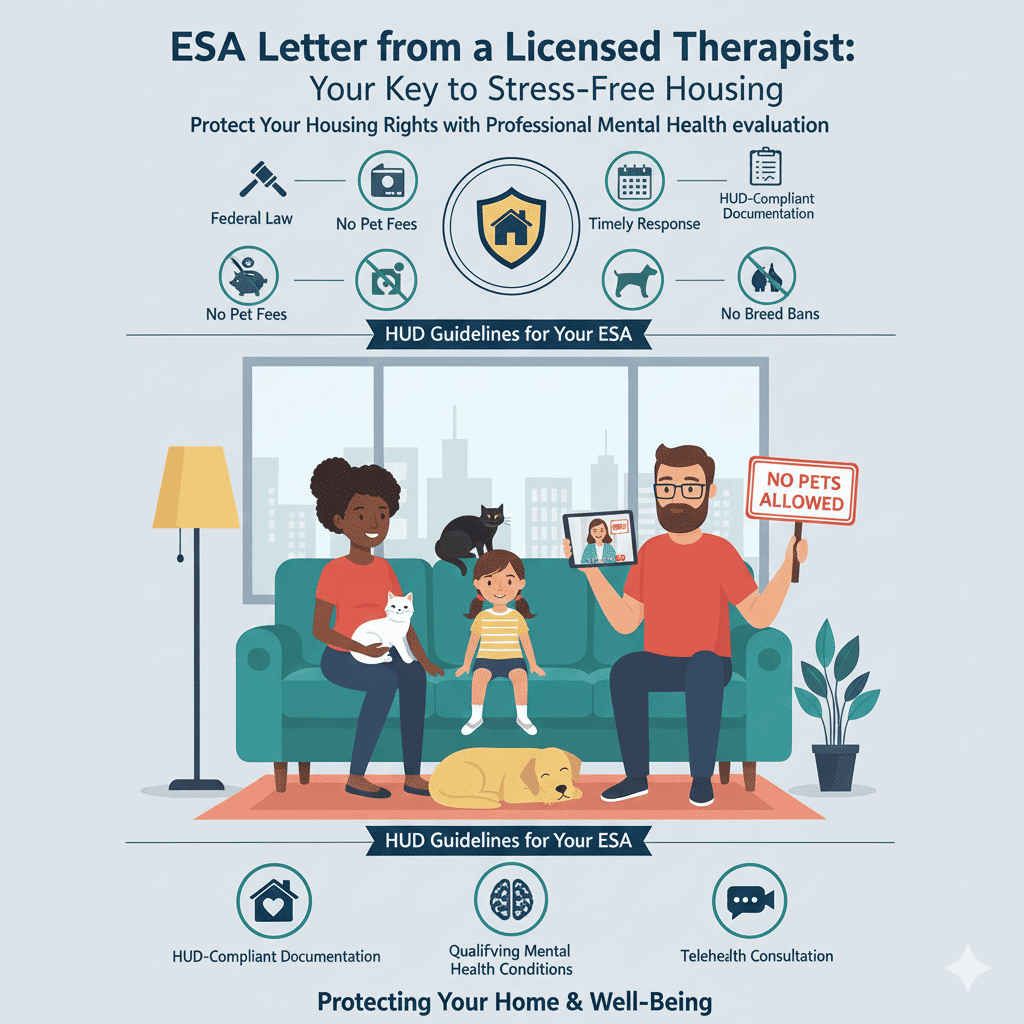
ESA Letter from a Licensed Therapist: Your Key to Stress-Free Housing
ESA Letter from a Licensed Therapist: Your Key to Stress-Free Housing
Finding the perfect home is hard enough without the added worry of pet restrictions or expensive monthly surcharges. For many, a dog or cat is more than a pet—it is a lifeline that provides essential emotional stability. If you are managing a mental health condition, obtaining an ESA letter from a licensed therapist is the most important step you can take to protect your housing rights and your peace of mind.
Under the Fair Housing Act (FHA), emotional support animals (ESAs) are not classified as pets; they are recognized as assistance animals. This means that with the right documentation, you are legally entitled to live with your animal even in “no-pet” housing, and you are exempt from all pet-related fees. However, the validity of these rights hinges entirely on the source of your documentation. In this guide, we will explore why a licensed professional is the only legitimate source for an ESA letter and how you can secure one easily and legally.
Why You Need an ESA Letter from a Licensed Therapist
The U.S. Department of Housing and Urban Development (HUD) is very specific about who can verify a tenant’s need for an assistance animal. A “certificate” from a registry website or a badge from an online store holds no legal weight. To be considered valid, your documentation must be an ESA letter from a licensed therapist or another qualified healthcare professional.
The Legal Standards for Validity
To satisfy HUD and FHA requirements, your letter must meet the following criteria:
-
Professional Credentials: It must be written by a Licensed Mental Health Professional (LMHP) such as a therapist, psychologist, psychiatrist, or clinical social worker.
-
State Licensure: The professional must be licensed to practice in the state where you reside.
-
Established Relationship: The therapist must have evaluated you (either in person or via telehealth) and confirmed that you have a mental or emotional disability.
-
The “Nexus”: The letter must clearly state that the animal provides support that alleviates at least one symptom of your condition.
Qualifying Mental Health Conditions
Many people are unaware of the broad range of conditions that qualify for an ESA. If a mental health challenge impacts your ability to perform major life activities—such as sleeping, working, or social interaction—you are likely eligible for an ESA letter from a licensed therapist.
Common Qualifying Conditions Include:
-
Anxiety and Panic Disorders: Animals provide a grounding presence during moments of high stress.
-
Depression: The routine and companionship of an ESA can combat feelings of isolation and hopelessness.
-
Post-Traumatic Stress Disorder (PTSD): ESAs can help mitigate hyper-vigilance and night terrors.
-
Bipolar Disorder: Helping to stabilize mood swings through consistent companionship.
-
Chronic Stress: Reducing cortisol levels and providing a calming influence.
-
Social Phobias: Acting as a “buffer” that makes navigating public spaces easier.
Comparison: Legitimate Clinician vs. Online Registry Scams
When searching for an ESA letter, it is easy to be misled by sites offering “instant registration.” Understanding the difference is crucial for your housing security.
| Feature | ESA Letter from a Licensed Therapist | Fake “Registry” Site |
| Legal Standing | Fully Protected by FHA/HUD | No Legal Protection |
| Professional Review | Real Clinician Evaluation | Automated/Instant |
| License Verification | State License Number Included | None or Fraudulent |
| Accepted by Landlords | Yes | Commonly Rejected |
| Waives Pet Rent/Fees | Yes | No |
At Perfect ESA Letter, we bridge the gap by connecting you with real, state-licensed professionals who provide legally binding documentation.
The Benefits of a Professional Telehealth Consultation
You don’t need to visit a therapist’s office in person to get a valid recommendation. HUD explicitly recognizes that a legitimate ESA letter from a licensed therapist can be issued through remote services or telehealth.
Why Telehealth is a Great Option:
-
Privacy and Comfort: Discuss your mental health from the safety of your own home.
-
Accessibility: Ideal for those who live in rural areas or have mobility issues.
-
Speed: You can often be matched with a clinician and complete your evaluation within days.
-
Specialization: Online platforms often have clinicians who specifically understand assistance animal laws, ensuring your letter is formatted correctly for HUD.
How to Submit Your ESA Letter to Your Landlord
Once you have secured your ESA letter from a licensed therapist, the process of requesting accommodation is straightforward. You are not asking for a favor; you are exercising a federal right.
-
Make a Written Request: Submit your letter along with a brief note stating: “I am requesting a reasonable accommodation for my emotional support animal under the Fair Housing Act.”
-
Timing Your Request: You can submit your letter before you move in, during the application process, or even after you have lived in the unit for months.
-
Know What They Can’t Ask: A landlord cannot ask about your specific diagnosis, require medical records, or demand that the animal have “special training.”
-
Response Time: Landlords are generally expected to respond to your request within 10 business days.
Internal Linking Suggestions
-
Anchor Text: requirements for an ESA letter
-
Anchor Text: Fair Housing Act for assistance animals
-
Anchor Text: ESA vs Service Dog for housing
Frequently Asked Questions (FAQs)
1. Can a therapist licensed in another state write my letter?
No. To be valid for housing, your ESA letter from a licensed therapist must be issued by a professional who is licensed to practice in your current state of residence.
2. Is there a difference between a “certificate” and an ESA letter?
Yes. A certificate or ID card is a novelty item with no legal standing. An ESA letter is a clinical recommendation that acts as your legal “prescription” for an assistance animal.
3. Can I get an ESA letter for my cat or a small bird?
Absolutely. While dogs are common, the FHA protects most common household animals—including cats, birds, and rabbits—as long as a therapist confirms their therapeutic benefit.
4. Do I have to pay pet rent if I have an ESA letter?
No. Once you provide a valid ESA letter from a licensed therapist, your landlord must waive all pet-related fees, including deposits and monthly pet rent.
5. Does my therapist need to use a specific landlord-provided form?
No. HUD guidelines state that landlords cannot require your therapist to fill out their specific forms. A valid letter on official letterhead is sufficient.
6. Can a landlord deny my request if my dog is a certain breed?
No. Under the FHA, breed and weight restrictions do not apply to ESAs. A landlord can only deny an animal if it poses a documented, direct threat to the safety of others.
7. How long is an ESA letter valid?
While the law doesn’t state an expiration, most landlords require a letter dated within the last 12 months to ensure your mental health need is current.
8. What if I don’t currently have a therapist?
You can still qualify. Services like Perfect ESA Letter connect you with licensed professionals for a one-on-one evaluation to determine your eligibility.
Take the Stress Out of Renting with an ESA
Your mental health is a priority, and your support animal is an essential part of your recovery. Don’t let restrictive housing policies or unfair fees add to your burden. By obtaining a legitimate ESA letter from a licensed therapist, you gain the legal protection you need to live comfortably with your companion.
At Perfect ESA Letter, we specialize in making this process as smooth as possible. We connect you with compassionate, state-licensed professionals who understand HUD regulations and are dedicated to supporting your mental health journey. Secure your rights and protect your home today.