
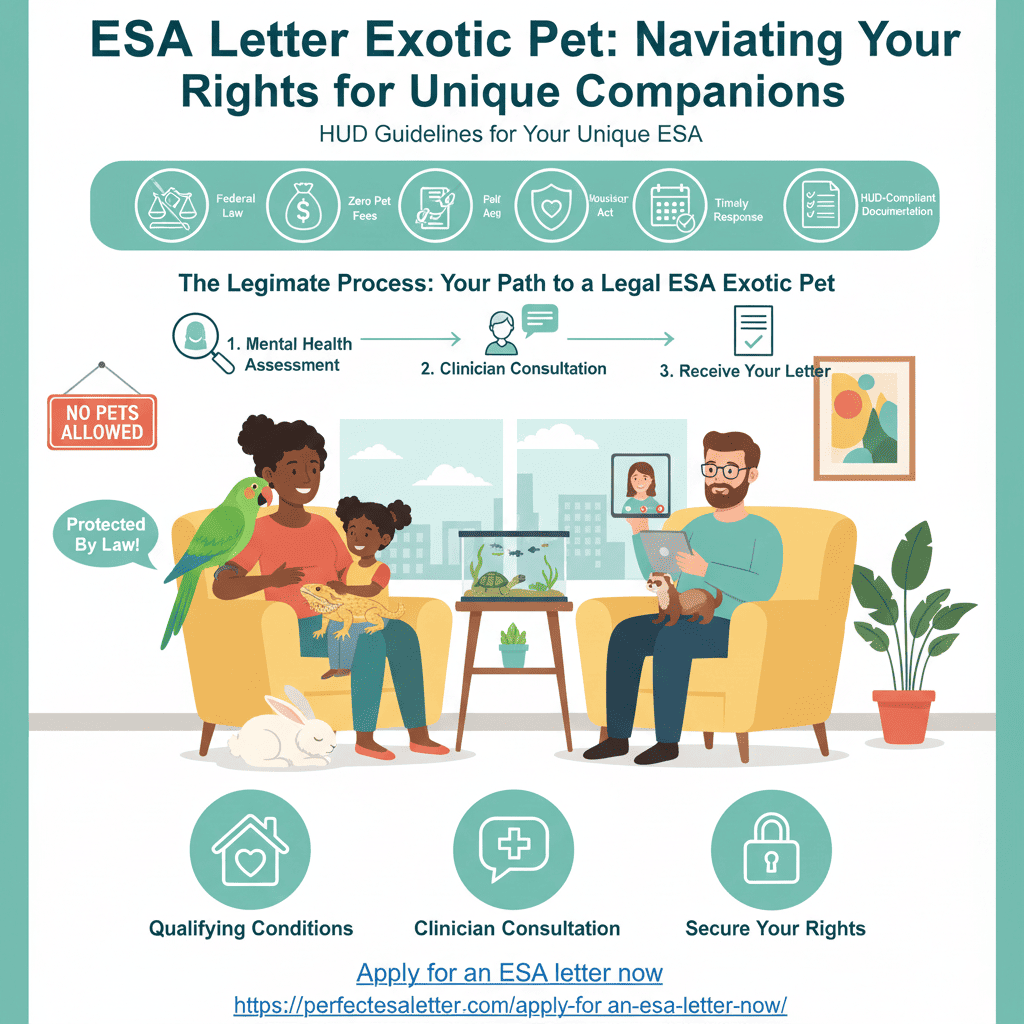
ESA Letter Exotic Pet: Navigating Your Rights for Unique Companions
ESA Letter Exotic Pet: Navigating Your Rights for Unique Companions
For many, the standard emotional support animal is a dog or a cat. However, for a growing number of individuals, true emotional grounding comes from a different kind of companion. Whether it is a bearded dragon that provides a sense of routine, a parrot that interacts through mimicry, or a ferret that offers playful distraction, non-traditional animals are often life-saving for those living with anxiety, depression, or PTSD.
If your companion isn’t a “standard” pet, you might worry about your housing rights. An ESA letter exotic pet is the legal key to ensuring your unique animal is recognized as an assistance animal under the Fair Housing Act (FHA). This document bridges the gap between traditional pet policies and your specific mental health needs.
Can an Exotic Animal Be an Emotional Support Animal?
The short answer is yes—but with a few important legal distinctions. Under the Department of Housing and Urban Development (HUD) guidelines, animals are divided into “common household pets” and “unique animals.”
Common Household ESAs
These include animals typically kept in homes for pleasure, such as:
-
Small birds and parrots
-
Rabbits and ferrets
-
Hamsters, gerbils, and other rodents
-
Fish and turtles
-
Small non-venomous reptiles
Unique or “Exotic” ESAs
If you are seeking an ESA letter exotic pet for an animal that falls outside the “common” category—such as a miniature pig, a goat, or a large non-traditional reptile—the burden of proof is higher. You must demonstrate a specific disability-related need for that particular species that a dog or cat could not fulfill.
Why You Need a Legitimate ESA Letter Exotic Pet
Possessing an ESA letter exotic pet transforms your companion’s legal status from a “pet” to an “assistance animal.” This shift provides you with significant protections, even in buildings with strict “no-pet” rules.
Key Benefits of Your Documentation:
-
Bypass Prohibited Species Lists: Many landlords ban reptiles or rodents. A valid letter overrides these policies.
-
No Pet Rent or Deposits: You are legally exempt from monthly surcharges and upfront “pet” security deposits.
-
Protection Under the FHA: Landlords must provide “reasonable accommodation” for your animal as long as it doesn’t pose a direct threat to safety.
-
Privacy Rights: You do not have to disclose the details of your medical diagnosis or provide your full medical records.
How to Qualify for a Non-Traditional ESA
The process for an ESA letter exotic pet is clinical, not administrative. You cannot simply “register” your exotic animal on a website. To be HUD-compliant, you must follow these steps:
1. Consult with a Licensed Professional
You must be evaluated by a Licensed Mental Health Professional (LMHP) licensed in your state. This evaluation can happen via a secure telehealth consultation.
2. Document the Therapeutic Benefit
For exotic animals, the clinician must be specific. They need to explain how the animal’s presence mitigates a symptom of your disability. For example, the tactile sensory input of a reptile might be the only thing that successfully grounds you during a sensory overload.
3. Verification of “Unique” Necessity
If your animal is truly “exotic” (not a common household pet), the letter should ideally explain why a traditional animal like a dog wouldn’t be sufficient for your specific needs.
At Perfect ESA Letter, we specialize in connecting individuals with clinicians who understand the nuances of non-traditional assistance animals.
Legal Protections and Landlord Rights
While the law is on your side, there are boundaries to what an ESA letter exotic pet can cover. Understanding these can help you avoid disputes with property managers.
Where You Are Protected:
-
Apartments and Rental Homes: The FHA applies to the vast majority of housing.
-
College Dormitories: Students are entitled to have their exotic ESA in campus housing.
Where Protections May Be Limited:
-
Direct Threats: If your exotic pet is a venomous snake or an aggressive animal that poses a safety risk, a landlord can legally deny the accommodation.
-
Public Access: Unlike service dogs, exotic ESAs do not have the right to enter grocery stores, restaurants, or malls.
-
Air Travel: Most airlines have restricted “in-cabin” travel to dogs, regardless of ESA status.
Internal Linking Suggestions
-
Anchor Text: how to qualify for an emotional support animal
-
Anchor Text: Fair Housing Act guidelines for assistance animals
-
Anchor Text: ESA letter for small mammals and reptiles
Frequently Asked Questions (FAQs)
1. Can a snake be an emotional support animal?
Yes. Non-venomous snakes are considered common household pets in many jurisdictions. With a valid ESA letter exotic pet, they are protected under the FHA.
2. Do I need to buy a “Certificate of Registration”?
No. There is no official registry for ESAs. A “certificate” or “ID card” bought online is not a legal document and will likely be rejected by your landlord. Only a letter from a licensed professional is valid.
3. Can my landlord charge more because my pet is “exotic”?
No. If you have a valid ESA letter, the landlord cannot charge any pet fees, regardless of the species.
4. What if my exotic pet is illegal in my city?
The Fair Housing Act does not typically override local “illegal species” ordinances. If an animal is banned by city law (e.g., a wolf-hybrid or a primate), an ESA letter may not be enough to keep it in your home.
5. Can I have more than one exotic ESA?
Yes. If you have a clinical need for multiple animals—for example, a bird for daytime interaction and a turtle for calming observation—a clinician can justify both in your documentation.
6. Do I have to show my landlord my letter before I move in?
You can request a reasonable accommodation at any time—before or after signing a lease. However, many choose to provide the letter after approval to prevent hidden discrimination.
7. Is a telehealth ESA letter valid for exotic animals?
Yes. HUD recognizes telehealth as a legitimate way to establish a professional relationship with a clinician, provided they are licensed in your state.
8. How do I know if my animal is “exotic” or “common”?
HUD generally defines common household pets as dogs, cats, small birds, rabbits, hamsters, gerbils, other rodents, fish, and turtles. Anything outside of this (like a monkey or a farm animal) is considered “unique.”
Protect Your Unique Connection Today
Your path to mental wellness shouldn’t be dictated by traditional pet standards. If an exotic animal is what helps you wake up every morning with a sense of peace, you deserve the legal right to live with that animal. An ESA letter exotic pet is your protection against unfair housing practices and unnecessary fees.
At Perfect ESA Letter, we believe in the power of all animals to heal. We make the process of securing your rights simple, clinical, and completely legal. Don’t let a “no-pets” policy or a “no-reptiles” rule separate you from the companion you rely on.