
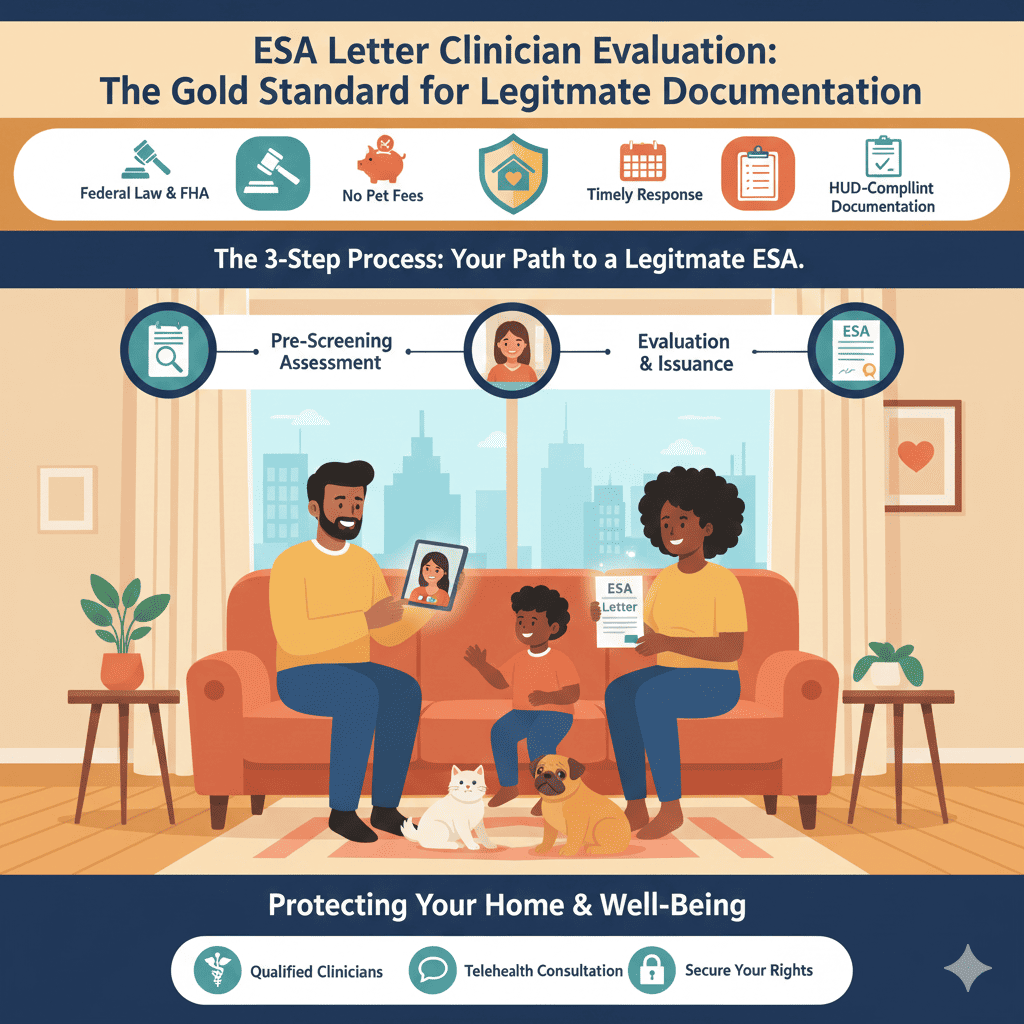
ESA Letter Clinician Evaluation: The Gold Standard for Legitimate Documentation
ESA Letter Clinician Evaluation: The Gold Standard for Legitimate Documentation
The companionship of an animal can be a lifeline for those navigating the complexities of mental health. Whether it is the calming presence of a dog during a panic attack or the quiet comfort of a cat during a depressive episode, emotional support animals (ESAs) play a documented role in clinical recovery. However, to transition from “pet owner” to “ESA handler” in the eyes of the law, you must undergo a formal ESA letter clinician evaluation.
While the internet is flooded with websites offering “instant” certificates and “official” registries, these documents carry no legal weight. Under the Fair Housing Act (FHA), a housing provider is only required to accommodate your animal if you provide a recommendation from a licensed professional. This guide explains why a professional evaluation is the only legitimate path to protecting your housing rights and how the process works from start to finish.
What is an ESA Letter Clinician Evaluation?
An ESA letter clinician evaluation is a professional assessment conducted by a Licensed Mental Health Professional (LMHP). The goal of this evaluation is to determine if an individual meets the federal criteria for a mental or emotional disability and if an animal is a necessary component of their treatment plan.
Unlike a standard medical check-up, this evaluation focuses specifically on your psychological well-being and the “therapeutic nexus”—the direct link between your animal’s presence and the alleviation of your symptoms. Without this professional “nexus,” a letter is not legally compliant with Department of Housing and Urban Development (HUD) standards.
Why a Clinician Evaluation is Non-Negotiable
-
Legal Compliance: HUD specifically outlines that a housing provider may request reliable documentation from a healthcare professional when a disability is not obvious.
-
Protection Against Fraud: Landlords are increasingly trained to spot “letter mill” documents. A letter backed by a real clinician evaluation stands up to scrutiny.
-
Ethical Standards: A licensed clinician ensures that an ESA is truly appropriate for your condition, preserving the integrity of assistance animal laws for everyone.
Who is Qualified to Perform the Evaluation?
To meet the legal requirements for a housing accommodation, your evaluation must be conducted by an authorized professional. This ensures that the person recommending the ESA has the clinical expertise to diagnose and treat mental health conditions.
Authorized Professionals Include:
-
Psychologists and Psychiatrists
-
Licensed Clinical Social Workers (LCSW)
-
Licensed Marriage and Family Therapists (LMFT)
-
Licensed Professional Counselors (LPC)
-
Mental Health Nurse Practitioners (PMHNP)
Important Note: The clinician must be licensed to practice in the state where you reside. If you live in Florida but your letter comes from a provider licensed only in California, your landlord may legally deny your request. At Perfect ESA Letter, we match you with state-specific clinicians to ensure your evaluation meets local and federal mandates.
The Evaluation Process: What to Expect
A legitimate ESA letter clinician evaluation is a structured process designed to safeguard both the tenant and the clinician. While it can be conducted via telehealth, it must involve a direct interaction between you and the provider.
1. Initial Screening
The process usually begins with a HIPAA-compliant questionnaire. You will provide information about your mental health history, current symptoms, and any functional limitations you experience (such as difficulty sleeping, working, or socializing).
2. Clinical Consultation
The heart of the evaluation is a one-on-one session with the clinician. During this time, the provider will:
-
Assess whether your condition meets the DSM-5 criteria for a mental or emotional disability.
-
Discuss how an animal helps you manage your daily life.
-
Evaluate if the animal is a “necessary” accommodation rather than just a “want.”
3. Determination and Documentation
If the clinician determines that you qualify, they will issue a signed letter on their official letterhead. This letter includes their license number, contact information, and a statement confirming your disability-related need for an ESA.
State-Specific Laws: The “30-Day Rule” and More
While the Fair Housing Act is a federal law, several states have passed additional legislation to prevent ESA fraud. Understanding these local nuances is a key part of your ESA letter clinician evaluation.
| State | Special Requirements |
| California | Requires an established provider-patient relationship for at least 30 days before a letter can be issued. |
| Florida | Prohibits “online-only” certificates; requires a valid telehealth or in-person evaluation with a licensed provider. |
| Montana | Also requires a 30-day therapeutic relationship and a clinician who can identify the specific emotional need the animal relieves. |
| Arkansas & Iowa | Have similar “established relationship” timelines to prevent the use of one-time “letter mill” services. |
By choosing a reputable service, you ensure that your clinician follows these specific timelines and protocols, making your letter much harder for a landlord to challenge.
Internal Linking Suggestions
-
Anchor Text: how to qualify for an emotional support animal
-
Anchor Text: Fair Housing Act requirements for ESAs
-
Anchor Text: avoiding ESA letter scams
Frequently Asked Questions (FAQs)
1. Can my landlord verify my ESA letter clinician evaluation?
Yes. While a landlord cannot ask for your specific diagnosis or medical records, they are allowed to contact the clinician to verify that the letter is authentic and that the clinician is currently licensed.
2. Does the clinician need to see my animal?
Generally, no. The ESA letter clinician evaluation focuses on your mental health and your need for support. Clinicians are not usually animal behaviorists and do not “certify” the animal’s training, as ESAs do not require training.
3. Is a one-time consultation enough for an ESA letter?
In many states, yes. However, in states like California or Montana, you must have at least two interactions over a 30-day period. Regardless of the state, the clinician must have “personal knowledge” of your condition.
4. What happens if I don’t qualify during the evaluation?
A legitimate clinician evaluation is an objective assessment. If the provider determines that you do not meet the legal definition of a disability, they will not issue a letter. Reputable platforms often offer a refund if you do not qualify.
5. Does the evaluation cover my ESA for air travel?
No. Since 2021, the Department of Transportation no longer requires airlines to recognize ESAs. Evaluations today are primarily focused on housing protections under the FHA.
6. Can a general practitioner (GP) perform an ESA evaluation?
Yes, a GP can perform the evaluation, but most prefer to refer patients to mental health specialists who are more familiar with the specific diagnostic criteria and HUD documentation standards.
7. Do I need a separate evaluation for each animal?
If you require more than one ESA, the clinician must perform an “individualized assessment” for each animal and document why one animal alone is insufficient to alleviate your symptoms.
8. Is the evaluation confidential?
Yes. All legitimate ESA letter clinician evaluations are protected by HIPAA. Your clinical notes are private and are not shared with your landlord; only the final recommendation letter is provided to them.
Secure Your Housing Rights with a Professional Evaluation
The bond between you and your emotional support animal is a key part of your path to wellness. However, that bond deserves the protection of a legally sound, professionally backed document. By undergoing an ESA letter clinician evaluation, you are not just getting a piece of paper—you are establishing a verifiable medical need that landlords are legally required to respect.
At Perfect ESA Letter, we take the guesswork out of the process. We connect you with compassionate, state-licensed clinicians who understand the intersection of mental health and housing law. Protect your home and your peace of mind by choosing a path that is ethical, legal, and clinician-verified.