
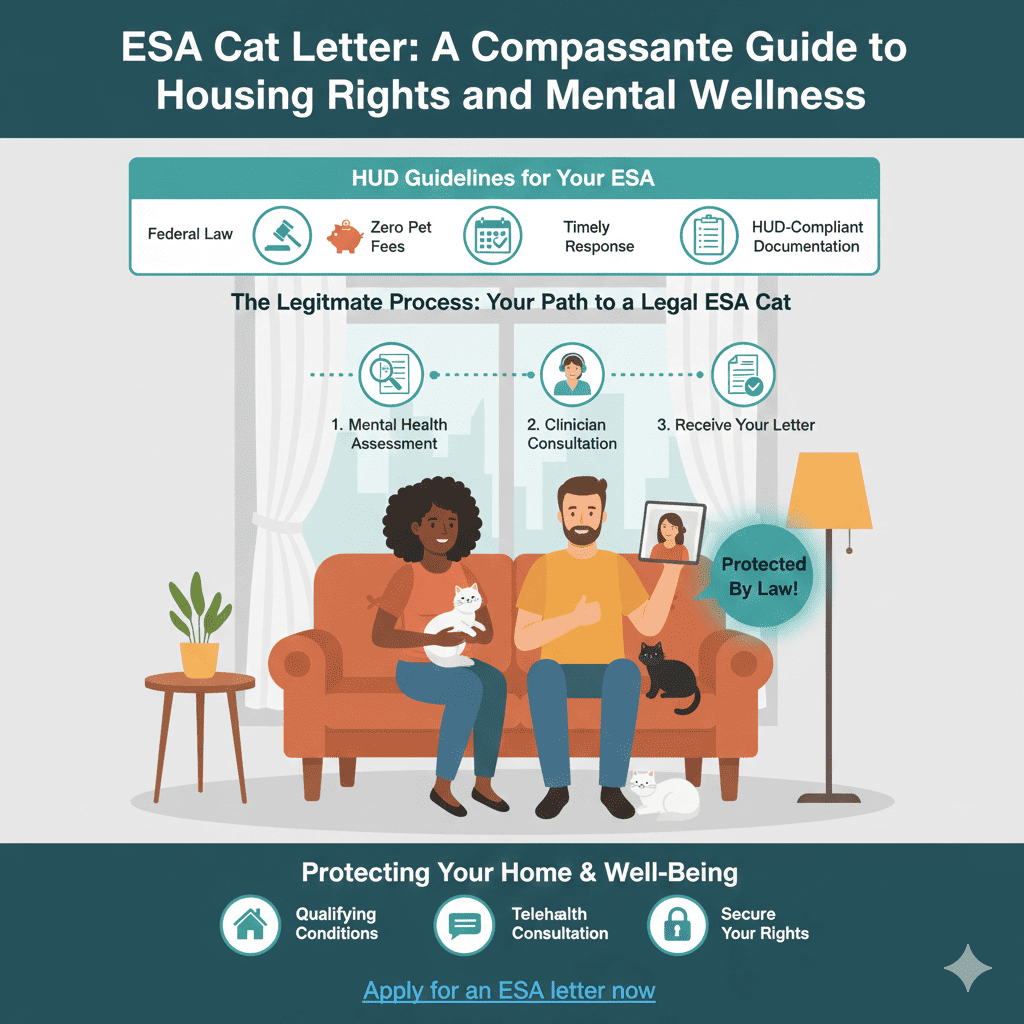
ESA Cat Letter: A Compassionate Guide to Housing Rights and Mental Wellness
ESA Cat Letter: A Compassionate Guide to Housing Rights and Mental Wellness
For many, a home isn’t complete without the soft purr of a feline companion. While cats are often viewed as independent, their ability to provide profound emotional grounding is unmatched. For individuals living with anxiety, depression, or PTSD, a cat is more than a pet—it is a vital part of a mental health treatment plan. However, navigating the modern rental market with an animal can be daunting. Between “no-pet” policies and exorbitant monthly pet rents, many tenants feel forced to choose between their housing and their health.
An ESA cat letter is the legal solution that bridges this gap. Under federal law, this document recognizes your cat as an assistance animal, ensuring you can live together without the burden of extra fees or restrictive rules. In this guide, we explore the therapeutic benefits of emotional support cats, the legal protections afforded by the Fair Housing Act (FHA), and the professional process of obtaining a legitimate letter.
The Mental Health Benefits of an ESA Cat
The therapeutic value of a cat is backed by more than just anecdotal evidence. Clinical studies show that interacting with a feline can lead to physiological changes that combat stress and improve mood. An ESA cat letter formalizes this relationship, acknowledging that the animal’s presence is a medical necessity.
How Cats Support Emotional Well-Being:
-
Stress Reduction: The frequency of a cat’s purr (between 25 and 150 Hertz) has been shown to lower blood pressure and reduce cortisol levels in humans.
-
Anxiety Management: The tactile sensation of petting a cat provides “grounding,” helping individuals stay present during panic attacks or high-stress moments.
-
Combatting Loneliness: For those living alone with depression, the consistent presence of a cat provides non-judgmental companionship and a sense of being “needed.”
-
Routine and Structure: Caring for a cat—feeding, grooming, and playing—creates a daily routine that can be life-changing for individuals struggling with motivation or executive dysfunction.
Your Legal Rights: The Fair Housing Act (FHA)
When you have a valid ESA cat letter, your cat is no longer legally classified as a “pet.” Instead, they are considered an “assistance animal.” This distinction grants you specific protections under the FHA, which applies to almost all types of housing, including apartments, condos, and even college dorms.
Key Protections for ESA Owners:
-
Exemption from “No-Pet” Policies: Even if a building strictly prohibits animals, they must make a “reasonable accommodation” for your ESA.
-
No Pet Deposits or Monthly Pet Rent: Landlords are legally prohibited from charging extra fees for an assistance animal.
-
No Breed or Size Restrictions: Unlike dogs, cats rarely face breed bans, but the FHA ensures that no feline can be denied based on its weight or type.
-
Protection Against Discrimination: A landlord cannot deny your rental application simply because you have an ESA.
Qualifying for an ESA Cat Letter
To qualify for these legal protections, you must have a diagnosable mental or emotional disability that substantially limits a major life activity. A licensed professional must evaluate your condition and determine that a cat is a necessary component of your care.
Common Qualifying Conditions:
| Condition | How a Cat Helps |
| Social Anxiety | Provides a calming presence that makes navigating home life easier. |
| Major Depression | Encourages activity and reduces feelings of isolation. |
| PTSD | Helps the owner feel safe and provides distraction during flashbacks. |
| Panic Disorder | Offers immediate tactile comfort to “break” the cycle of a panic attack. |
| Insomnia | A cat’s presence can promote tranquility and improve sleep quality. |
The Legitimate Process: How to Get Your Letter
To be accepted by property managers, your ESA cat letter must be issued by a Licensed Mental Health Professional (LMHP). HUD (the Department of Housing and Urban Development) has recently tightened guidelines to prevent fraud, making it essential to follow a clinical path.
1. Clinical Evaluation
You must speak with a professional—such as a psychologist, psychiatrist, or LCSW—licensed in your state. This can be done through a secure telehealth consultation. They will assess your symptoms and the role your cat plays in your daily life.
2. Establishing the “Nexus”
The clinician must document the “nexus,” or the direct link, between your disability and the assistance your cat provides. Without this connection, a letter is not legally valid for housing.
3. Official Documentation
The final letter must be on the clinician’s official letterhead and include:
-
The clinician’s license type, number, and state of issuance.
-
The date of the evaluation.
-
Confirmation that you meet the criteria for a disability under the FHA.
-
Their contact information for landlord verification.
At Perfect ESA Letter, we facilitate this entire process by connecting you with state-licensed professionals who specialize in assistance animal documentation.
Red Flags: Avoiding “Registry” and “Certificate” Scams
As you search for an ESA cat letter, you will likely encounter sites offering “instant registration” or “official ID cards.” These are scams. * There is no official ESA registry. Any site claiming to “register” your cat with the government is selling a product with no legal value.
-
Vests and ID cards are not required. A landlord only needs to see your signed letter from a licensed professional.
-
Instant approval is impossible. A legitimate clinician needs time to review your history and conduct a consultation.
If a website doesn’t involve a live or asynchronous consultation with a real doctor, the document will likely be rejected by your landlord.
Internal Linking Suggestions
-
Anchor Text: how to qualify for an emotional support animal
-
Anchor Text: Fair Housing Act guidelines for cats
-
Anchor Text: difference between ESAs and service animals
Frequently Asked Questions (FAQs)
1. Does my cat need special training to be an ESA?
No. Unlike service dogs, emotional support cats do not require any specialized task training. Their primary function is to provide emotional comfort through their natural behavior and presence.
2. Can my landlord ask for my medical records?
No. Under HUD guidelines, a landlord cannot ask for your specific diagnosis, medical records, or a detailed history of your condition. The ESA cat letter itself is sufficient proof of your need.
3. Is a telehealth ESA letter valid?
Yes. HUD explicitly recognizes that a legitimate clinician-patient relationship can be established through telehealth. As long as the provider is licensed in your state, the letter is legally binding.
4. Can I have more than one emotional support cat?
Yes. If you have a clinical need for multiple animals (for example, one for daytime anxiety and another that helps with nighttime terrors), a clinician can write a letter justifying the need for more than one ESA.
5. What if I already have a cat and want to make it an ESA?
You can absolutely do this. If your existing pet is already providing you with emotional support that alleviates your symptoms, a clinician can evaluate you and provide the necessary documentation.
6. Can a landlord deny my cat if they are “allergic”?
Generally, no. A landlord’s personal allergies are not a valid reason to deny a reasonable accommodation request under the FHA. They must find a way to accommodate you, such as ensuring you live in a separate wing or building if applicable.
7. Does an ESA cat have the right to go to restaurants?
No. An ESA cat letter provides housing rights only. It does not grant “public access” rights to businesses, grocery stores, or restaurants. Those rights are reserved for service animals.
8. How long does the process take?
With a reputable service, you can typically complete your evaluation and receive your digital letter within 24 to 48 hours of your consultation.
Protect Your Feline Companion and Your Peace of Mind
Your cat is an essential partner in your mental health journey. You should never have to deal with the anxiety of “pet-free” housing or the financial strain of unnecessary fees when your animal is a medical necessity. A legitimate ESA cat letter is your shield against housing discrimination and your ticket to a more stable, supportive home life.
At Perfect ESA Letter, we take the stress out of the process. We match you with compassionate, licensed professionals who understand the law and are dedicated to your well-being. Don’t let restrictive housing rules stand in the way of your recovery.