
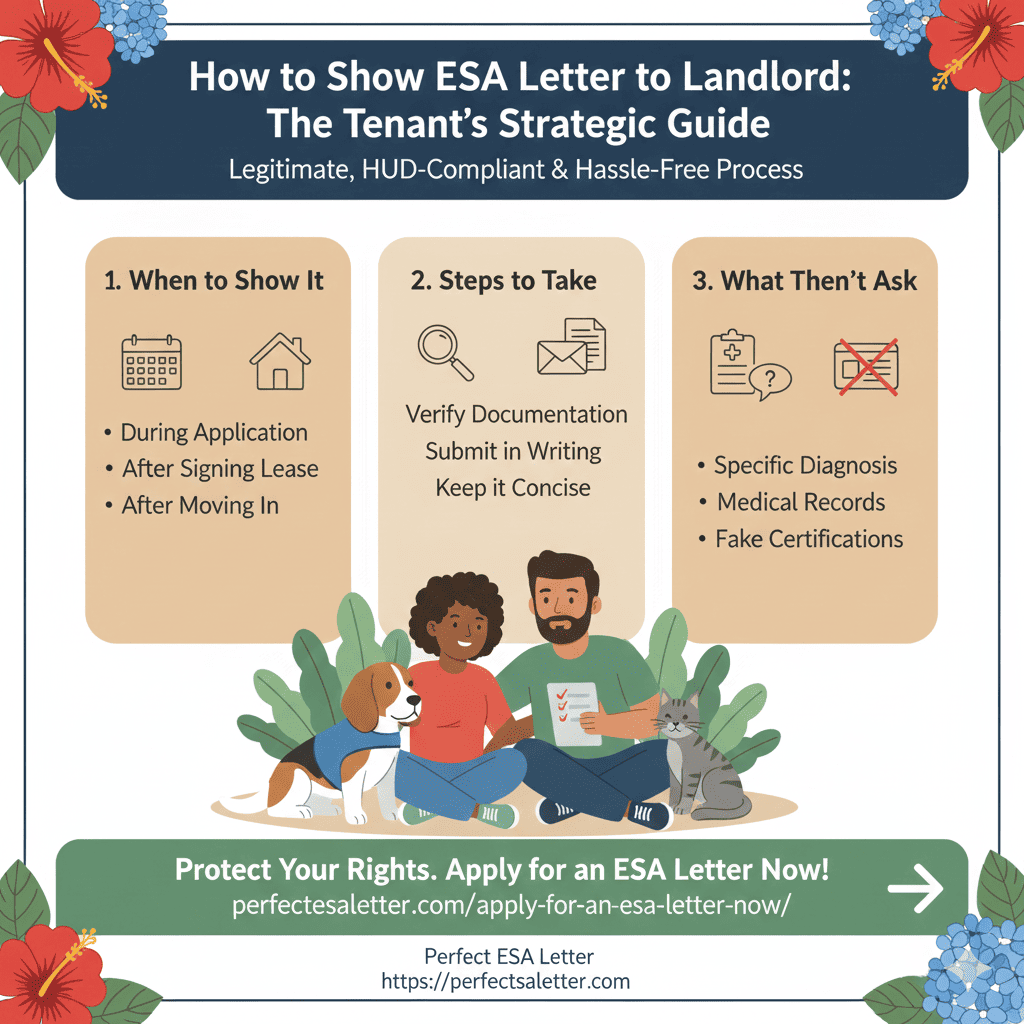
How to Show ESA Letter to Landlord: The Tenant’s Strategic Guide
How to Show ESA Letter to Landlord: The Tenant’s Strategic Guide
The moment you receive your emotional support animal (ESA) letter, a weight lifts off your shoulders. You finally have the medical documentation needed to ensure your companion can stay by your side. However, the next step often brings a new wave of anxiety: how to show an ESA letter to a landlord without causing conflict or facing a denial.
Under the Fair Housing Act (FHA), most housing providers are legally required to provide “reasonable accommodation” for assistance animals. This means “no-pet” policies are waived, and pet fees are eliminated. But while the law is on your side, the way you present your letter can determine whether the process is a quick “yes” or a long, drawn-out legal battle.
At Perfect ESA Letter, we provide HUD-compliant documentation that landlords trust. Apply for an ESA letter now to get started with a licensed professional.
When is the Best Time to Show Your ESA Letter?
One of the most debated aspects of how to show an ESA letter to a landlord is timing. While you have the legal right to request an accommodation at any time—even after moving in—the timing often dictates the landlord’s reaction.
Option 1: During the Application Process
Many experts recommend disclosing your ESA during the application phase. This establishes transparency from the start.
-
Pros: You move in knowing your animal is fully approved.
-
Cons: Some tenants fear “hidden discrimination,” where a landlord might pick another applicant for an unrelated reason to avoid the ESA.
Option 2: After the Lease is Signed (But Before Move-In)
This is a popular middle ground. Once the lease is signed, the landlord cannot easily rescind the offer without legal repercussions.
-
Pros: Protects you from initial application discrimination.
-
Cons: Can feel “dishonest” to some landlords, potentially straining the early relationship.
Option 3: After Moving In
If you develop a mental health condition or adopt an animal during your tenancy, you can submit your letter then.
-
Pros: Totally legal and sometimes necessary.
-
Cons: Landlords may be more skeptical if they have already seen the animal on the property without permission.
Step-by-Step: How to Show Your ESA Letter to a Landlord
Follow this professional protocol to ensure your request is taken seriously and remains compliant with HUD standards.
Step 1: Verify Your Documentation
Before you send anything, ensure your letter is valid. It must be on the official letterhead of a licensed healthcare professional, include their license number and state of issuance, and be dated within the last 12 months.
Step 2: Submit Your Request in Writing
Avoid having a verbal conversation in passing. A written request creates a time-stamped paper trail, which is essential if you ever need to file a HUD complaint. Email is generally preferred for this reason.
Step 3: Keep It Professional and Concise
You do not need to share your medical history, your diagnosis, or a long explanation of why you have an animal. The law protects your privacy. A simple reference to the FHA and your professional’s recommendation is all that is required.
Step 4: Provide Veterinary Records (If Requested)
While the ESA letter covers the need for the animal, landlords still have the right to ensure the animal is safe. Being ready with vaccination records and proof of local licensing shows that you are a responsible tenant.
ESA Submission Checklist for Tenants
| Action Item | Why it Matters |
| Written Request | Creates a legal record for FHA compliance. |
| Reference the FHA | Shows the landlord you understand your rights. |
| Attach the PDF | Ensures they have the primary document immediately. |
| State Your Privacy | Reminds them that they cannot ask for medical records. |
| Request Confirmation | Prevents them from claiming they “never saw it.” |
Sample Email Template: Request for Reasonable Accommodation
If you are unsure how to show an ESA letter to a landlord, use this copy-paste template. It is designed to be professional, polite, and legally firm.
Subject: Reasonable Accommodation Request for Assistance Animal – [Your Name]
Dear [Landlord or Property Manager Name],
I am writing to formally request a reasonable accommodation under the Fair Housing Act (FHA) regarding my emotional support animal (ESA).
I am a tenant at [Property Address/Unit Number], and I have a disability-related need for an assistance animal. Attached to this email, you will find a formal letter from my licensed healthcare provider confirming that this animal is a necessary part of my treatment plan to alleviate symptoms of my condition.
As per FHA and HUD guidelines, I understand that this accommodation includes a waiver of any pet-related fees, deposits, or breed/weight restrictions.
Please confirm receipt of this request and my documentation. I look forward to your acknowledgment and am happy to provide the animal’s vaccination records if needed.
Sincerely,
[Your Full Name]
[Your Phone Number]
Internal Linking Suggestions
What Landlords Are NOT Allowed to Ask
Knowing how to show an ESA letter to a landlord also means knowing when to say “no” to their questions. Under HUD’s 2020 guidance, landlords are strictly prohibited from:
-
Asking for your specific medical diagnosis (e.g., “Do you have depression or anxiety?”).
-
Asking to see your medical records or therapy notes.
-
Requiring the animal to be “certified” or “registered” (these are scams).
-
Demanding that the doctor provide more information than what is in a standard ESA letter.
-
Requiring the animal to have specialized training.
If a landlord insists on these things, they may be moving toward housing discrimination, and you should document their requests carefully.
Frequently Asked Questions (FAQs)
1. Can a landlord call my doctor to verify the letter?
Yes. A landlord has the right to verify that the professional who signed the letter is real and that their license is active. However, they cannot ask the doctor about your specific health details.
2. What if my landlord says the letter is from a “fake” online site?
As long as you used a service like Perfect ESA Letter that connects you with a human licensed professional in your state, the letter is valid. HUD explicitly recognizes telehealth and online evaluations as legitimate forms of care.
3. Can I be evicted for getting an ESA without telling my landlord first?
A landlord cannot evict you for having an ESA if you have a valid letter. However, it is always better to submit the letter before the animal is discovered to avoid “lease violation” notices which can be stressful to resolve.
4. Do I need to show my ESA letter every year?
Most landlords will accept a letter indefinitely, but some may ask for an updated letter once a year (or upon lease renewal) to ensure the medical need is still current. It is a best practice to keep your assessment up to date.
5. Can my landlord charge me a “processing fee” for the letter?
No. Charging any fee to “process” a reasonable accommodation request is considered discrimination under the Fair Housing Act.
6. What happens if the building has a weight limit and my dog is larger?
ESA letters bypass weight and breed restrictions. Unless the landlord can prove the specific animal is a direct threat or causes “undue financial burden” (which is very rare), they must accommodate the animal regardless of size.
7. Do I have to show my ESA letter to the neighbors?
No. Your medical accommodation is a private matter between you and the property management. You have no obligation to explain your animal’s status to other tenants.
8. Can a landlord require the animal to wear a vest?
No. Vests and ID tags are not legally required for ESAs. While some people choose to use them, a landlord cannot make them a condition for approval.
Conclusion: Take the Stress Out of the Process
Learning how to show an ESA letter to a landlord is about confidence and compliance. When you present a professionally drafted letter from a licensed provider, you are communicating that you take your rights—and your responsibilities as a tenant—seriously.
At Perfect ESA Letter, we ensure that every client is matched with a state-licensed professional who understands the specific legal requirements of your area. Our letters are designed to meet HUD standards, giving you the best possible chance for a smooth and immediate approval.
Don’t wait until you’re facing a lease violation. Get the protection you and your animal deserve.