
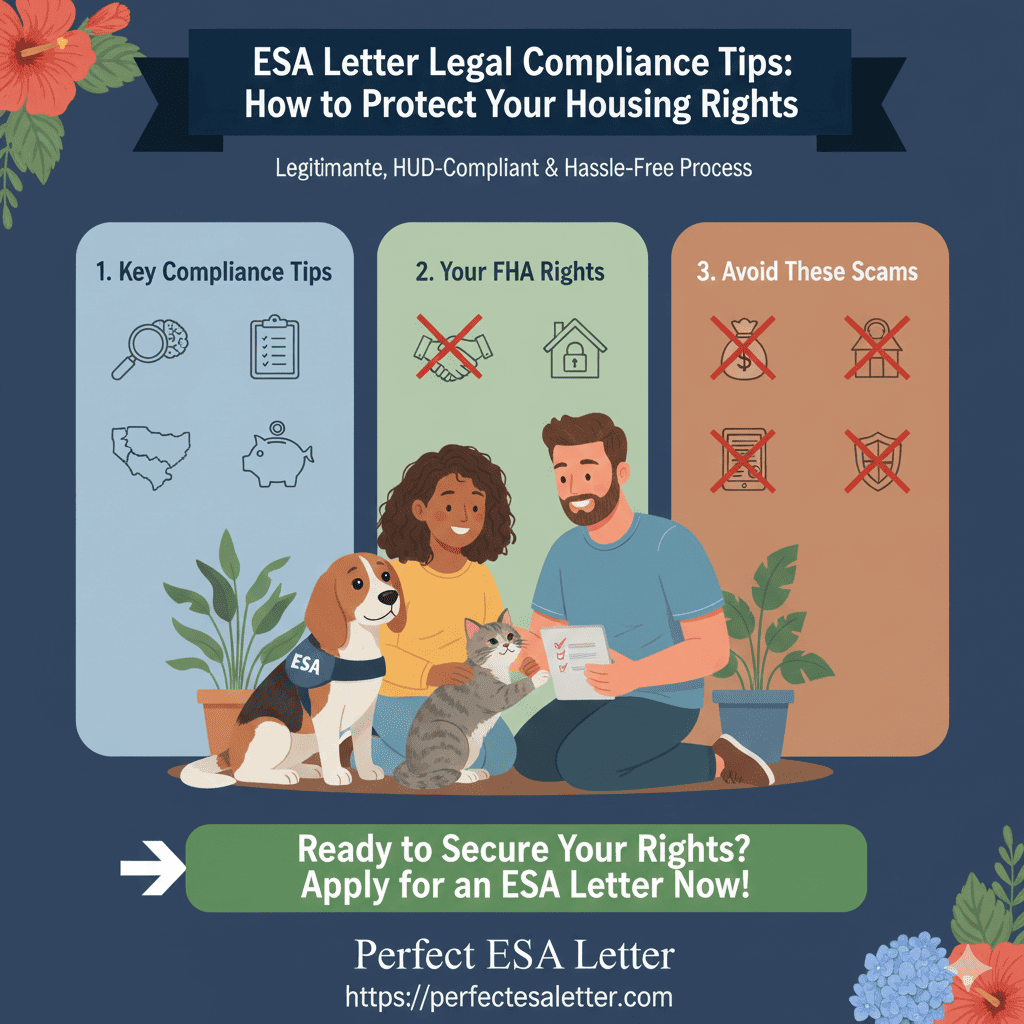
ESA Letter Legal Compliance Tips: How to Protect Your Housing Rights
ESA Letter Legal Compliance Tips: How to Protect Your Housing Rights
Navigating the intersection of mental health and housing law can feel like a daunting task. For many, an emotional support animal (ESA) provides the stability and comfort necessary to manage daily challenges. However, the legal validity of your housing accommodation depends entirely on the quality of your documentation. Understanding ESA letter legal compliance tips is not just about following rules—it’s about ensuring that you and your companion can live together without the threat of eviction or illegal fees.
The Fair Housing Act (FHA) provides the legal framework for ESAs, but property managers are becoming increasingly vigilant about verifying these documents. To avoid complications, your letter must align with specific guidelines set by the U.S. Department of Housing and Urban Development (HUD).
At Perfect ESA Letter, we specialize in bridging the gap between clinical care and legal necessity. Apply for an ESA letter now to get a document that is fully compliant with federal law.
Why Legal Compliance is Non-Negotiable
A “pet” and an “assistance animal” are two different legal entities. While a pet is subject to building rules, breed bans, and monthly fees, an assistance animal is protected as a reasonable accommodation for a disability. If your documentation is non-compliant, your animal remains a “pet” in the eyes of the law, leaving you vulnerable to:
-
Illegal Pet Rent: Charges ranging from $20 to $100 per month.
-
Security Deposit Issues: High upfront costs for pet-friendly units.
-
Eviction Risks: If you bring an animal into a “no-pets” building with invalid paperwork.
By following the right ESA letter legal compliance tips, you remove these risks and establish a clear, professional relationship with your housing provider.
Top 5 ESA Letter Legal Compliance Tips for Tenants
To ensure your request for accommodation is successful, keep these compliance standards at the forefront of your search for a provider.
1. Verify the Clinician’s License and State Jurisdiction
One of the most frequent reasons for ESA letter rejection is a mismatch in geography. HUD guidelines suggest that a “reliable” document typically comes from a provider who is familiar with the patient.
-
Compliance Tip: Ensure the Licensed Mental Health Professional (LMHP) is licensed in the state where you currently reside or where you are moving. Landlords often check state licensing boards to verify this.
2. Avoid “Registration” and “Certification” Scams
There is no such thing as an “Official ESA Registry.” Any website that offers to put your dog in a national database or provides an “ESA Certificate” is not providing a legal document.
-
Compliance Tip: Only a signed letter from a human clinician holds weight under the FHA. Certificates and ID tags carry zero legal value and often signal to landlords that the documentation is fraudulent.
3. Establish a Therapeutic Relationship
Recent updates to state laws (such as in California and Montana) emphasize that a “therapeutic relationship” must exist. This means a clinician should have a meaningful interaction with you before issuing a letter.
-
Compliance Tip: Avoid “instant” sites. A compliant process includes an evaluation or consultation where the clinician assesses your need for the animal.
4. Ensure the Letter Includes the “Clinical Nexus”
A valid letter doesn’t just say you have a pet. It must establish a “nexus” or a connection between your disability and the relief the animal provides.
-
Compliance Tip: The letter should state that you have a mental or emotional impairment that substantially limits one or more major life activities and that the animal provides support that alleviates at least one symptom.
5. Keep Documentation Current
While the FHA does not explicitly state that letters expire, most housing providers require a letter to be “current,” which usually means dated within the last 12 months.
-
Compliance Tip: Plan to renew your assessment annually. This shows the landlord that your medical need is ongoing and well-managed.
Comparing Compliant vs. Non-Compliant Documentation
| Feature | Compliant Letter (Perfect ESA Letter) | Non-Compliant (Scam Site) |
| Provider Type | State-Licensed LMHP | Unlicensed “Consultant” or AI |
| Verification | Clinician’s license number provided | No license number or generic number |
| Legal Basis | Fair Housing Act (FHA) / HUD | No legal citation or misuse of ADA |
| Interaction | Live Consultation/Clinical Review | Automated quiz with no human review |
| Physical Goods | Medical documentation only | Vests, ID cards, and “certificates” |
Landlord Rights: What They Can Legally Ask
Part of staying compliant is knowing your boundaries. Under HUD rules, a landlord cannot ask for your specific medical diagnosis, nor can they ask to see your medical records. However, they can ask for a letter that confirms you meet the definition of a disability and have a disability-related need for the animal.
If a landlord asks for more than what is legally required, you can refer them to the HUD FHEO-2020-01 notice. Being educated on your own compliance helps you push back against overreaching requests.
The Cost of Non-Compliance
Many people look for the cheapest or fastest option, but the “cost” of a rejected letter is much higher than the price of a legitimate service.
-
Application Denials: If you are applying for a new apartment, an invalid ESA letter can lead to your application being rejected.
-
Legal Fees: Fighting a wrongful eviction due to bad paperwork is expensive and time-consuming.
-
Emotional Stress: The fear of losing your animal due to a technicality in your letter is a burden no one should carry.
Choosing a service that prioritizes ESA letter legal compliance tips ensures that your first submission is your only submission.
Internal Linking Suggestions
Frequently Asked Questions (FAQs)
1. Can a landlord require an ESA to be trained?
No. Unlike service dogs, emotional support animals do not require any specialized training. Their “work” is their presence. A landlord cannot deny your request because the animal doesn’t perform tasks.
2. Do I need to use a specific form for my ESA letter?
No. Landlords cannot force you or your doctor to use a specific form or have the document notarized. A signed letter on professional letterhead that meets HUD criteria is sufficient.
3. Can I have more than one ESA?
Yes, but you must have documentation that supports the need for each animal. If you have two animals, the clinician must explain how each one serves a unique therapeutic purpose.
4. Does an ESA letter cover breed or weight restrictions?
Yes. Legally compliant documentation allows you to bypass breed and weight limits in housing. The landlord can only deny an animal if it poses a direct threat to the safety of others or would cause significant damage.
5. Is a telehealth evaluation for an ESA legal?
Yes. HUD recognizes that clinicians may provide services via telehealth. As long as the provider is licensed and conducts a proper evaluation, the resulting letter is fully compliant.
6. Why do landlords prefer letters from local doctors?
Local clinicians are seen as more “reliable” because they are likely to have an established relationship with the patient. Using a service that matches you with a state-specific clinician is one of the best ESA letter legal compliance tips.
7. What happens if my landlord denies my compliant letter?
If your letter meets all federal standards and is still denied, you may be facing housing discrimination. You can file a complaint with HUD’s Office of Fair Housing and Equal Opportunity (FHEO).
8. Does an ESA letter exempt me from pet deposits?
Yes. Because an ESA is an assistance animal and not a pet, landlords cannot charge pet deposits or pet rent. You are, however, responsible for any actual damages the animal might cause to the property.
Conclusion: Secure Your Peace of Mind with Perfect ESA Letter
Following ESA letter legal compliance tips is the surest way to guarantee a smooth transition into your new home. By choosing a provider that understands the nuances of the Fair Housing Act and HUD requirements, you protect yourself from the stress of rejection and the financial burden of illegal fees.
At Perfect ESA Letter, we don’t just provide documentation; we provide a legally-backed path to a better quality of life. Our network of state-licensed professionals is dedicated to ensuring that your rights are respected and your animal is protected.
Don’t leave your housing to chance. Ensure your documentation is 100% compliant and professional.