
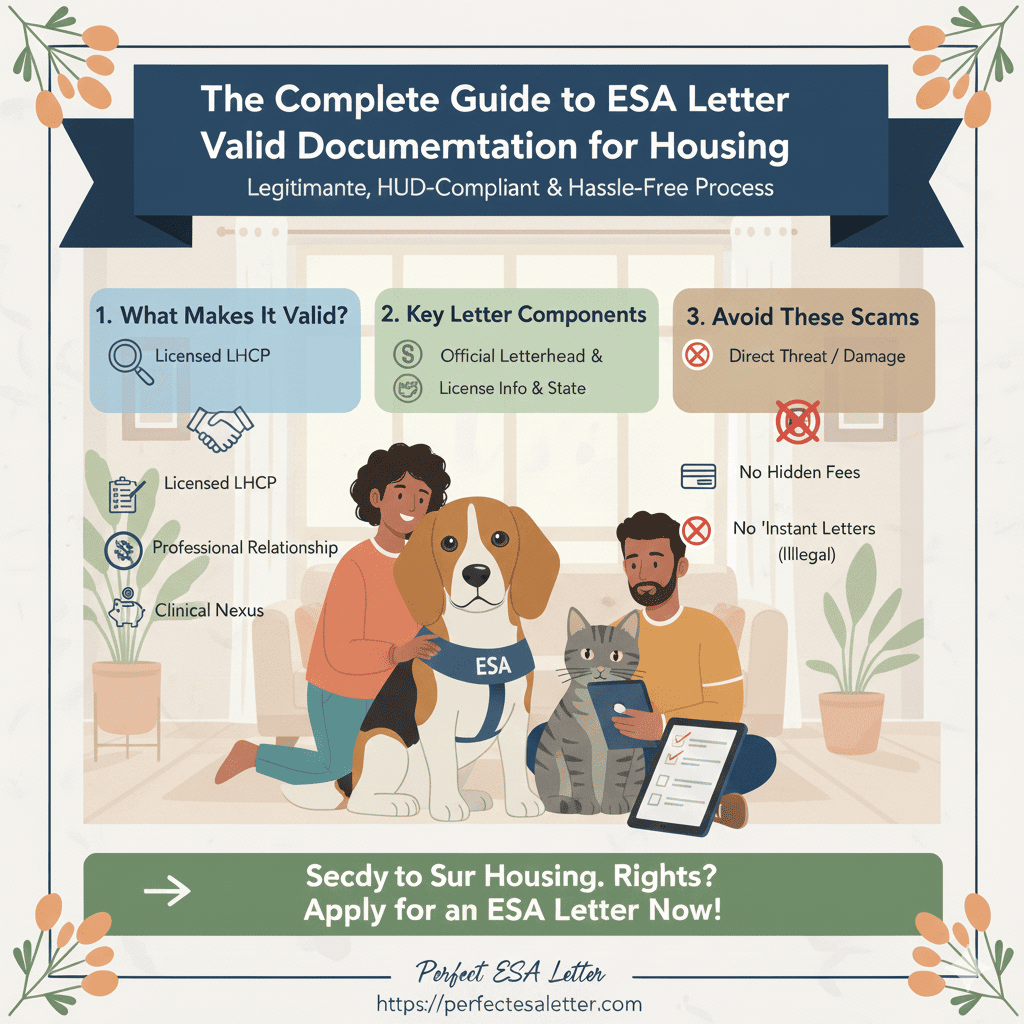
The Complete Guide to ESA Letter Valid Documentation for Housing
The Complete Guide to ESA Letter Valid Documentation for Housing
For millions of Americans living with mental health challenges, an emotional support animal is more than a companion—it is a vital part of their treatment and recovery. However, the path to living with your animal in a “no-pets” building is paved with legal requirements. To protect your rights and avoid illegal pet fees, you must provide your landlord with ESA letter valid documentation.
The internet is saturated with websites offering “instant registration” and “official certificates,” yet many of these documents have no legal standing. Under the Fair Housing Act (FHA) and guidelines from the U.S. Department of Housing and Urban Development (HUD), a valid document must come from a licensed healthcare professional.
At Perfect ESA Letter, we specialize in connecting tenants with state-licensed clinicians to provide documentation that stands up to legal scrutiny. Apply for an ESA letter now to secure your housing future.
What Qualifies as ESA Letter Valid Documentation?
Not every note from a doctor counts as a legal ESA letter. To be considered ESA letter valid documentation for housing, the document must meet specific federal criteria. According to HUD, the letter must establish that the individual has a disability and that there is a disability-related need for the animal.
The 4 Essential Pillars of a Valid Letter
-
Licensed Healthcare Professional (LHCP): The letter must be written by a licensed professional, such as a psychiatrist, psychologist, LCSW, LMHC, or even a nurse practitioner or primary care physician.
-
State-Specific Licensing: In many jurisdictions, and according to best practices, the professional must be licensed to practice in the state where the tenant resides.
-
A Professional Relationship: The document must be based on a legitimate clinical evaluation. HUD has explicitly stated that documents obtained from websites that sell certificates without a personal evaluation are generally not sufficient.
-
Clinical Nexus: The letter must clearly link the animal’s presence to the alleviation of the tenant’s symptoms.
Why “Registries” and “Certificates” Are Not Valid
One of the most common mistakes tenants make is purchasing an “ESA Registration” or “Official ID Card.” It is important to understand that:
-
There is no official national registry for emotional support animals.
-
Certificates and vests carry zero legal weight under the Fair Housing Act.
-
Landlords have the right to reject any documentation that does not include a signed letter from a licensed professional.
When a landlord sees an ID card or a “lifetime registration,” it often signals to them that the tenant may be using a scam service, which can lead to a more difficult approval process.
Key Components of a Legally Compliant ESA Letter
When you receive your documentation, check it against this checklist to ensure it will be accepted by your property manager.
| Component | Requirement for Validity |
| Letterhead | Must be on the professional’s official practice letterhead. |
| License Info | Must include the provider’s license type, number, and state of issuance. |
| Issue Date | Must be recently dated (typically within the last 12 months). |
| Patient Name | Must match the legal name on your lease agreement. |
| Statement of Need | Must state that the animal provides support for a mental health condition. |
| Signature | Must be signed by the licensed professional (digital signatures are okay). |
Landlord Rights: What Can They Verify?
Understanding ESA letter valid documentation also means knowing what a landlord is legally allowed to do once you submit your request.
Verification vs. Intrusiveness
A landlord can:
-
Contact the professional who signed the letter to verify its authenticity.
-
Check the state licensing board to ensure the provider’s license is active.
-
Request a new letter if the one provided is over a year old.
A landlord cannot:
-
Ask for your specific medical diagnosis or treatment history.
-
Request your medical records.
-
Require you to use a specific form or have the document notarized.
-
Ask the clinician to provide details under “penalty of perjury.”
State-Specific Requirements You Need to Know
While the Fair Housing Act is a federal law, several states have passed additional regulations to define what constitutes ESA letter valid documentation.
-
California (AB 468): Requires a 30-day established relationship between the patient and the professional before a letter can be issued.
-
Iowa, Montana, and Louisiana: These states also have similar “30-day” relationship requirements to prevent fraudulent claims.
-
Arkansas and Illinois: Have specific laws regarding the “Assistance Animal Integrity Act,” which penalties for misrepresenting a pet as an ESA.
Using a service like Perfect ESA Letter ensures that your clinician is aware of these nuances and provides a letter that complies with both federal and state-level mandates.
How to Submit Your Documentation to a Landlord
To ensure your request for reasonable accommodation is handled professionally, follow these steps:
-
Submit in Writing: Even if you have a verbal conversation, always follow up with a written request (email is best) and attach your ESA letter.
-
Keep it Simple: You do not need to provide a long life story. A simple note saying, “I am requesting a reasonable accommodation for my emotional support animal. Attached is my documentation from my healthcare provider,” is sufficient.
-
Keep Copies: Always keep a digital and physical copy of your ESA letter valid documentation and a record of when you sent it to your landlord.
Internal Linking & Resources
Frequently Asked Questions (FAQs)
1. Can a landlord charge me a pet fee if I have a valid letter?
No. Under the FHA, once you provide ESA letter valid documentation, the landlord must waive all pet-related fees, including pet rent and upfront pet deposits.
2. Is an ESA letter from a telehealth provider valid?
Yes. HUD explicitly recognizes that many legitimate healthcare professionals provide services remotely. As long as the provider is licensed and has personal knowledge of your condition, a telehealth-issued letter is valid.
3. Can my landlord deny my ESA because of its breed?
Generally, no. Breed, weight, and size restrictions do not apply to emotional support animals. A landlord can only deny an animal if it poses a direct threat to the safety of others or would cause significant physical damage to the property.
4. How often should I renew my ESA documentation?
Most landlords require that an ESA letter be no more than one year old. It is a best practice to renew your letter annually to ensure your housing protection remains uninterrupted.
5. Do I need an ESA vest for the documentation to be valid?
No. Vests, ID tags, and harnesses are accessories and have no legal standing. The only document that provides legal protection for an ESA in housing is the letter from your licensed professional.
6. Can I have more than one ESA?
Yes. You can have multiple ESAs, but your documentation must support the need for each animal. If you have two cats, your letter should explain why both are necessary for your mental health.
7. What happens if my landlord says the letter is “fake”?
If your letter meets all HUD requirements (signed, on letterhead, with license info) and the landlord still denies it, they may be in violation of the Fair Housing Act. You can file a complaint with HUD or seek legal advice.
8. Does my ESA letter work for air travel?
No. Since 2021, the Department of Transportation no longer requires airlines to recognize ESAs. For air travel, your animal would be considered a pet unless they are a trained Psychiatric Service Dog (PSD).
Secure Your Housing Rights Today
The difference between a stress-free move and a legal battle often comes down to the quality of your paperwork. Don’t risk your housing by using “instant” sites that provide invalid documents.
At Perfect ESA Letter, we pride ourselves on providing ESA letter valid documentation that landlords trust. Our process is designed to be thorough, HIPAA-compliant, and fully aligned with the latest HUD and FHA guidelines.
Ready to live without the fear of pet fees or denials?
Get your legitimate clinical evaluation from a professional who cares.