
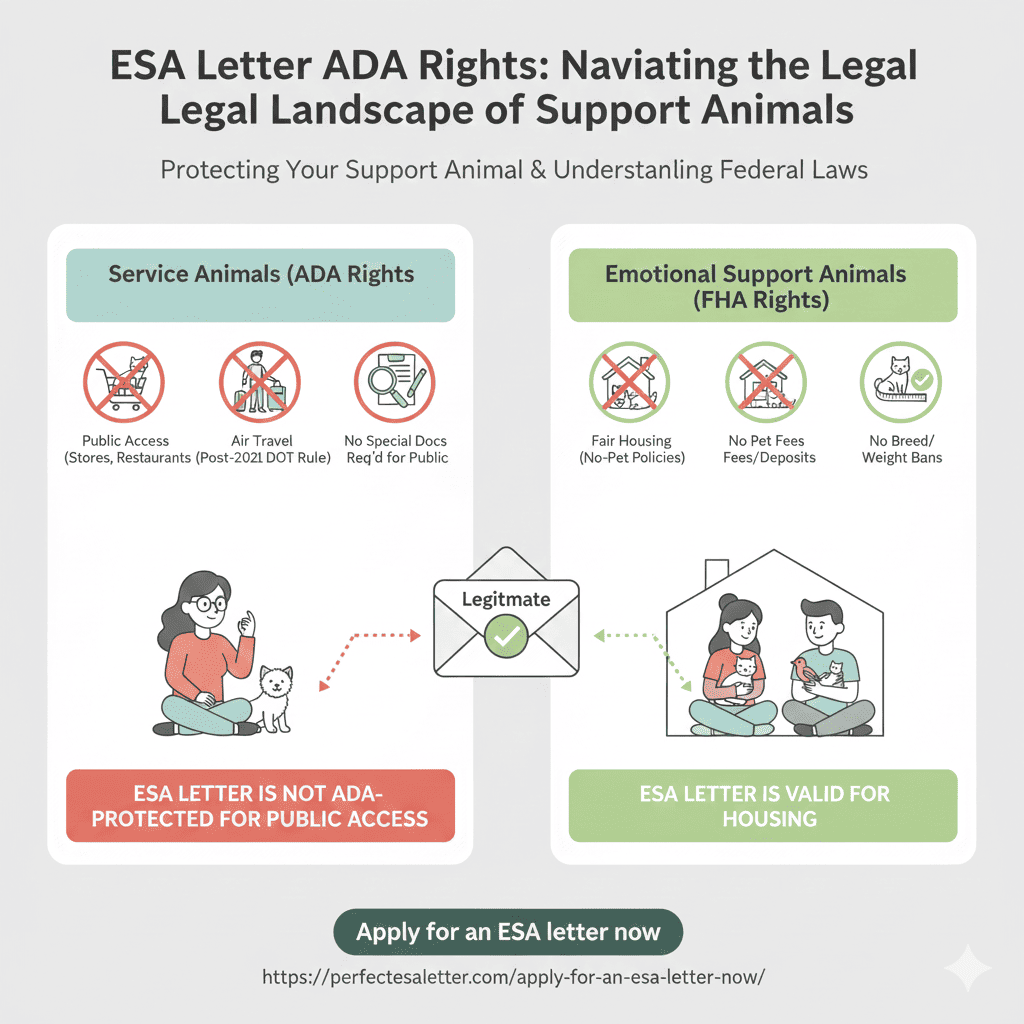
ESA Letter ADA Rights: Navigating the Legal Landscape of Support Animals
ESA Letter ADA Rights: Navigating the Legal Landscape of Support Animals
For many individuals living with mental health challenges, an emotional support animal (ESA) provides the stability and comfort necessary to navigate daily life. However, when it comes to legal protections, there is often significant confusion surrounding an ESA letter and ADA rights. You may have heard that the Americans with Disabilities Act (ADA) protects all animals used for disability support, but the reality is more nuanced.
Understanding where the ADA ends and other federal laws—like the Fair Housing Act (FHA)—begin is crucial for any ESA owner. If you’ve ever wondered if your ESA can enter a restaurant or if a landlord can legally deny your animal because they aren’t a “service dog,” this guide will clear up the misconceptions. We break down the relationship between an ESA letter and federal rights to ensure you can advocate for yourself with confidence.
The Truth About ESA Letter ADA Rights vs. Service Animals
The most common misconception is that an ESA letter grants you the same public access rights as a service dog under the ADA. To understand your rights, you must first understand the legal distinction between these two categories.
What the ADA Protects
The Americans with Disabilities Act (ADA) primarily focuses on service animals. According to the ADA, a service animal is specifically defined as a dog (or in rare cases, a miniature horse) that is individually trained to perform work or tasks for the benefit of an individual with a disability.
-
Public Access: Service animals have the right to accompany their handlers in almost all public spaces, including restaurants, grocery stores, and hospitals.
-
Training Requirement: Because they perform specific tasks (like guiding the blind or alerting to a seizure), they are protected under the ADA.
Where ESAs Fit In
Emotional support animals provide therapeutic benefit through their presence and companionship, but they are not trained to perform specific tasks. Because they lack this specialized training, ESAs do not have public access rights under the ADA. An ESA letter does not legally require a restaurant or a shopping mall to allow your animal inside.
Key Takeaway: While an ESA letter doesn’t fall under ADA public access titles, it is the “golden ticket” for housing protections under the Fair Housing Act (FHA).
If Not the ADA, Which Laws Protect Your ESA?
While the ADA may not grant public access to ESAs, other federal laws provide powerful protections that are often confused with “ADA rights.”
1. The Fair Housing Act (FHA)
The FHA is the primary law protecting ESA owners. Under the FHA, housing providers must provide “reasonable accommodation” for assistance animals, which includes ESAs.
-
No Pet Fees: Landlords cannot charge pet rent or deposits for an ESA.
-
No Breed Bans: Your animal cannot be denied based on its breed or weight.
-
No-Pet Housing: You can live with your ESA even in buildings that strictly prohibit pets.
2. Section 504 of the Rehabilitation Act
This law applies to housing that receives federal financial assistance (like public housing). It mirrors the FHA’s protections, ensuring that individuals with disabilities have equal access to government-funded housing with their support animals.
3. ADA Title I (Employment)
While ESAs don’t have automatic rights in public stores, they can be considered a reasonable accommodation in the workplace under Title I of the ADA. An employer may allow an ESA if it helps an employee perform their job, though this is decided on a case-by-case basis.
Why You Need a Valid ESA Letter
Because ESAs are not “task-trained,” the only way to prove their necessity to a landlord or employer is through a professional ESA letter. This document serves as the bridge between your medical need and your legal rights.
Essential Components of a Legitimate Letter
To satisfy federal housing requirements and withstand landlord scrutiny, your letter must include:
-
Professional Credentials: Issued by a Licensed Mental Health Professional (LMHP).
-
State Licensure: The clinician must be licensed to practice in your state.
-
The Clinical Recommendation: A statement that the animal is a necessary part of your treatment plan for a mental health disability.
-
Verification Details: The clinician’s license number, signature, and contact information.
At Perfect ESA Letter, we specialize in connecting you with state-licensed professionals who provide fully compliant documentation that meets all federal standards.
Comparing Rights: Service Animals vs. ESAs
Understanding the “rights gap” helps you avoid legal trouble when out in public with your animal.
| Feature | Service Animal (ADA Protected) | ESA (FHA Protected) |
| Species Allowed | Dogs & Miniature Horses | Any common household animal |
| Training Required | Yes (Specific Tasks) | No (Companionship Only) |
| Public Access | Yes (Restaurants, Stores, etc.) | No (Limited to Housing) |
| Housing Rights | Yes (No fees/restrictions) | Yes (No fees/restrictions) |
| Documentation | Not required for public access | Required for Housing |
Internal Linking Suggestions
-
Anchor Text: difference between service dogs and emotional support animals
-
Anchor Text: how to qualify for a psychiatric service dog
-
Anchor Text: Fair Housing Act overview for ESA owners
Frequently Asked Questions (FAQs)
1. Do ESA letters fall under ADA public access rights?
No. The ADA only grants public access rights to trained service animals. Emotional support animals are protected primarily in housing under the Fair Housing Act (FHA), not for general public access in stores or restaurants.
2. Can a landlord ask for my ADA “certification”?
No, because “ADA certification” does not exist for ESAs or service animals. Landlords can, however, ask for a valid ESA letter from a licensed mental health professional to verify your need for a reasonable accommodation.
3. Can I take my ESA to work under the ADA?
Under Title I of the ADA, you can request to bring your ESA to work as a “reasonable accommodation.” Unlike housing, where approval is almost always mandatory for valid letters, employers can deny the request if it causes “undue hardship” to the business.
4. Is a vest or ID card required by the ADA for my ESA?
No. Vests and ID cards are not legally required by the ADA or the FHA. In fact, presenting “official-looking” IDs can sometimes make landlords more suspicious, as these are often associated with online scams rather than legitimate medical documentation.
5. Can my ESA be a breed that is usually banned?
Yes. Under the FHA (often confused with ADA rights in housing), breed and weight restrictions do not apply to assistance animals. A landlord cannot deny your ESA just because it is a Pitbull or a large breed dog.
6. Does the ADA protect ESAs on airplanes?
Not anymore. As of January 2021, the Department of Transportation updated its rules. Airlines are no longer required to recognize ESAs under the Air Carrier Access Act. Only trained service animals (including Psychiatric Service Dogs) are currently protected for air travel.
7. What if my landlord says their insurance doesn’t allow ESAs?
This is generally not a valid reason for denial. Federal law typically overrides private insurance policies. The landlord would have to prove that their insurance would actually be canceled or become prohibitively expensive to deny your request.
8. Can I train my ESA to become a Service Dog?
Yes. If your dog is trained to perform a specific task that assists with your disability (such as deep pressure therapy during a panic attack), they may qualify as a Psychiatric Service Dog (PSD), which does have public access rights under the ADA.
Protect Your Rights with a Legitimate ESA Letter
Navigating the nuances of ESA letter ADA rights and housing laws can be confusing, but you don’t have to do it alone. While the ADA might not get your cat into a movie theater, the Fair Housing Act ensures that your “no-pet” apartment is a safe haven for both you and your animal.
The key to exercising these rights is having documentation that is 100% legally compliant. At Perfect ESA Letter, we streamline the process, matching you with licensed experts who understand the federal requirements inside and out. Don’t let a landlord’s misunderstanding of the law cost you your peace of mind or your animal companion.