
ESA Letter Federal Laws: Your Comprehensive Guide to Housing Rights
ESA Letter Federal Laws: Your Comprehensive Guide to Housing Rights
For individuals managing mental health conditions, the companionship of an emotional support animal (ESA) is often a cornerstone of their well-being. However, navigating the legal requirements to keep that animal in your home can be stressful. Many tenants face pushback from landlords who are either unaware of the law or rely on outdated pet policies. Understanding ESA letter federal laws is your most powerful tool in ensuring you and your animal stay together legally and affordably.
Federal law recognizes that emotional support animals are not “pets”—they are assistance animals. This distinction is the key to unlocking protections that standard pet owners do not have. From the Fair Housing Act (FHA) to the specific guidelines issued by the Department of Housing and Urban Development (HUD), the legal framework is designed to prevent discrimination and ensure that those with disabilities have equal access to housing.
The Pillar of ESA Protection: The Fair Housing Act (FHA)
The most significant of all ESA letter federal laws is the Fair Housing Act. Enacted as part of the Civil Rights Act, the FHA prohibits discrimination in almost all housing-related activities based on race, color, religion, sex, familial status, national origin, and disability.
How the FHA Defines “Assistance Animals”
Unlike the Americans with Disabilities Act (ADA), which primarily covers service dogs in public spaces, the FHA uses the broader term “assistance animal.” This category includes both highly trained service dogs and untrained emotional support animals. Under the FHA, a housing provider must provide “reasonable accommodation” for an assistance animal if:
-
The person has a disability (physical or mental) that substantially limits one or more major life activities.
-
There is a disability-related need for the animal (i.e., the animal provides emotional support that alleviates symptoms of the disability).
Your Core Rights Under the FHA:
-
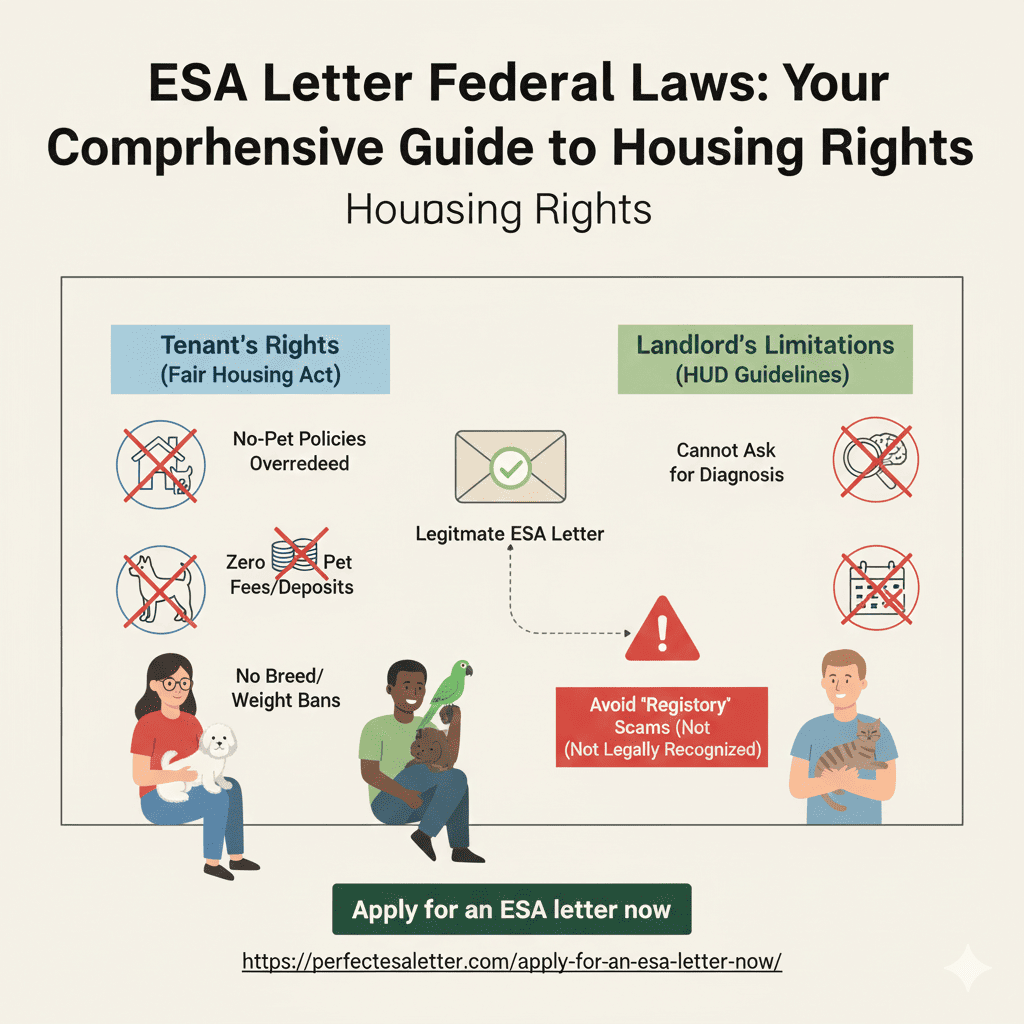
“No-Pet” Rule Waivers: Even if a building has a strict “no-pets” policy, federal law requires landlords to make an exception for your ESA.
-
Exemption from Pet Fees: Landlords cannot charge you pet rent, pet deposits, or one-time pet fees for an assistance animal.
-
Override of Breed and Weight Limits: Policies that ban specific breeds (like Pitbulls) or enforce weight limits (e.g., under 25 lbs) do not apply to ESAs.
HUD Guidelines: The Rulebook for ESA Documentation
While the FHA provides the rights, the Department of Housing and Urban Development (HUD) provides the specific rules on how those rights are exercised. HUD guidelines are essential to any ESA letter federal laws discussion because they dictate what a landlord can—and cannot—request from you.
What Landlords Can Legally Request
If your disability is not “readily apparent” (which is true for most mental health conditions), a housing provider is entitled to request reliable documentation of your disability-related need for an ESA. This documentation is your ESA letter.
Key Requirements for a Valid ESA Letter:
-
Written by a Licensed Healthcare Professional: This includes psychologists, psychiatrists, LCSWs, or even your primary care doctor.
-
Professional Letterhead: Must include the provider’s contact info and license number.
-
Specific Verbiage: The letter must state that you have a qualifying disability and that the animal provides a specific therapeutic benefit.
At Perfect ESA Letter, we ensure that every evaluation is handled by a state-licensed professional who understands these exact HUD mandates, making your documentation legally robust.
Section 504 and Other Federal Protections
While the FHA is the primary law, other federal statutes also play a role in protecting ESA owners.
Section 504 of the Rehabilitation Act
This law applies specifically to housing that receives federal financial assistance (such as public housing or HUD-subsidized apartments). It mirrors the FHA but often carries stricter enforcement. If you live in government-funded housing, Section 504 ensures you cannot be excluded or charged fees for your assistance animal.
The Air Carrier Access Act (ACAA) – A Recent Change
It is important for this ESA letter federal laws guide to note a major shift: as of January 2021, the Department of Transportation (DOT) no longer requires airlines to treat ESAs as service animals. While some airlines still allow them, many now treat ESAs as standard pets. For air travel, many individuals now opt for Psychiatric Service Dog (PSD) training, as PSDs still enjoy full cabin access under the ACAA.
Legal Limitations: When Can a Landlord Say No?
No federal law is absolute. There are specific, limited circumstances where a landlord may legally deny an ESA request:
-
Direct Threat: If the specific animal has a documented history of being dangerous or aggressive.
-
Substantial Damage: If the animal has caused significant physical damage to the property that cannot be mitigated.
-
Undue Burden: If allowing the animal would cause a fundamental alteration to the nature of the housing or create an extreme financial hardship (this is very rare for standard residential units).
-
Owner-Occupied Exemption: The FHA generally does not apply to buildings with four or fewer units where the owner lives in one of the units (The “Mrs. Murphy” Exemption).
Federal Law vs. Standard Pet Policies
| Category | Standard Pet | ESA (Federal Law Protected) |
| Pet Rent | Required | Prohibited |
| Pet Deposit | Required | Prohibited |
| No-Pet Housing | Banned | Allowed |
| Breed Bans | Applicable | Not Applicable |
| Documentation | None | Valid ESA Letter Required |
Internal Linking Suggestions
-
Anchor Text: Fair Housing Act requirements for assistance animals
-
Anchor Text: how to qualify for an emotional support animal
-
Anchor Text: ESA letter vs. Psychiatric Service Dog letter
Frequently Asked Questions (FAQs)
1. Does federal law require my ESA to be “certified” or “registered”?
No. According to HUD, “registration” certificates or ID cards purchased online are not sufficient to establish a disability-related need for an animal. The only documentation recognized under ESA letter federal laws is a letter from a licensed healthcare professional.
2. Can a landlord require me to provide my medical records?
No. Under the FHA, landlords are prohibited from asking for detailed medical records or your specific diagnosis. They are only entitled to confirmation that you have a disability and a need for the animal.
3. Is my ESA protected in college dorms?
Yes. Federal laws like the FHA and Section 504 apply to university housing. Colleges must allow students with a valid ESA letter to keep their animals in dorms and campus apartments without extra fees.
4. Can a landlord ignore my request?
No. HUD suggests that housing providers should respond to an accommodation request promptly, usually within 10 days. If a landlord ignores your request or delays it unreasonably, they may be in violation of federal law.
5. Do I need a different letter for every state?
While federal law (FHA) is national, clinicians must be licensed in the state where the patient resides. If you move from California to Texas, you should obtain an updated letter from a professional licensed in Texas.
6. Can a landlord charge a “processing fee” for my ESA letter?
No. Charging a fee to “verify” or “process” a reasonable accommodation request is considered discriminatory and is illegal under federal law.
7. Does the FHA protect animals other than dogs?
Yes. Unlike the ADA (which is limited to dogs), the FHA allows for cats, birds, rabbits, and other “common household animals” to serve as emotional support animals.
8. What if my landlord’s insurance company bans certain breeds?
Federal law generally overrides insurance policies. HUD has stated that a landlord cannot deny an ESA based on breed alone unless they can prove that their insurance carrier would actually cancel their policy or substantially increase costs because of that specific animal.
Secure Your Federal Rights Today
Navigating ESA letter federal laws shouldn’t be a hurdle to your mental health. The laws are clear: if you have a legitimate need and a professional recommendation, you have the right to live with your support animal in peace, without the burden of extra fees or restrictive pet policies.
At Perfect ESA Letter, we are dedicated to helping you exercise these rights. We connect you with state-licensed mental health professionals who understand FHA and HUD requirements, ensuring your documentation is legally sound and ready for your landlord. Don’t let a “no-pet” policy stand in the way of your well-being.