
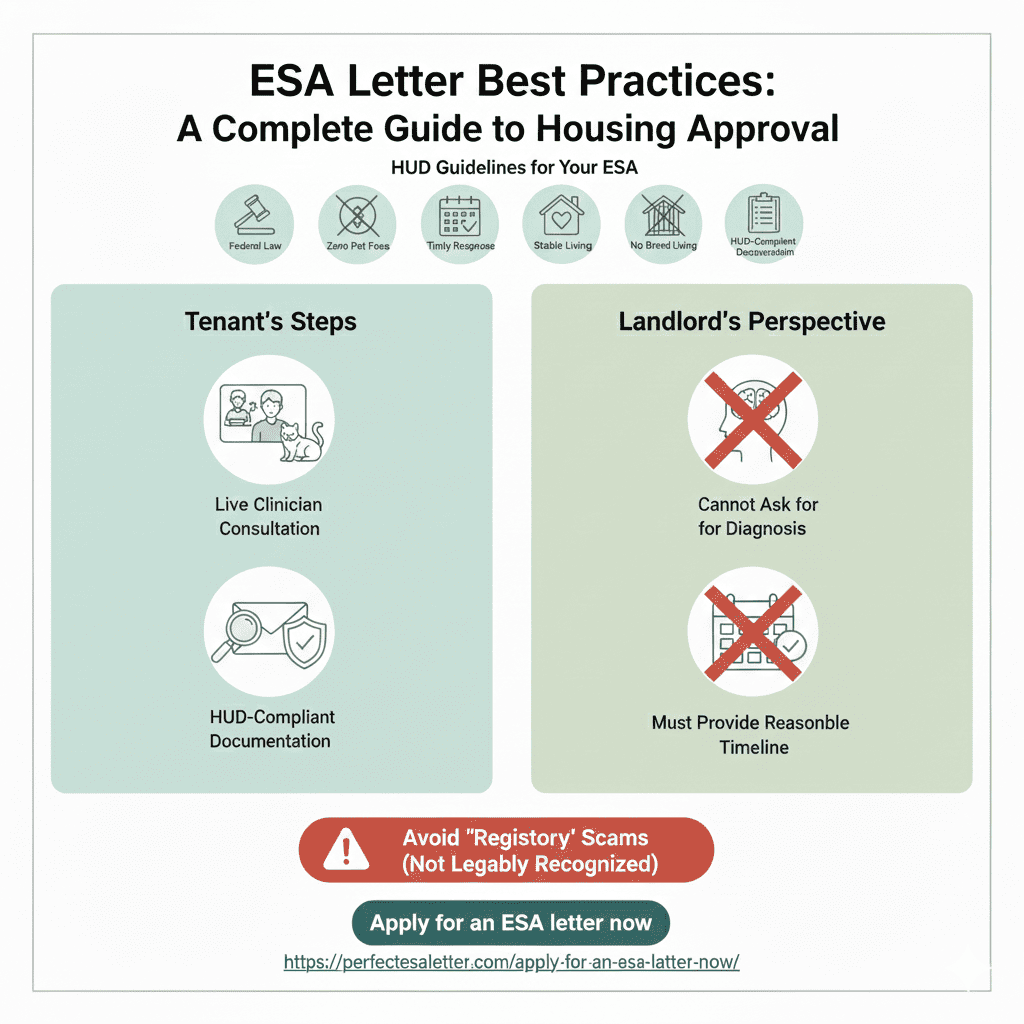
ESA Letter Best Practices: A Complete Guide to Housing Approval
ESA Letter Best Practices: A Complete Guide to Housing Approval
For individuals managing mental health challenges, an emotional support animal is a lifeline. However, the path to securing “reasonable accommodation” in housing is often paved with complex paperwork and skeptical property managers. If you’ve ever felt anxious about presenting your documentation to a landlord, you aren’t alone. Following ESA letter best practices is the difference between a seamless move-in and a stressful legal battle.
The Fair Housing Act (FHA) provides robust protections for ESA owners, but these rights are only as strong as the documentation supporting them. Landlords are increasingly savvy about identifying “instant” or fraudulent letters, making it more important than ever to ensure your request is beyond reproach. This guide explains the industry-standard best practices to ensure your housing rights are respected and your animal is welcomed home.
The Foundation of ESA Letter Best Practices
To get your emotional support animal approved, you must treat the process with professional rigor. An ESA letter is not a “pet pass”; it is a medical recommendation that mandates a legal accommodation.
1. Prioritize a Real Clinician Relationship
The most critical of all ESA letter best practices is establishing a legitimate patient-provider relationship. The Department of Housing and Urban Development (HUD) has tightened its stance on “letter mills.” A valid letter must come from a Licensed Mental Health Professional (LMHP) who has evaluated your condition.
-
Avoid: Websites that offer letters based solely on a 2-minute automated quiz.
-
Seek: Services that include a live telehealth or in-person consultation.
2. Verify Your Clinician’s State License
Federal law requires that the professional signing your letter is licensed to practice in your specific state. Landlords often use state licensing boards to verify this information. If you live in Texas but your letter is signed by a clinician only licensed in New Jersey, your landlord has a legal basis to deny the request.
3. Ensure HUD-Compliant Content
A generic doctor’s note may not suffice. A compliant ESA letter must include:
-
Professional Letterhead: Including the provider’s name, office address, and phone number.
-
License Details: The clinician’s license type (e.g., LCSW, Psychologist), license number, and state of issuance.
-
The “Therapeutic Nexus”: A statement that the animal provides support that alleviates at least one symptom of your disability.
Best Practices for Talking to Your Landlord
Communication is where most ESA requests succeed or fail. How you present your ESA letter best practices to your landlord can set the tone for your entire residency.
Timing Your Request
While you are legally allowed to request accommodation at any time—even after moving in—being proactive is usually the best approach.
-
Ideal: Submit your letter along with your rental application or shortly after signing the lease.
-
Backup: If you develop a need for an ESA while already living in the unit, submit the letter as soon as it is issued to avoid “unauthorized pet” warnings.
Use Written Communication
Always submit your request and your ESA letter via email or certified mail. This creates a “paper trail” that is essential if you ever need to file a complaint with HUD.
-
Pro Tip: Keep a dedicated folder (physical or digital) containing your letter, your written request, and any responses from the landlord.
Reference the Fair Housing Act
When submitting your letter, politely mention that you are “requesting a reasonable accommodation under the Fair Housing Act.” This signals to the property manager that you understand your rights and are providing legitimate documentation.
ESA Letter Best Practices vs. Common Mistakes
| Best Practice | Common Mistake |
| Live Clinical Evaluation | Buying a “certificate” from a registry. |
| In-State Licensed Provider | Using an out-of-state or unlicensed doctor. |
| Annual Renewals | Submitting a letter that is several years old. |
| Focus on Housing Rights | Assuming ESAs have public access (restaurants/stores). |
| Maintaining Animal Behavior | Allowing the ESA to damage property or cause noise. |
Internal Linking Suggestions
-
Anchor Text: how to identify an ESA letter scam
-
Anchor Text: Fair Housing Act guidelines for assistance animals
-
Anchor Text: ESA letter for cats: specific requirements
Avoiding the “Registry” and “ID Card” Trap
One of the most dangerous departures from ESA letter best practices is the purchase of “official” registries, vests, or ID cards.
-
The Reality: There is no government-recognized registry for ESAs.
-
The Risk: HUD explicitly states that registration certificates are not sufficient proof of a disability-related need for an animal. Presenting these items often signals to a landlord that your documentation might be illegitimate, leading to deeper scrutiny or denial.
Frequently Asked Questions (FAQs)
1. Does my landlord have 10 days to respond?
HUD guidelines suggest that housing providers should respond to an accommodation request “promptly,” which is generally considered within 10 business days. If your landlord ignores your request for weeks, they may be in violation of the FHA.
2. Can a landlord require my doctor to be “local”?
While the clinician must be licensed in your state, HUD has clarified that they do not necessarily need to be in your same city. Telehealth is a widely accepted method for obtaining a legitimate ESA evaluation.
3. What should I do if my landlord asks for my medical records?
This is a violation of ESA letter best practices and the law. A landlord can verify the authenticity of your letter and the clinician’s license, but they cannot demand your specific diagnosis, clinical notes, or medical history.
4. Is it a best practice to get my animal a vest?
A vest is not legally required and does not grant any rights. However, some owners find that a vest helps neighbors understand that the animal is a working assistance animal, which can reduce social friction in common areas.
5. Can I have two ESAs in one apartment?
Yes. However, the best practice is to have your clinician explain why each animal is necessary. For example, one animal might help with nighttime anxiety, while another assists with social isolation during the day.
6. Can a landlord deny my ESA if they have an “aggressive breed” ban?
No. Federal law overrides local breed bans in housing. A landlord can only deny a specific animal if it has a documented history of aggression or if its presence would cause an “undue financial burden” (e.g., the landlord’s insurance specifically dropping them).
7. Should I renew my ESA letter every year?
Yes. While the FHA doesn’t strictly state an expiration date, most landlords consider a letter “current” if it was issued within the last 12 months. Renewing annually is a best practice to ensure you are never caught with outdated documentation.
8. What if I am moving to a different state?
If you move, you should obtain a new letter from a professional licensed in your new state. This is one of the most overlooked ESA letter best practices that prevents landlords from rejecting out-of-state documentation.
Secure Your Housing Rights with Confidence
Adhering to ESA letter best practices isn’t just about following rules—it’s about protecting the relationship you have with your support animal. When you provide a landlord with a professional, HUD-compliant letter from a verified clinician, you remove the “reasons to say no” and replace them with a legally protected “yes.”
At Perfect ESA Letter, we pride ourselves on upholding the highest industry standards. We match you with state-licensed professionals for a genuine evaluation, ensuring your letter meets every legal requirement. Don’t risk your housing on a generic template or a registry scam. Get a letter that is built on best practices and designed to work.