
ESA Letter for Landlords Explained: A Complete Guide to Your Housing Rights
ESA Letter for Landlords Explained: A Complete Guide to Your Housing Rights
For millions of Americans, an emotional support animal (ESA) is far more than a pet; they are a vital medical necessity. However, the process of moving into a new apartment or keeping your current home can become a legal minefield when property managers get involved. Understanding an ESA letter for landlords explained in clear, simple terms is the first step toward ensuring you and your animal companion stay together without facing discrimination or illegal fees.
Under the Fair Housing Act (FHA), individuals with mental or emotional disabilities have the right to request “reasonable accommodation” for their assistance animals. But what exactly does that mean for you? From avoiding monthly pet rent to navigating “no-pet” policies, this guide breaks down the legal landscape to empower you in your next conversation with a landlord.
What is an ESA Letter for Landlords?
An ESA letter is a formal document written by a Licensed Mental Health Professional (LMHP). It serves as a recommendation that an emotional support animal is a necessary part of your treatment for a qualifying mental health condition, such as anxiety, depression, or PTSD.
Why the Letter is Your Shield
In the eyes of federal law, a valid ESA letter transforms your pet into an “assistance animal.” This distinction is critical. While pets are subject to a landlord’s rules, assistance animals are protected by federal civil rights. An ESA letter for landlords explained basically functions as a legal prescription that grants you access to housing protections that standard pet owners simply do not have.
Essential Components of a Valid Letter
To be legally binding under HUD (Department of Housing and Urban Development) guidelines, your letter must include:
-
The professional’s official letterhead and contact information.
-
The clinician’s license type, license number, and state of licensure.
-
A statement confirming you have a mental or emotional disability that substantially limits one or more major life activities.
-
A clear explanation of how the animal alleviates symptoms of your condition.
-
The clinician’s signature and date.
ESA Letter for Landlords Explained: Your Legal Protections
When you present a legitimate letter to a housing provider, several federal protections immediately take effect. These laws apply to most types of housing, including apartments, condos, and even college dorms.
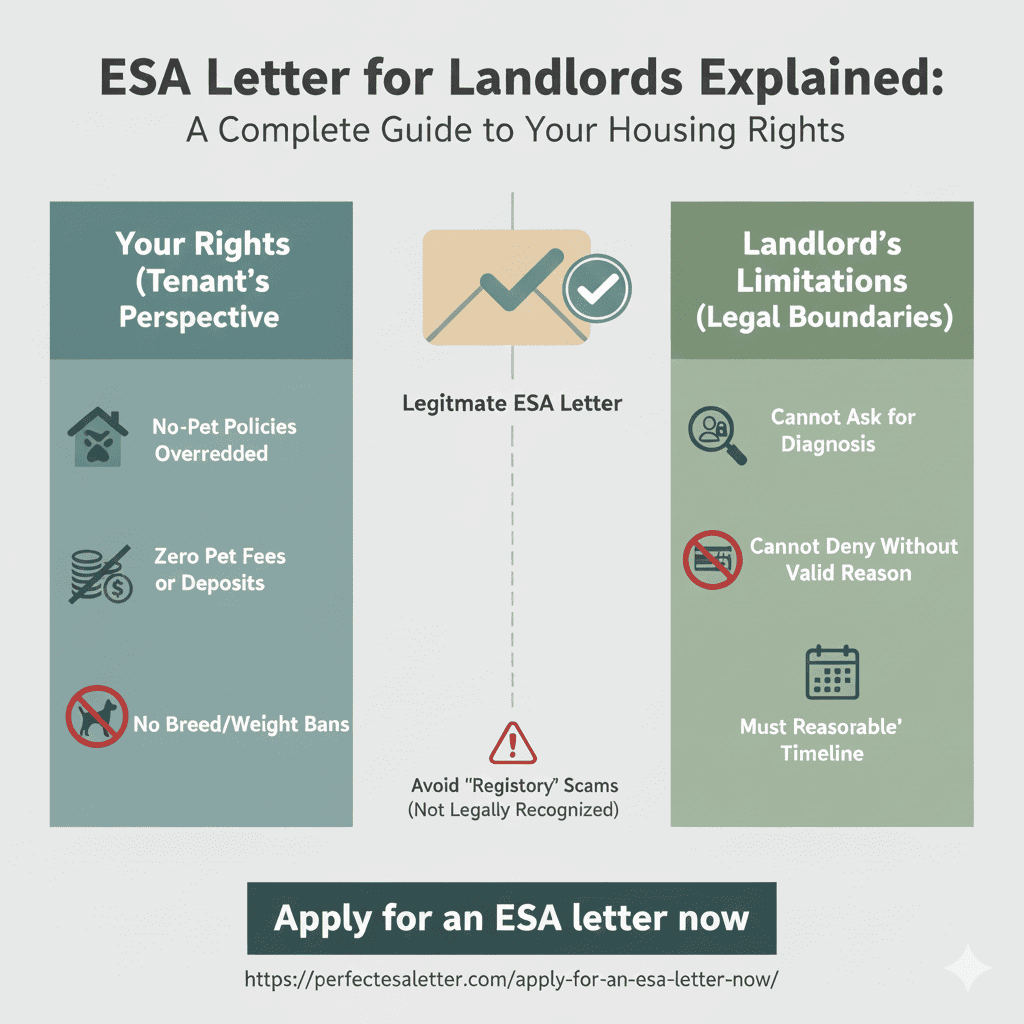
1. Exemption from “No-Pets” Policies
Even if a building has a strict policy against animals, the FHA requires landlords to make an exception for you. They cannot deny your application or evict you solely because you have an emotional support animal.
2. Waiver of All Pet Fees
One of the most significant benefits of having an ESA letter is the financial relief. Landlords are legally prohibited from charging:
-
Monthly Pet Rent: You should not see an extra $25–$100 on your monthly bill.
-
Upfront Pet Deposits: You are not required to pay a special “pet security deposit.”
-
Pet Fees: Non-refundable “pet entrance fees” are also waived.
3. Protection from Breed and Weight Restrictions
Many apartments have “aggressive breed” lists or 25-pound weight limits. Legally, these do not apply to ESAs. A landlord cannot deny your German Shepherd or your large-breed dog as long as the animal does not pose a direct, documented threat to the safety of others.
What a Landlord Can (and Cannot) Legally Ask
A common point of friction is the “verification” process. Knowing the boundaries of the law will help you handle intrusive questions.
| The Landlord CAN Ask For: | The Landlord CANNOT Ask For: |
| A copy of your official ESA letter. | Your specific medical diagnosis (e.g., “Tell me why you have PTSD”). |
| Verification of the clinician’s license. | Access to your detailed medical records or session notes. |
| Proof of local vaccinations/licensing. | Proof that the animal has undergone “specialized training.” |
| An updated letter (usually once a year). | You to pay a “processing fee” for your accommodation request. |
Pro Tip: If a landlord asks for “official registration” or a “certificate,” they are misinformed. HUD explicitly states that registration certificates are not required and are often a sign of a scam. The letter is the only document that matters.
Common Roadblocks and How to Overcome Them
Even with the law on your side, some landlords may try to push back. Here is how to handle the most frequent objections.
“I don’t accept letters from online doctors.”
HUD guidance (Notice FHEO-2020-01) clearly states that legitimate healthcare professionals can provide services remotely, including over the internet. As long as your letter comes from a clinician licensed in your state who has evaluated you, the landlord must accept it. At Perfect ESA Letter, we ensure you are matched with state-licensed professionals to satisfy this requirement.
“My insurance won’t allow that breed.”
Landlords often use insurance as an excuse. However, the burden is on the landlord to prove that allowing your animal would cause an “undue financial or administrative burden.” Most courts have ruled that simply saying “my insurance might go up” is not enough to deny a reasonable accommodation.
“You didn’t tell me about the animal when you applied.”
You are not legally required to disclose your ESA during the application process. You can request a reasonable accommodation at any time—before you move in, during your lease, or even after a landlord sends a “notice to quit” for a pet violation.
Internal Linking Suggestions
-
Anchor Text: how to qualify for a psychiatric service dog
-
Anchor Text: ESA letter sample for housing
-
Anchor Text: HUD guidelines for emotional support animals
Frequently Asked Questions (FAQs)
1. Does a landlord have to accept an ESA letter?
Yes, in almost all cases. Under the Fair Housing Act, landlords are required to provide reasonable accommodation for assistance animals. The only rare exceptions include owner-occupied buildings with four or fewer units or single-family homes sold/rented without a broker.
2. Can a landlord require me to use their specific form?
No. HUD rules state that landlords cannot force a healthcare professional to use a specific form or provide notarized documents. A standard letter on the provider’s letterhead that meets legal requirements is sufficient.
3. How long does a landlord have to respond to my request?
According to HUD guidelines, housing providers should respond to an ESA accommodation request “promptly,” which is generally considered within 10 days.
4. Can I be evicted for getting an ESA after moving in?
No, as long as you provide a valid ESA letter. You can request accommodation at any time. It is always best to submit your letter as soon as you have it to avoid “pet policy” misunderstandings.
5. Are there any animals that cannot be ESAs?
HUD generally allows “common household animals” like dogs, cats, birds, rabbits, and even certain reptiles. “Unique” animals (like monkeys or livestock) require much higher levels of justification from your doctor.
6. Do I need to buy a vest or ID tag for my ESA?
No. Vests, tags, and ID cards have no legal standing and do not grant any rights. The only thing a landlord can legally require is the ESA letter from your licensed professional.
7. What happens if my animal damages the apartment?
While you don’t pay pet fees, you are still responsible for your animal’s behavior. If your ESA damages the property (e.g., chews the carpet), the landlord can deduct the repair costs from your standard security deposit when you move out.
8. Can a landlord call my therapist?
A landlord can call the number on the letter to verify that the letter is authentic and that the clinician is indeed treating you. However, the therapist cannot share your private medical history or diagnosis without your written consent.
Secure Your Peace of Mind Today
Navigating an ESA letter for landlords explained doesn’t have to be a source of stress. Your animal is a crucial part of your mental health journey, and you deserve a home where both of you are welcome. By obtaining a legitimate, HUD-compliant letter, you remove the barriers of pet rent, breed bans, and discriminatory “no-pet” policies.
At Perfect ESA Letter, we streamline the process by connecting you with compassionate, state-licensed mental health professionals. We handle the clinical evaluation so you can focus on what matters—enjoying your home with your support animal. Don’t let a landlord’s pet policy dictate your well-being.