
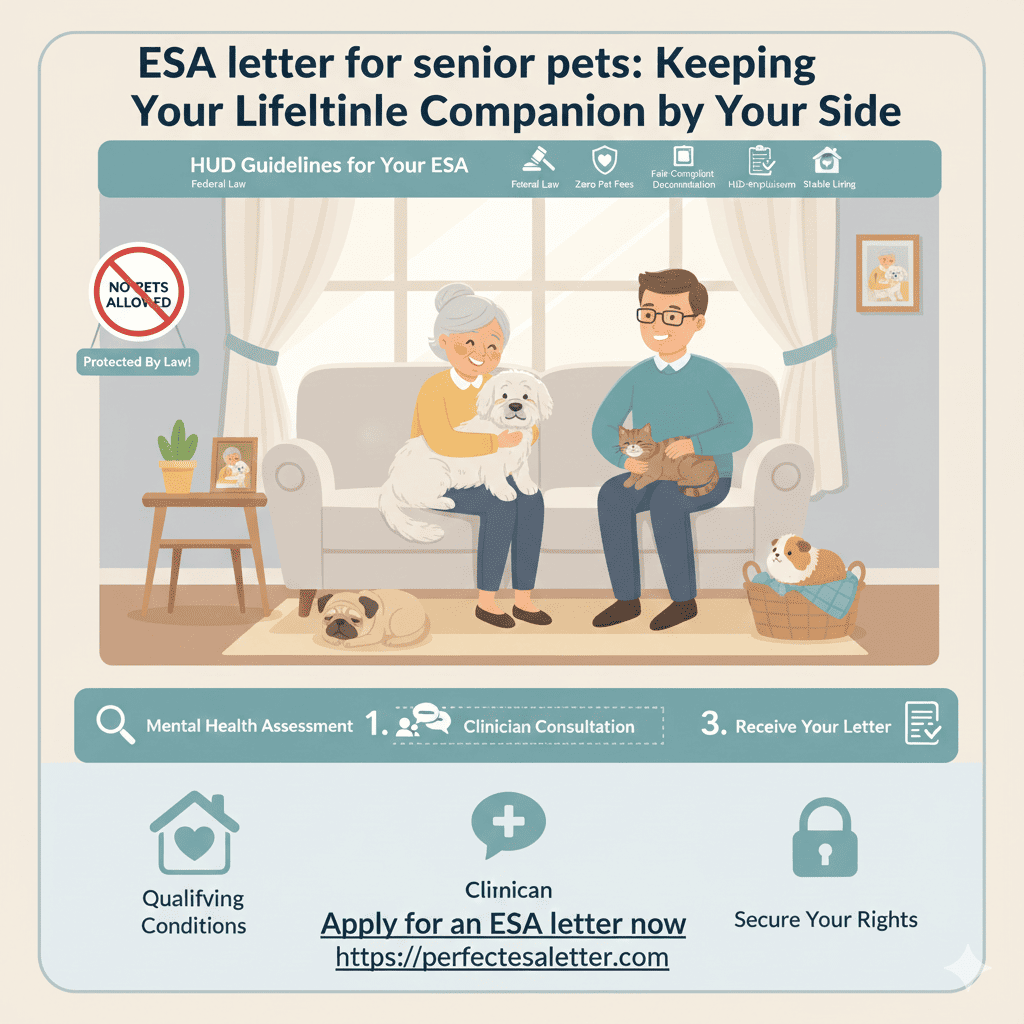
ESA letter for senior pets: Keeping Your Lifelong Companion by Your Side
ESA letter for senior pets: Keeping Your Lifelong Companion by Your Side
The bond between a human and an animal often deepens as the years go by. For many, a senior pet is not just a domestic animal; they are a living history of comfort, a steady presence through life’s ups and downs. However, as pets age, owners often face unique housing challenges. Some rental properties have “no-pet” policies that make finding a new home difficult, while others impose hefty “pet rent” that can strain a budget. Obtaining an ESA letter for senior pets is the most effective legal way to ensure that you and your aging companion are never separated by restrictive housing rules.
An Emotional Support Animal (ESA) provides essential therapeutic support for individuals dealing with mental health challenges such as anxiety, depression, or loneliness. For many seniors or individuals living alone, an older pet’s calm demeanor is exactly what is needed for emotional regulation. This guide will walk you through the importance of an ESA letter for senior pets, the legal protections you deserve, and how to obtain a legitimate document through a licensed professional.
Why Senior Pets Make the Best Emotional Support Animals
While puppies and kittens are often the center of attention, senior pets possess a unique set of qualities that make them exceptional emotional support animals. An ESA letter for senior pets recognizes the profound mental health benefits these loyal companions provide.
The Therapeutic Value of an Older Animal:
-
Predictable Temperament: Senior pets are typically calmer and have established personalities, making them ideal for owners who need a low-stress environment.
-
Low Energy Requirements: For owners struggling with chronic fatigue or physical limitations alongside mental health challenges, the slower pace of a senior pet is often a perfect match.
-
Unmatched Emotional Intuition: After years of living with humans, senior pets are often highly attuned to their owner’s emotional states, offering comfort exactly when it is needed most.
-
Mutual Support: The act of caring for an aging animal can provide a sense of purpose and routine, which is vital for managing symptoms of depression.
Your Legal Rights Under the Fair Housing Act (FHA)
When you have a valid ESA letter for senior pets, your animal is legally classified as an assistance animal, not a pet. This distinction is critical for your housing security. The Fair Housing Act (FHA) provides several ironclad protections for ESA owners.
Key Housing Protections:
-
Exemption from “No-Pet” Policies: Even if a building strictly prohibits animals, they must make a “reasonable accommodation” for your senior ESA.
-
No Pet Deposits or Monthly Pet Rent: Landlords are legally prohibited from charging extra fees for an assistance animal. This is especially beneficial for those on a fixed income.
-
Protection Against Age or Weight Limits: Some buildings only allow “small” or “young” pets. An ESA letter bypasses these arbitrary rules.
-
No Breed Restrictions: If your senior pet is a breed often restricted by insurance or management, the FHA ensures they can still live with you.
Comparison Table: Standard Pet vs. ESA Senior Pet
| Feature | Standard Senior Pet | ESA Senior Pet |
| Housing Permission | Landlord’s Discretion | Federal Right |
| Monthly Pet Rent | Usually Required | Legally Exempt |
| Pet Deposits | Often Required | Legally Exempt |
| Legal Status | Property/Pet | Assistance Animal |
How to Obtain a Legitimate ESA Letter for Senior Pets
To ensure your housing request is accepted, your ESA letter for senior pets must be issued by a Licensed Mental Health Professional (LMHP). HUD (the Department of Housing and Urban Development) has specific guidelines to prevent fraud, so the process must be clinical.
1. Clinical Assessment
You must consult with a professional—such as a psychologist, psychiatrist, or licensed counselor—who is licensed in your state. This can be done conveniently through a secure telehealth appointment.
2. Identifying the “Nexus”
The clinician must document the “nexus,” which is the direct link between your mental health condition and the support your senior pet provides. For instance, the clinician may note that your dog’s presence reduces the severity of your anxiety.
3. Professional Documentation
The final letter must be on the clinician’s official letterhead and include:
-
The clinician’s license type, number, and state of issuance.
-
Confirmation that you have a disability as defined by the FHA.
-
A recommendation for an emotional support animal as a necessary accommodation.
At Perfect ESA Letter, we facilitate this entire process by connecting you with state-licensed professionals who specialize in assistance animal documentation.
Avoiding Scams: Identifying Fraudulent Registries
As you look for an ESA letter for senior pets, you will likely see sites offering “instant registration” or “official ID cards.” These are almost always scams.
-
There is no official ESA registry. Any site claiming to “register” your pet with the government is selling a product with no legal value.
-
Vests and ID cards are not required. A landlord only needs to see your signed letter from a licensed professional.
-
A consultation is mandatory. If a website doesn’t involve a real interaction with a doctor, the document will likely be rejected by your landlord.
Internal Linking Suggestions
-
Anchor Text: how to qualify for an emotional support animal
-
Anchor Text: Fair Housing Act guidelines for senior pets
-
Anchor Text: difference between ESAs and service animals
Frequently Asked Questions (FAQs)
1. Can a landlord deny my senior ESA?
A landlord can only deny an ESA if the specific animal poses a direct threat to the safety of others or would cause “undue financial burden” to the property. Given that senior pets are generally calm, denials are very rare.
2. Does my senior pet need special training?
No. Unlike service dogs, emotional support animals do not require specialized task training. Their primary role is to provide comfort through their natural behavior and presence.
3. Is a telehealth ESA letter valid?
Yes. HUD explicitly recognizes that a legitimate clinician-patient relationship can be established via telehealth. As long as the provider is licensed in your state, the letter is legally binding.
4. What if I have more than one senior pet?
If you have a clinical need for multiple animals (for example, one for anxiety and another that helps with depression), a clinician can write a letter justifying the need for more than one ESA.
5. My pet is very old and doesn’t move much. Can they still be an ESA?
Absolutely. The therapeutic value of an ESA is not based on their activity level, but on the emotional bond and comfort they provide to their owner.
6. Do I have to tell my landlord about my ESA before I sign the lease?
You are not legally required to disclose your ESA until you are ready to request a “reasonable accommodation.” Many people wait until after the lease is signed to avoid potential bias.
7. Can a landlord ask for my medical records?
No. A landlord cannot ask for your specific diagnosis or your full medical history. The ESA letter for senior pets is sufficient proof of your need.
8. How long does the process take?
With a reputable service, you can typically complete your evaluation and receive your digital letter within 24 to 48 hours.
Protect Your Loyal Companion and Your Peace of Mind
Your senior pet has been there for you for years; now it is time to ensure you can be there for them. You should never have to deal with the fear of being forced to rehome an aging animal due to “no-pet” rules or the financial strain of unnecessary fees. A legitimate ESA letter for senior pets is your legal protection against housing discrimination and your ticket to a more stable, supportive home life.
At Perfect ESA Letter, we take the stress out of the process. We match you with compassionate, licensed professionals who understand the law and are dedicated to your well-being. Don’t let restrictive housing rules stand in the way of your bond with your lifelong friend.