
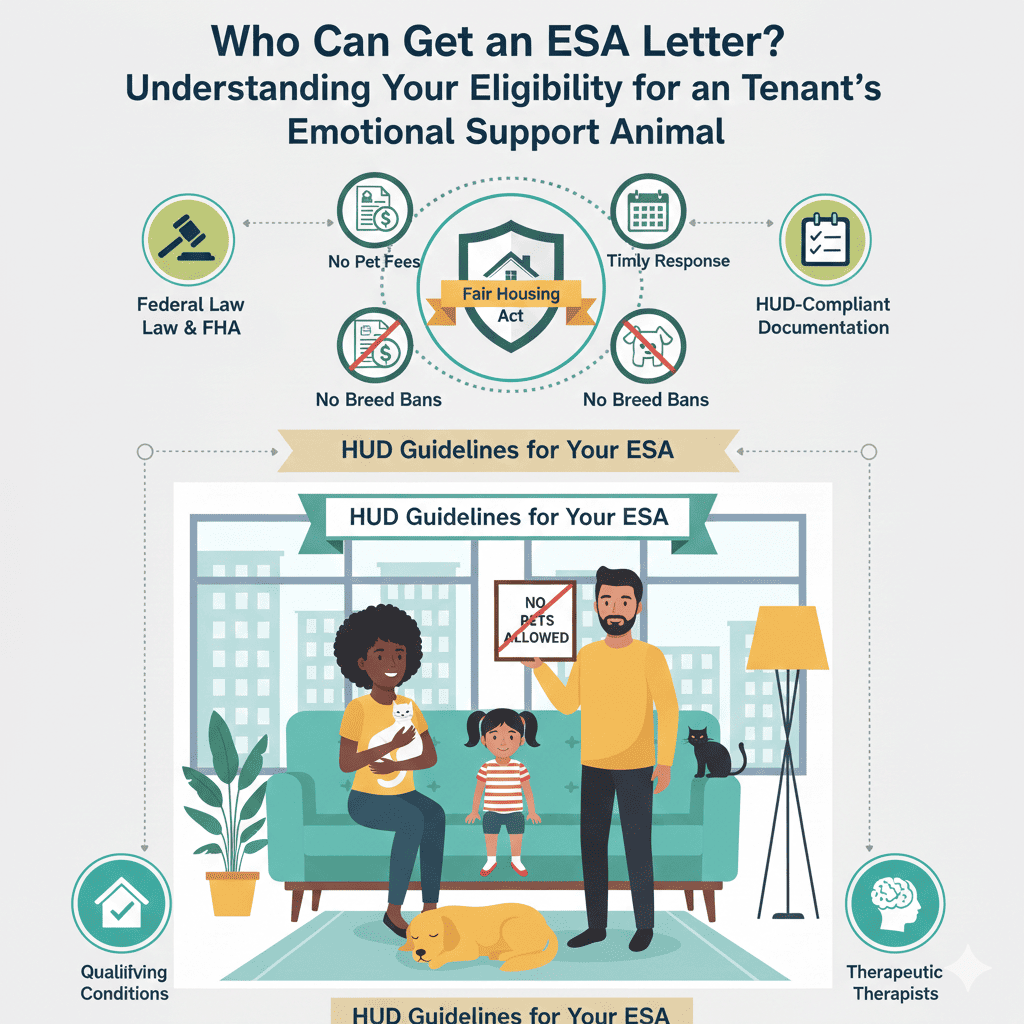
Who Can Get an ESA Letter? Understanding Your Eligibility for an Emotional Support Animal
Who Can Get an ESA Letter? Understanding Your Eligibility for an Emotional Support Animal
In an increasingly stressful world, the therapeutic value of an animal companion cannot be overstated. For those living with mental health challenges, a dog, cat, or even a rabbit is often more than a pet—they are a vital source of stability and comfort. If you are struggling with emotional hurdles and find that your animal helps you cope, you may be wondering, “Who can get an ESA letter?”
Understanding the criteria for an Emotional Support Animal (ESA) is the first step toward securing your legal rights as a tenant. Under the Fair Housing Act (FHA), individuals with qualifying mental or emotional disabilities are entitled to live with their animals in “no-pet” housing and are exempt from paying pet-related fees. This guide will walk you through the clinical requirements, qualifying conditions, and the professional process of obtaining a valid letter.
The Legal Definition: Who Can Get an ESA Letter?
According to the U.S. Department of Housing and Urban Development (HUD), an emotional support animal is a type of assistance animal that provides emotional support to alleviate one or more identified symptoms or effects of a person’s disability.
So, who can get an ESA letter? To be eligible, a person must meet two primary legal criteria:
-
A Diagnosable Disability: You must have a mental or emotional impairment that is recognized in the Diagnostic and Statistical Manual of Mental Disorders (DSM-5).
-
A Functional Limitation: This impairment must “substantially limit” at least one major life activity, such as sleeping, working, social interaction, or concentrating.
-
The Therapeutic Nexus: There must be a clear connection (nexus) between the person’s disability and the support the animal provides.
If your animal helps you manage your symptoms and allows you to function better in your daily life, you are likely a candidate for an ESA letter.
Qualifying Mental Health Conditions
Many people believe that you need a severe or physical disability to qualify for an ESA. In reality, a wide range of mental and emotional health conditions can make you eligible. If you suffer from any of the following, you may be asking who can get an ESA letter for your specific situation.
Anxiety and Stress Disorders
Whether it is Generalized Anxiety Disorder (GAD), social anxiety, or panic disorder, animals provide a grounding presence. They can help lower heart rates during an attack and provide the security needed to navigate social environments.
Depressive Disorders
For those struggling with depression, the routine of caring for an animal provides a necessary sense of purpose. The unconditional love and companionship of an ESA can significantly reduce feelings of isolation and hopelessness.
Post-Traumatic Stress Disorder (PTSD)
Veterans and survivors of trauma often find that ESAs help mitigate hyper-vigilance and night terrors. An animal’s presence creates a “safe zone” that allows for emotional healing.
Neurodevelopmental Disorders
Individuals with ADHD or Autism Spectrum Disorder (ASD) often benefit from the sensory input and emotional regulation provided by an animal companion.
Other Common Qualifying Conditions:
-
Bipolar Disorder
-
Chronic Stress
-
Obsessive-Compulsive Disorder (OCD)
-
Learning Disabilities
-
Phobias
-
Sleep Disorders/Insomnia
Comparison: Who Qualifies for an ESA vs. a Service Dog?
It is common to confuse ESAs with service dogs, but the eligibility and training requirements differ significantly.
| Feature | Emotional Support Animal (ESA) | Service Animal (Dog) |
| Who Can Get One? | People with mental/emotional disabilities. | People with physical or psychiatric disabilities. |
| Training Required? | None. | Must be trained to perform specific tasks. |
| Species Allowed? | Most common household animals. | Dogs only (and sometimes miniature horses). |
| Public Access? | Limited (mostly housing). | Full access to all public areas. |
| Documentation? | ESA Letter required. | No “letter” required by law. |
The Professional Evaluation: Who Can Write the Letter?
The answer to who can get an ESA letter also depends on who writes it. Federal law is very specific about the credentials of the professional issuing the recommendation. A valid letter must be written by a Licensed Mental Health Professional (LMHP).
Legitimate Providers Include:
-
Psychiatrists and Psychologists
-
Licensed Clinical Social Workers (LCSW)
-
Licensed Marriage and Family Therapists (LMFT)
-
Licensed Professional Counselors (LPC)
-
Primary Care Physicians or Nurse Practitioners
Why “Registries” Fail
Many websites offer “instant certificates” or “official badges.” These are often scams. Landlords are legally allowed to reject any documentation that does not come from a licensed professional who has evaluated the patient. At Perfect ESA Letter, we ensure you are connected with a real, state-licensed clinician to maintain 100% legal compliance.
How the ESA Process Works for Renters
Once you determine that you meet the criteria for who can get an ESA letter, the process of securing your housing rights is straightforward.
-
Clinical Assessment: You will participate in an evaluation (often via a secure telehealth platform) to discuss your mental health history and how your animal helps you.
-
Issuance of the Letter: If you qualify, the clinician will write a letter on their official letterhead, including their license number and contact information.
-
Submission to Landlord: You provide this letter to your landlord as part of a “Reasonable Accommodation” request.
-
Protection Realized: Once accepted, you are no longer subject to “no-pet” rules, breed bans, or pet rent.
Internal Linking Suggestions
-
Anchor Text: how to qualify for an emotional support animal
-
Anchor Text: Fair Housing Act and ESA laws
-
Anchor Text: benefits of an ESA for anxiety
Overcoming Common Landlord Objections
Even after you’ve answered who can get an ESA letter and obtained your own, some landlords may push back. Here is how to handle the most common objections:
- “We have a weight limit of 25 lbs.”
Under the FHA, weight and breed restrictions do not apply to assistance animals. As long as your animal is not a direct threat to others, it must be accommodated.
- “You need to pay a pet deposit.”
Charging a deposit or “pet rent” for an ESA is considered discrimination. You are only responsible for actual damages the animal might cause to the property.
- “I need to see your medical records.”
Landlords are prohibited from asking for your specific diagnosis, medical history, or the severity of your disability. A valid ESA letter is the only proof they are entitled to receive.
Frequently Asked Questions (FAQs)
1. Who can get an ESA letter for an existing pet?
Anyone who has a qualifying mental health condition and finds that their existing pet provides therapeutic relief can get an ESA letter. You do not need to get a “new” animal to qualify.
2. Can I get an ESA letter if I don’t have a therapist?
Yes. Many people do not have a regular therapist. Services like Perfect ESA Letter connect you with licensed professionals who can perform an evaluation specifically for an ESA recommendation.
3. Does my landlord have to accept my ESA letter?
If the letter is valid and comes from a licensed professional, the answer is generally yes. However, certain housing types (like owner-occupied buildings with 4 or fewer units) may be exempt from the FHA.
4. Can I get an ESA letter for a cat or a bird?
Yes! While dogs are common, cats, birds, rabbits, and other common household animals can qualify as ESAs as long as they provide support for your condition.
5. Is there a specific age requirement for who can get an ESA letter?
No. Children, teenagers, adults, and seniors can all qualify for an ESA letter if they have a documented mental or emotional disability.
6. Can a landlord deny my ESA if it’s a “dangerous” breed?
No. HUD guidelines state that breed-specific legislation or insurance policies are not valid reasons to deny an ESA. Denial can only happen if that specific animal has a history of aggression.
7. Do I need to register my ESA on a government website?
No. There is no such thing as a government-run ESA registry. Any site asking you to “register” your pet is likely a scam. The letter is your only legal requirement.
8. Does the ESA letter expire?
The law does not state an expiration date, but most landlords require the letter to be current—usually issued within the last 12 months—to prove the disability-related need is ongoing.
Take Control of Your Housing Rights Today
The question of who can get an ESA letter isn’t about jumping through hoops—it’s about ensuring that people with mental health challenges have the same right to a comfortable home as everyone else. Your animal companion is a crucial part of your health and happiness, and the law is on your side.
At Perfect ESA Letter, we take the complexity out of the process. We connect you with compassionate, state-licensed professionals who understand the therapeutic bond between humans and animals. Stop worrying about pet fees and housing restrictions, and start focusing on your well-being.