
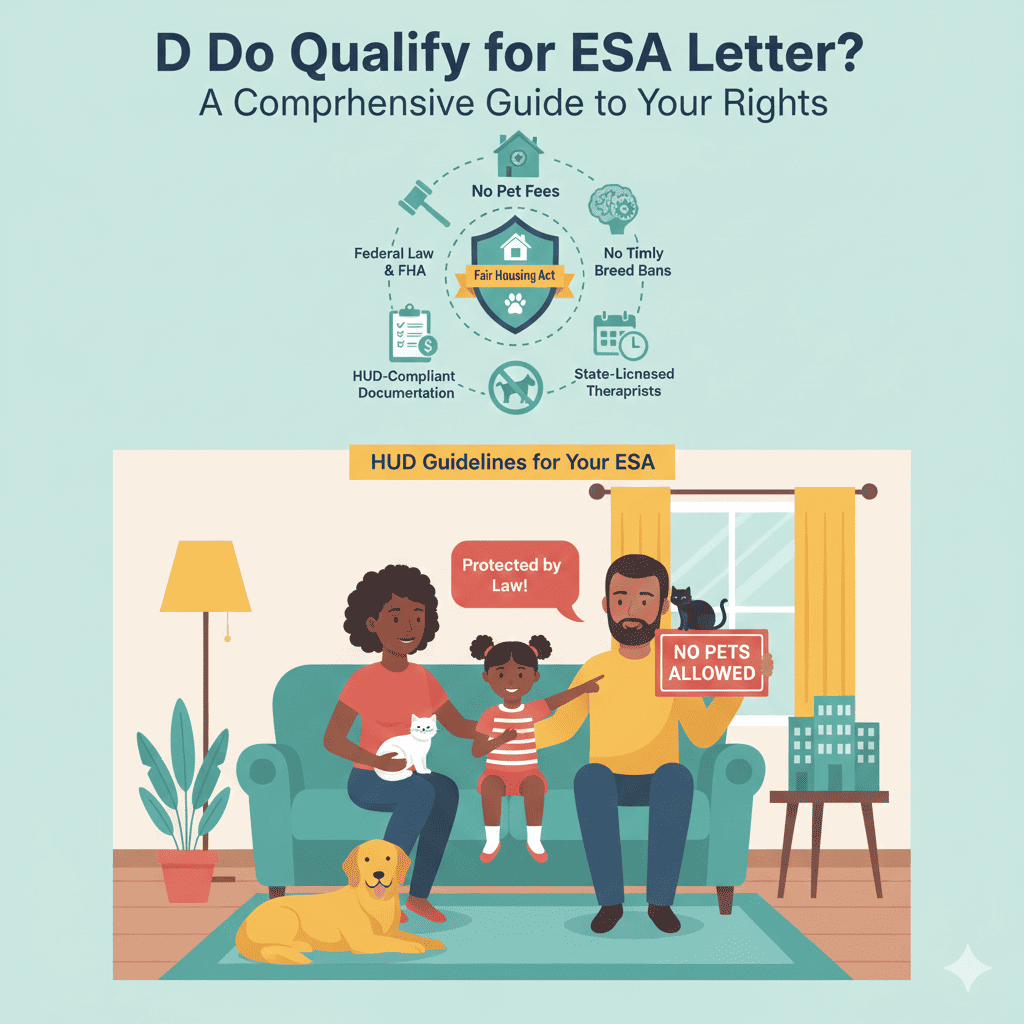
Do I Qualify for an ESA Letter? A Comprehensive Guide to Your Rights
Do I Qualify for an ESA Letter? A Comprehensive Guide to Your Rights
Living with a mental health condition can feel like an invisible weight that follows you everywhere. Whether it’s the gripping chest pain of an anxiety attack or the heavy fog of depression, these challenges affect how you work, socialize, and relax. For millions of people, a dedicated animal companion provides more than just “pet” ownership—they provide a vital lifeline of emotional stability.
If you’ve ever asked yourself, “Do I qualify for an ESA letter?”, you are already taking the first step toward securing the legal protections you deserve. An Emotional Support Animal (ESA) is not just a pet; it is a recognized part of a treatment plan for those dealing with emotional or mental impairments.
In this guide, we will break down the clinical criteria for eligibility, the specific conditions that qualify, and how you can obtain a legally binding letter that ensures your animal can live with you, even in “no-pet” housing.
What is an Emotional Support Animal (ESA)?
Before diving into the question of “Do I qualify for an ESA letter?”, it’s important to understand the legal definition. Under the Fair Housing Act (FHA), an ESA is an assistance animal that provides therapeutic benefits to an individual with a disability.
Unlike service dogs (like guide dogs for the blind), ESAs do not require specialized training to perform specific tasks. Their “work” is their presence. By providing comfort, companionship, and a sense of security, they help alleviate the symptoms of various mental health disorders.
Key Benefits of Qualifying for an ESA:
-
Housing Acceptance: You can live in rental properties that have “no-pet” policies.
-
Fee Waivers: Landlords are prohibited from charging pet deposits or monthly pet rent for an ESA.
-
Exemption from Breed/Weight Bans: Your ESA is protected regardless of its size or breed.
-
Legal Protection: You are shielded from housing discrimination based on your need for an assistance animal.
Do I Qualify for an ESA Letter? Understanding the Criteria
To qualify for an ESA letter, you must meet two primary legal requirements set by the Department of Housing and Urban Development (HUD):
-
You must have a mental or emotional disability: This condition must be recognized in the Diagnostic and Statistical Manual of Mental Disorders (DSM-5) and must “substantially limit” at least one major life activity (such as sleeping, working, or social interaction).
-
The animal must provide a “nexus” of support: There must be a clear connection between your condition and the support the animal provides. The animal’s presence must help mitigate at least one symptom of your disability.
Who Makes the Final Determination?
Only a Licensed Mental Health Professional (LMHP)—such as a psychiatrist, psychologist, LCSW, or LMFT—can determine if you qualify. They must evaluate your mental health history and current symptoms to certify that an ESA is a necessary part of your treatment.
Common Mental Health Conditions That Qualify
If you are struggling with any of the following conditions, there is a high likelihood that you qualify for an emotional support animal.
1. Anxiety Disorders
Whether it is Generalized Anxiety Disorder (GAD), social phobia, or panic disorder, the calming presence of an animal can lower cortisol levels and help ground you during moments of high stress.
2. Depression
The companionship of an ESA provides a sense of purpose and reduces feelings of isolation. For many, the need to care for an animal (feeding, walking) helps create a routine that is essential for managing depressive episodes.
3. Post-Traumatic Stress Disorder (PTSD)
Veterans and trauma survivors often rely on ESAs to help manage hyper-vigilance, night terrors, and emotional numbing. An animal provides a consistent sense of safety.
4. Attention Deficit Hyperactivity Disorder (ADHD)
ESAs can help individuals with ADHD by providing a structured schedule and a calming sensory experience, which can help improve focus and emotional regulation.
5. Other Qualifying Conditions:
-
Bipolar Disorder
-
Obsessive-Compulsive Disorder (OCD)
-
Chronic Stress
-
Autism Spectrum Disorder
-
Learning Disabilities
-
Phobias
| Condition | How an ESA Helps |
| Panic Attacks | Provides a grounding physical presence to interrupt the attack. |
| Insomnia | Offers a sense of security that allows for better sleep quality. |
| Social Anxiety | Acts as a social “buffer” and provides comfort in public spaces. |
How the Evaluation Process Works
If you think you qualify, the process of getting a letter is straightforward, provided you work with a legitimate service. Avoid “instant” certificate sites, as these are often scams that landlords will reject.
Step 1: Pre-Screening
You typically start with an assessment or quiz to see if your symptoms align with qualifying conditions. This helps determine if you are a good candidate for a professional evaluation.
Step 2: Consultation with an LMHP
You will meet with a licensed professional (often via telehealth). They will discuss your symptoms, how they impact your life, and how an animal helps you cope. This is a non-judgmental, clinical conversation.
Step 3: Receiving Your Letter
If the professional determines you qualify, they will issue a signed letter on their official letterhead. This letter must include their license number and contact information for landlord verification.
Why You Need a Valid Letter for Housing
Landlords are becoming increasingly savvy about ESA laws. They have the right to verify that your letter is legitimate and that it comes from a licensed professional in good standing.
Without a valid ESA letter, you could be forced to pay thousands in pet fees or even face eviction if you are in a “no-pet” building. A legal letter from Perfect ESA Letter ensures that your documentation meets all HUD and state requirements, giving you the confidence to stand up for your rights.
Internal Linking Suggestions
-
Anchor Text: ESA housing laws and regulations (Link to a detailed guide on the Fair Housing Act)
-
Anchor Text: how to talk to your landlord about an ESA (Link to a communication guide)
-
Anchor Text: difference between service dogs and ESAs (Link to a comparison article)
Frequently Asked Questions (FAQs)
1. Can my primary care doctor write an ESA letter?
Yes, any licensed medical or mental health professional can write an ESA letter. However, many general practitioners are unfamiliar with the specific HUD requirements, which is why working with a specialized mental health professional is often more effective.
2. Is there an official registry for ESAs?
No. There is no such thing as an “official” federal registry for emotional support animals. Websites that sell “registration” or “ID cards” are selling products with no legal standing. The only document that matters is a letter from an LMHP.
3. Do I qualify for an ESA letter if I have multiple pets?
Yes, but your letter must justify the need for each animal. If you have two cats that both alleviate different symptoms of your anxiety, your clinician must document that specific need.
4. Can a landlord deny my ESA if it’s a “restricted” breed?
No. Under the Fair Housing Act, breed and weight restrictions do not apply to assistance animals. A landlord can only deny an ESA if the specific animal has a documented history of being dangerous or destructive.
5. What if I already have my pet—can I turn it into an ESA?
Absolutely. Most ESAs were pets first. If your existing pet already helps you manage your mental health symptoms, you can qualify to have them officially recognized as an ESA.
6. Do I need to get my letter renewed?
While federal law doesn’t explicitly state an expiration date, most landlords require a letter that has been issued or updated within the last 12 months to ensure your medical need is still current.
7. Can I get an ESA letter for my dorm room?
Yes. The Fair Housing Act applies to most university housing and dorms. Students with qualifying mental health conditions have the same rights to an ESA as renters in private apartments.
8. Does the letter have to mention my specific diagnosis?
No. For your privacy, the letter does not need to state that you have “Clinical Depression” or “Severe Anxiety.” It only needs to state that you have a mental impairment that meets the criteria for a disability and that the ESA is a necessary accommodation.
Secure the Support You Deserve Today
If you find yourself constantly asking, “Do I qualify for an ESA letter?”, the answer is likely within reach. You shouldn’t have to navigate life’s mental health hurdles without the comfort of your companion, and you certainly shouldn’t have to pay extra fees just to keep them by your side.
At Perfect ESA Letter, we streamline the process by connecting you with compassionate, state-licensed professionals who can provide you with a 100% legal and HUD-compliant letter. Take control of your housing situation and prioritize your mental health today.