
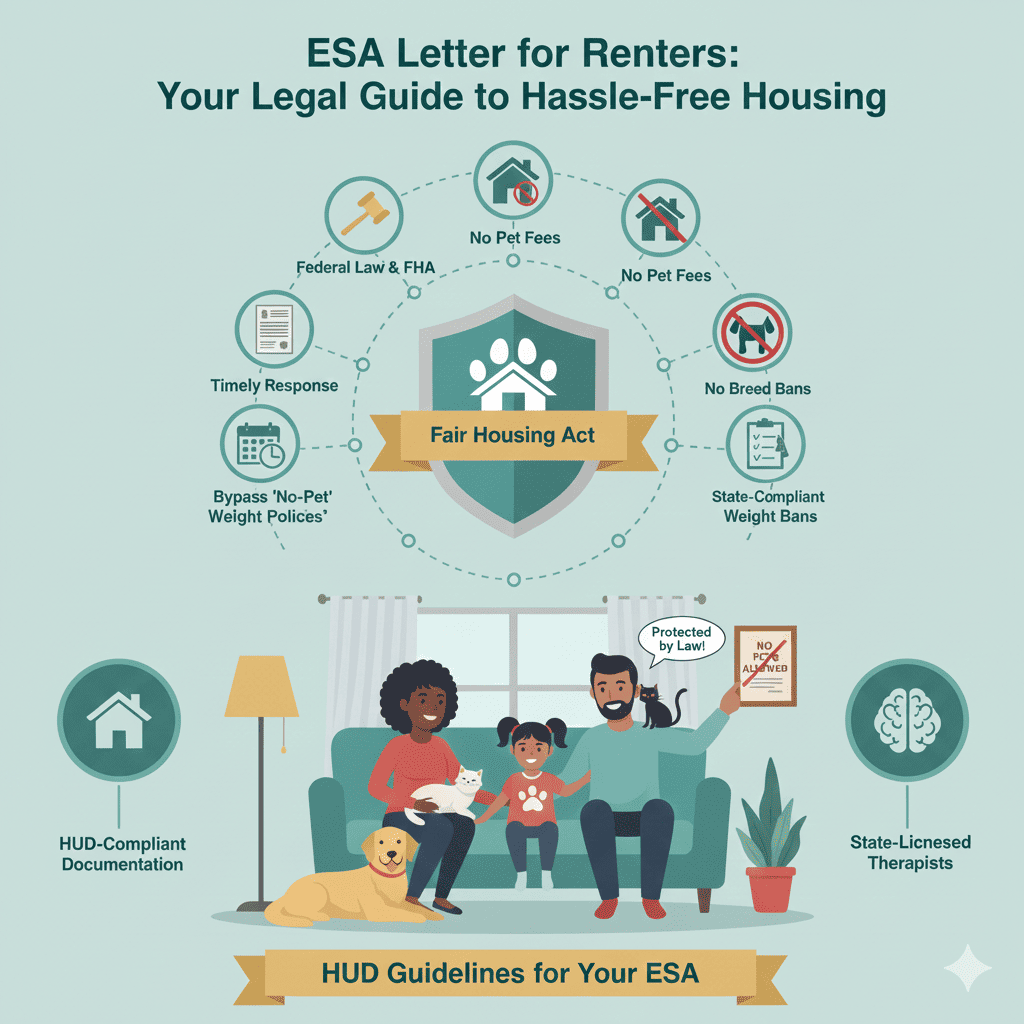
ESA Letter for Renters: Your Legal Guide to Hassle-Free Housing
ESA Letter for Renters: Your Legal Guide to Hassle-Free Housing
Finding the perfect rental is hard enough without the added stress of a “no-pets” policy or exorbitant monthly pet fees. For many individuals, an emotional support animal (ESA) isn’t just a pet; they are a vital companion that provides the stability needed to manage mental health conditions like anxiety, depression, or PTSD.
If you are a tenant, an ESA letter for renters is your most powerful tool. Under federal law, this document transforms your animal from a “pet” into a “legal assistance animal,” granting you protections that standard pet owners don’t have. This guide explores your rights under the Fair Housing Act (FHA), how to handle landlord interactions, and why a legitimate letter is the only way to secure your housing peace of mind.
What is an ESA Letter for Renters?
An ESA letter for renters is a formal document written by a licensed mental health professional (LMHP) that verifies your need for an emotional support animal as part of your treatment plan. This letter serves as a “prescription” for the therapeutic benefits your animal provides.
Because the Fair Housing Act (FHA) governs most rental properties in the U.S., having this letter means your landlord must provide “reasonable accommodation.” Essentially, they are legally required to waive their pet policies to ensure you have equal opportunity to use and enjoy your home.
Key Benefits for Tenants:
-
Bypass “No-Pet” Policies: Live in buildings that otherwise prohibit animals.
-
Eliminate Pet Rent: Save hundreds or thousands of dollars in monthly fees.
-
No Pet Deposits: Landlords cannot charge an upfront deposit for an ESA.
-
Exemption from Breed/Weight Restrictions: Your Great Dane or Pit Bull is protected regardless of building size or breed limits.
The Legal Landscape: Fair Housing Act Protections
The Department of Housing and Urban Development (HUD) provides the framework that protects you. According to HUD guidelines, assistance animals (which includes ESAs) are not pets. Therefore, standard pet rules do not apply.
What Landlords Can and Cannot Ask
When you provide an ESA letter for renters, your landlord has limited rights regarding what they can investigate.
| Landlord Action | Legally Permitted? | Explanation |
| Request a valid ESA letter | YES | They can ask for documentation if your disability isn’t obvious. |
| Verify the provider’s license | YES | They can check if the clinician is active in your state. |
| Ask for your medical records | NO | This is a violation of HIPAA and privacy laws. |
| Require the animal to be trained | NO | ESAs do not require specialized task training. |
| Ask for a specific diagnosis | NO | They only need to know you have a qualifying disability. |
How to Get a Legitimate ESA Letter for Renters
To ensure your ESA letter for renters is accepted, it must meet strict clinical and legal standards. “Instant” certificates or registry badges bought online are often flagged as fraudulent by savvy property managers.
5 Requirements for a Valid Letter:
-
Licensed Professional: Must be written by an LMHP (Psychologist, LCSW, LMFT, etc.) or a physician.
-
Professional Letterhead: Must include the provider’s contact info and practice details.
-
License Number: The professional’s state license number and type must be clearly listed.
-
Established Relationship: In many states (like California and Florida), you must have an established therapeutic relationship with the provider for at least 30 days.
-
Direct Nexus: The letter must state that the animal alleviates specific symptoms of your disability.
At Perfect ESA Letter, we connect you with state-licensed professionals who understand these nuances, ensuring your letter is 100% compliant with the latest HUD standards.
How to Submit Your Request to Your Landlord
Submitting your ESA letter for renters should be a transparent and professional process. While you can make a request orally, we always recommend doing so in writing to create a legal paper trail.
Step-by-Step Submission Process:
-
Review Your Lease: Identify the existing pet policies so you know exactly which rules you are asking to waive.
-
Draft a Formal Request: Send an email or letter stating: “I am requesting a reasonable accommodation under the Fair Housing Act for my emotional support animal.”
-
Attach Your Letter: Include the digital or physical copy of your signed ESA letter.
-
Allow Time for Review: Landlords generally have 10 days to respond to your request.
-
Keep Records: Save copies of all communications in case you need to file a complaint later.
Common Challenges and Landlord Objections
Even with a valid ESA letter for renters, you may face pushback. Here is how to handle the most common “No” responses:
“Our insurance doesn’t allow this breed.”
HUD is clear: a landlord cannot deny an ESA based on insurance breed restrictions unless the insurance company proves they would cancel the policy specifically because of your individual animal. This is extremely rare and difficult for landlords to prove.
“You must pay a pet deposit.”
Remind them politely that under the FHA, an ESA is not a pet. Charging a fee for an assistance animal is considered discriminatory. However, you are still responsible for any actual physical damage the animal causes to the property.
“I don’t accept letters from online doctors.”
HUD’s 2020 guidance explicitly states that letters from licensed healthcare professionals delivered via telehealth are valid, provided the professional has personal knowledge of the patient.
Internal Linking Suggestions
-
Anchor Text: qualifying conditions for an ESA (Link to a page on anxiety/depression/PTSD)
-
Anchor Text: ESA vs. Service Dog for housing (Link to a comparison guide)
-
Anchor Text: state-specific ESA laws (Link to a state-by-state resource)
Frequently Asked Questions (FAQs)
1. Can a landlord evict me for having an ESA?
Not if you have a valid ESA letter for renters. If you provide the documentation, the landlord must allow the animal. Evicting a tenant because of a protected assistance animal is a violation of federal fair housing laws.
2. Does my ESA need to wear a vest or have an ID tag?
No. There is no legal requirement for an ESA to wear a vest or carry an ID card. In fact, many “ID cards” sold online are red flags for fraud. Your only required document is your clinician-signed letter.
3. Can I have more than one ESA in my apartment?
Yes. You can have multiple emotional support animals, but your ESA letter for renters must provide a clinical justification for why each individual animal is necessary for your treatment.
4. What types of animals can be ESAs?
According to HUD, ESAs are typically “common household animals” like dogs, cats, small birds, rabbits, hamsters, or fish. Unique animals (like a goat or a monkey) require much higher levels of justification.
5. What if I am moving into a new apartment soon?
You should submit your ESA letter for renters as soon as your application is approved or once you sign the lease. You are not legally required to disclose your ESA during the initial application process to prevent “stealth discrimination.”
6. Can a landlord deny my ESA if it’s “too big”?
No. Size and weight restrictions do not apply to assistance animals. A landlord can only deny an ESA if the specific animal poses a direct threat to the safety of others or would cause “undue financial burden” (which is a very high legal bar).
7. Do I need to renew my ESA letter every year?
While the FHA doesn’t strictly require annual renewal, most landlords will request an updated letter every 12 months to ensure your need for the accommodation is still current.
8. What should I do if my landlord says no?
If a landlord refuses a valid letter, you can file a formal housing discrimination complaint with HUD. Often, mentioning that you are prepared to do this is enough to resolve the issue.
Secure Your Home with the Support You Need
Living as a tenant shouldn’t mean sacrificing your mental well-being. An ESA letter for renters is your legal shield against unfair fees and restrictive policies. By obtaining a legitimate, state-compliant letter, you protect your rights, your wallet, and the bond you share with your support animal.
At Perfect ESA Letter, we make the process simple, discreet, and legally sound. Our network of licensed professionals is ready to help you navigate the housing market with confidence. Don’t let a “no-pets” sign stop you from finding your next home.