
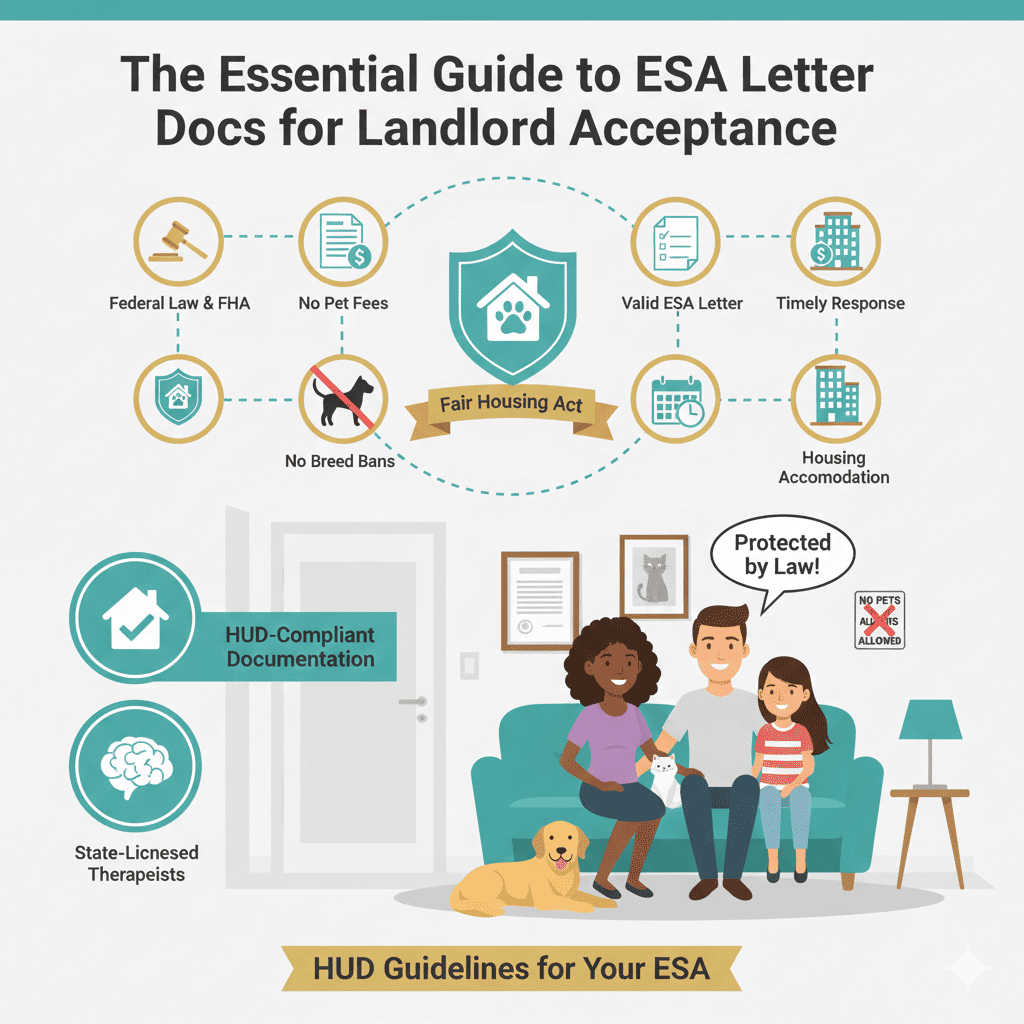
The Essential Guide to ESA Letter Docs for Landlord Acceptance
The Essential Guide to ESA Letter Docs for Landlord Acceptance
For many tenants living with emotional or mental health challenges, the support of an animal is a non-negotiable part of their wellness journey. However, the process of moving into a new apartment or keeping a companion in a “no-pets” building often leads to a stressful confrontation with property management. The key to resolving these conflicts lies in understanding the specific ESA letter docs for landlord approval.
Under the Fair Housing Act (FHA), emotional support animals (ESAs) are recognized as assistance animals rather than pets. This legal distinction grants you the right to live with your animal without paying pet deposits or monthly pet rent. To exercise these rights, however, you must provide your housing provider with the correct documentation. In this guide, we will break down exactly what makes an ESA letter valid and how to present your documents to ensure 100% compliance.
What Exactly Are ESA Letter Docs for Landlord Submission?
An ESA letter docs for landlord request is essentially a formal recommendation from a licensed healthcare professional. It serves as medical verification that you have a disability-related need for an emotional support animal. While the animal does not require specialized training (unlike a service dog), the documentation itself must meet very specific federal criteria to be considered legally binding.
Why Landlords Require Documentation
Property managers use these documents to verify two main things:
-
That you meet the legal definition of having a disability under the Fair Housing Act.
-
That there is a clear “nexus,” or connection, between your disability and the assistance the animal provides.
Without the proper paperwork, a landlord is within their rights to treat your animal as a standard pet, meaning they could enforce breed restrictions or charge pet-related fees.
The Checklist: What Your ESA Letter Must Include
To ensure your ESA letter docs for landlord acceptance are never questioned, your letter must contain specific information. HUD (Department of Housing and Urban Development) has provided clear guidelines on what constitutes a legitimate request.
1. Professional Letterhead
The document must be on the official letterhead of a Licensed Mental Health Professional (LMHP). This should include their practice name, address, and contact information.
2. Licensing Information
The professional must include their license type (e.g., LCSW, LMFT, Psychologist, or Psychiatrist), the state where they are licensed, and their license number. Landlords often verify these numbers on state databases.
3. The Date of Issuance
While the FHA doesn’t explicitly state an expiration date, most landlords require the letter to be current—usually within the last 12 months. This proves that the need for the ESA is ongoing.
4. A Statement of Disability-Related Need
The letter must confirm that you have a mental or emotional impairment that substantially limits one or more major life activities. Crucially, it must state that the animal provides support that alleviates symptoms of that impairment.
Comparison: Valid vs. Invalid ESA Documentation
| Feature | Legitimate ESA Letter | Online “Registration” / Certificate |
| Source | Licensed Medical Professional | Automated Website |
| Clinical Evaluation | Included (via consultation) | None |
| HUD Compliant | YES | NO |
| Waives Pet Fees | YES | NO |
| Legal Standing | Federal Protection (FHA) | None (Scam) |
Many “registry” websites promise instant certification or “official” ID tags. Landlords are increasingly trained to spot these as fraudulent. Only a signed letter from a licensed professional provides the legal weight needed to bypass housing restrictions.
How to Present Your ESA Docs to Your Landlord
Once you have your ESA letter docs for landlord review, the way you present them can make a significant difference in how the request is handled.
-
Submit a Written Request: Along with your letter, provide a brief written request for a “Reasonable Accommodation.” This creates a paper trail for your records.
-
Timing Matters: You can submit your request before you move in, during your lease, or even after a landlord has issued a “no-pets” warning. However, submitting it before moving the animal in is always the smoothest path.
-
Be Transparent but Private: You do not have to disclose your specific medical diagnosis. The letter confirms the need without violating your privacy.
-
Wait for the Decision: Landlords generally have 10 to 30 days to respond. They may ask for “verification,” which allows them to contact the clinician to confirm the letter is authentic.
At Perfect ESA Letter, we ensure our clinicians are prepared to respond to these verification requests, giving you peace of mind throughout the approval process.
Internal Linking Suggestions
-
Anchor Text: how to qualify for an emotional support animal
-
Anchor Text: Fair Housing Act housing rights
-
Anchor Text: ESA vs. Psychiatric Service Dog
Overcoming Landlord Objections
Even with the correct ESA letter docs for landlord submission, you might encounter pushback. Here is how to handle common objections:
- “We don’t allow large dogs.”
Under the FHA, breed and weight restrictions are waived for ESAs. Unless the specific dog poses a direct safety threat, they must allow it.
- “You need to pay a pet deposit.”
This is illegal. Assistance animals are not pets. Charging a deposit for an ESA is considered discrimination under federal law.
- “We need to see your medical records.”
Property managers are legally prohibited from asking for your medical history, diagnosis, or the severity of your disability. A valid ESA letter is the only medical proof they are entitled to receive.
Frequently Asked Questions (FAQs)
1. Does a landlord have to accept my ESA letter?
If the letter is from a licensed professional and you live in a building covered by the Fair Housing Act, yes. The landlord must provide a “reasonable accommodation” and allow the animal.
2. Can a landlord charge a fee for processing ESA letter docs?
No. There are no administrative fees or processing charges allowed for reasonable accommodation requests.
3. What if my landlord’s insurance doesn’t allow certain breeds?
HUD is very clear on this: a landlord cannot deny an ESA based on an insurance policy’s “aggressive breed” list. They would have to prove that their insurance would actually be canceled to deny the request, which is rarely the case.
4. Is an online ESA letter from Perfect ESA Letter legal?
Yes. Our process involves a consultation with a state-licensed mental health professional. This creates the “provider-patient relationship” required by HUD and state laws, making the letter legally binding for housing.
5. Can I have more than one ESA?
Yes, but your ESA letter docs for landlord submission must justify the need for each animal. For example, the letter should explain why one animal is not sufficient to alleviate your symptoms.
6. Do I need to get a new letter every year?
While not explicitly stated in the FHA, many landlords request an annual update to ensure the therapeutic need is still present. It is generally best practice to have a letter that is less than a year old.
7. Does the landlord have the right to call my therapist?
Yes, but only to verify that the letter is authentic and that the clinician is indeed treating you. They cannot ask about your specific symptoms or treatment plan.
8. What housing is exempt from the FHA?
Small owner-occupied buildings (4 units or fewer) and single-family homes rented without a broker are sometimes exempt. However, the vast majority of rental housing in the U.S. must comply with FHA rules.
Secure Your Right to a Stress-Free Home
Navigating the legalities of ESA letter docs for landlord approval shouldn’t be a burden on your mental health. The laws exist to protect you, and the right documentation is your key to a stable living environment. By securing a legitimate, clinician-backed letter, you can move forward with the confidence that your housing is secure and your animal companion is welcome.
At Perfect ESA Letter, we specialize in providing HUD-compliant documentation that stands up to landlord scrutiny. We connect you with the right professionals to ensure your rights are protected and your housing experience is hassle-free.